
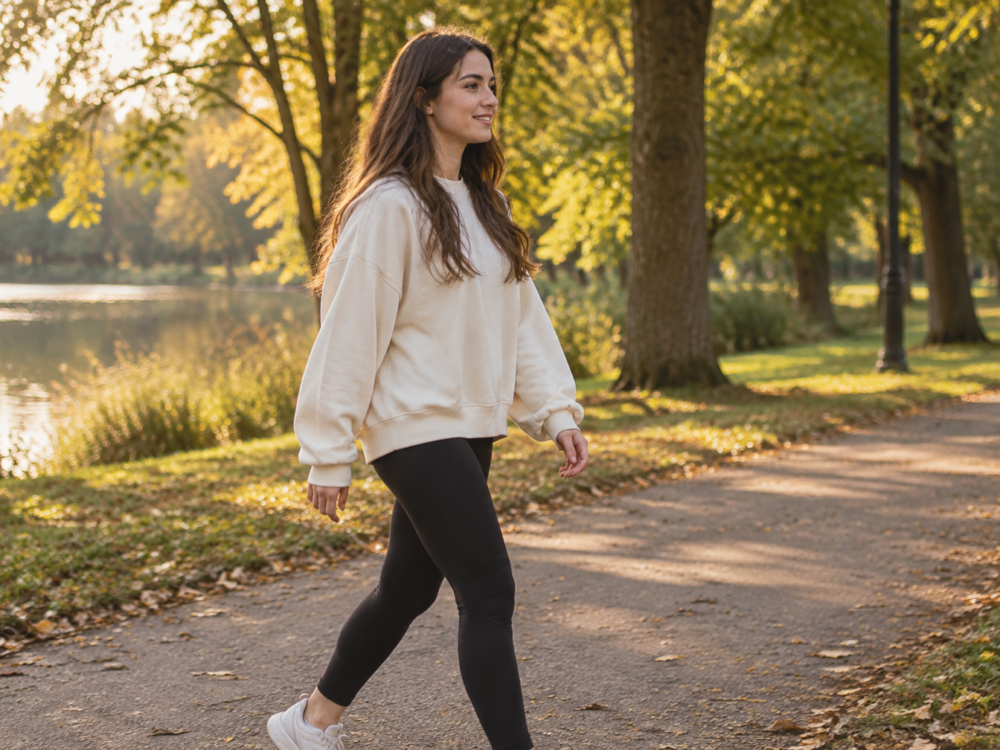
Eleven minutes in, I wanted to turn around.
Not because my feet hurt. Not because it was cold. Because for the first time in months, there was nothing in my ears, nothing in my hands, and nothing between me and my own head. And my own head, it turns out, had been saving up.
It started with an email I should have answered on Tuesday. Then a conversation from three years ago, replayed with a better comeback. Then a quiet, ugly little thought about whether everyone else had figured something out that I missed. All of that, in eleven minutes, on a sidewalk, with a perfectly nice sunset going to waste.
I’d signed up for a hot-girl walk. I got a hearing.
If that sounds familiar, stay with me. This isn’t a post about how a walk fixed my life. It’s about what I found when I finally stopped outrunning my own head, why it felt so bad at first, and how to make it feel a lot less bad on purpose.
What a Hot-Girl Walk Actually Is
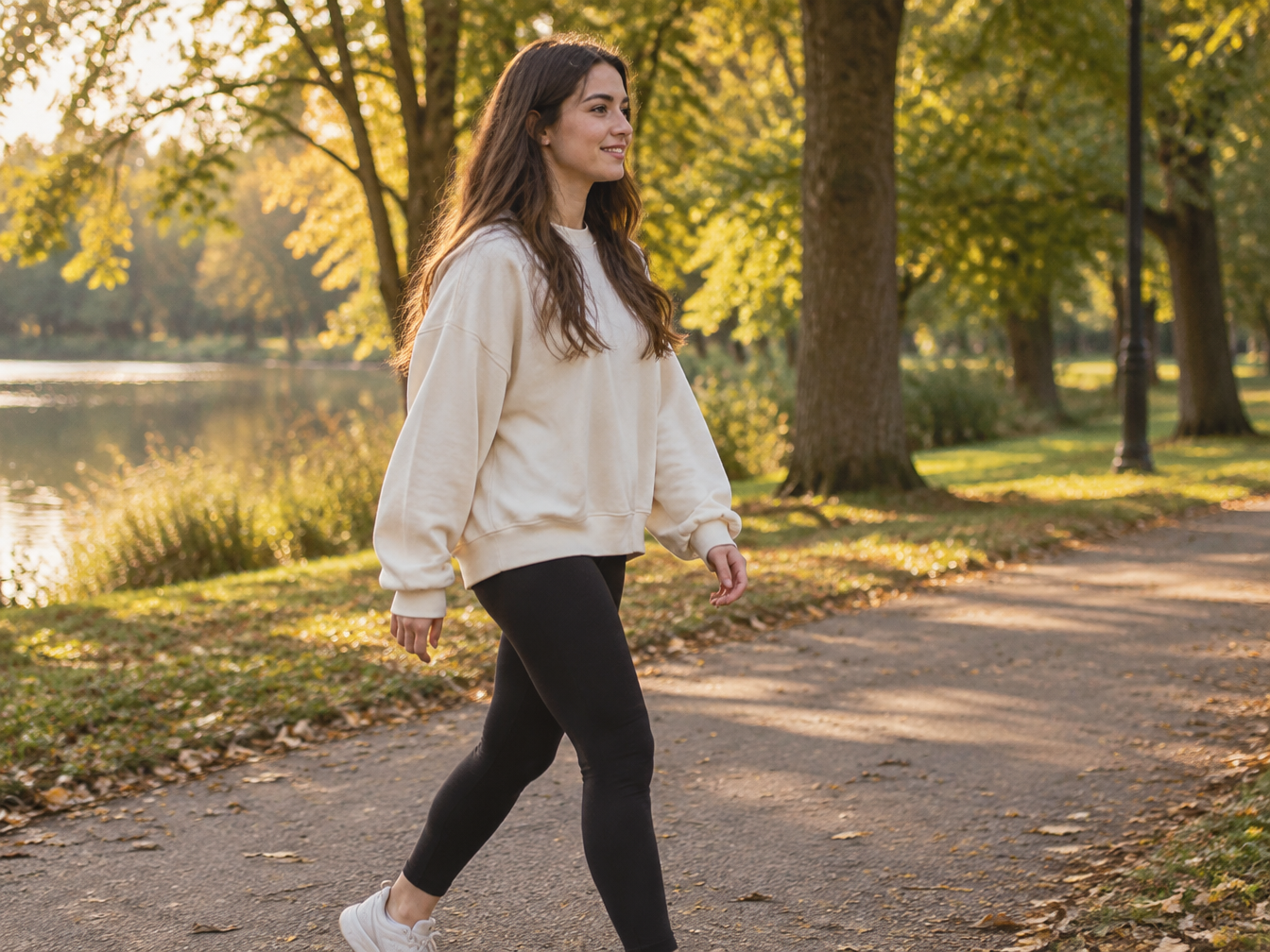
First, the trend itself, because the name does it no favors. The idea comes from a TikTok posted on February 25, 2021, by the creator @exactlyliketheothergirls, who described it as a four-mile mindfulness walk [1]. The rules were simple. Think about what you’re grateful for. Think about your goals and how you’ll reach them. Remind yourself how beautiful you are. And skip the podcasts, so you can be alone with your thoughts [1].
Then everybody remixed it. Within a year the trend had walking groups, playlists and a whole community around it, and most people dropped the strict rules and kept the core: walk, pay attention, feel a little better afterward [3]. It spread because it’s free, it needs no equipment, and nobody has to be fit to do it [3].
Here’s what I didn’t expect. It’s basically a mindfulness exercise in a cute outfit. If you’re curious what meditation actually is, a walk with no distractions is a pretty honest preview.
The First Ten Minutes Are Humiliating
Nobody tells you this part.
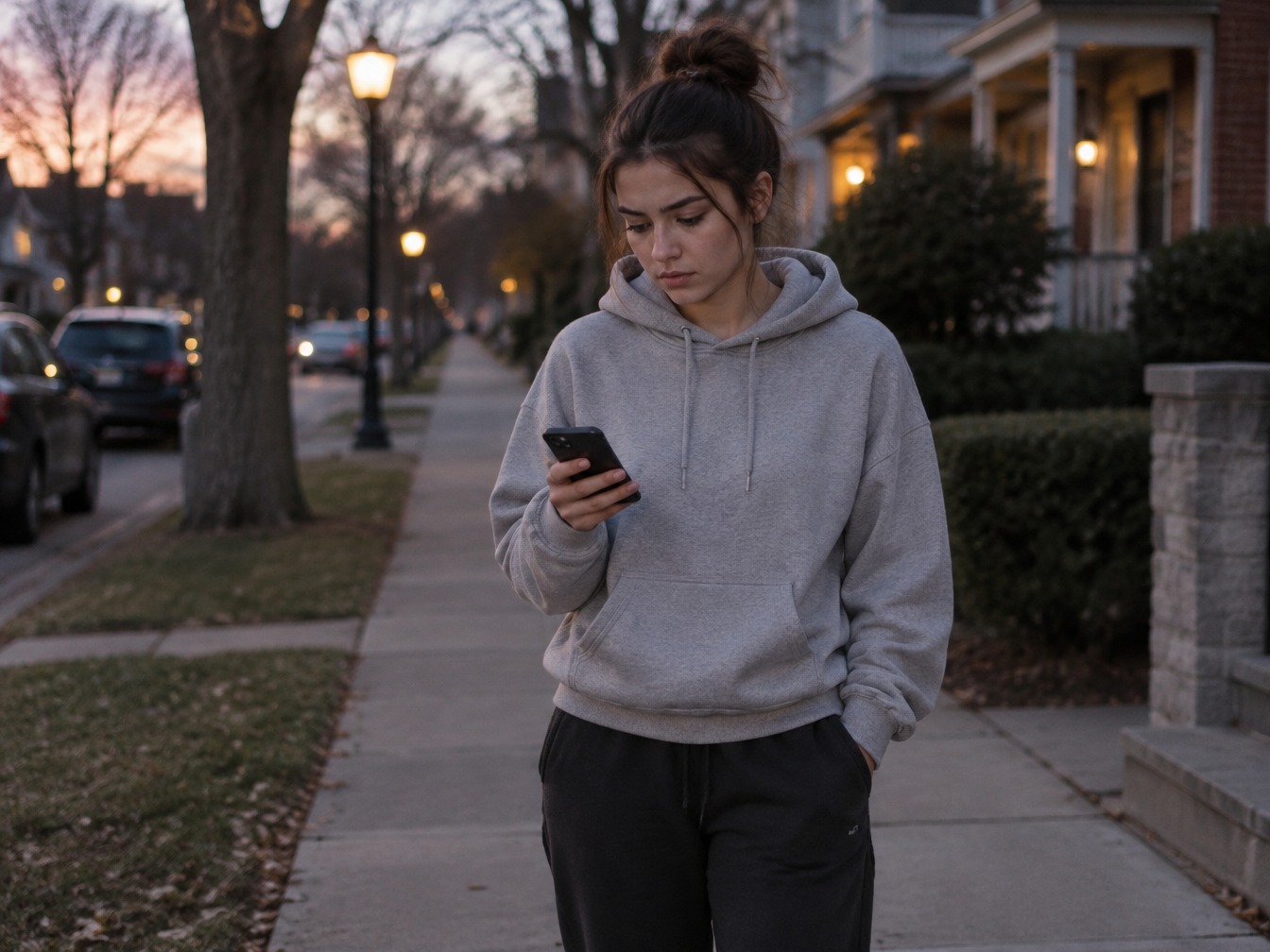
The Instagram version of the walk is golden light, a good playlist and a woman glowing with self-love. The real version starts with an itch to check your phone. You reach for it three times before you’ve left your street. Your hand knows the way even when your brain doesn’t.
Then comes the noise. Not dramatic noise, just the low hum of a mind that has never been asked to be quiet. A to-do list. A text you didn’t send. A dinner you’re dreading. For a while it feels like boredom, and boredom feels like a personal failure, so you reach for your phone again.
I want to be honest about how strange that is. I can sit through three hours of videos about people I’ve never met. I couldn’t sit through ten minutes with myself.
And the weird part is that I wasn’t doing anything wrong. I was doing exactly what every phone, every feed and every notification has trained me to do: fill the gap. A pause at a crosswalk used to be a pause. Now it’s a chance to check something. The walk simply took the something away.
Why Silence Feels Like an Emergency

There’s a reason this feels so bad, and it’s not that you’re broken.
Psychologists use the word rumination for the habit of replaying the same worries on a loop. In a well-known 2015 Stanford study, researchers sent 38 healthy adults on a 90-minute walk, either through a grassland path lined with oak trees or along a busy four-lane road. Afterward, the nature walkers reported significantly lower rumination, and brain scans showed reduced activity in the subgenual prefrontal cortex, a region linked to negative emotion. The road walkers showed no change [2][4].

I should be clear about what that does and doesn’t prove. The study tested long walks in nature, not hot-girl walks. Nobody has proven that a trending routine rewires your brain. But it does suggest that where you walk, and how long, can change how loud your thoughts get.
It also lines up with what researchers have found about the science-backed benefits of meditation: paying attention on purpose, without a screen in the way, tends to settle a restless mind. The walk is the same muscle in a different gym.
There’s one more thing worth saying about rumination. It feels like problem-solving. It isn’t. Problem-solving moves toward an answer, and rumination just circles. The tell is simple: if you’ve had the same thought five times and you’re no closer to doing anything about it, you’re not thinking, you’re looping. Walking doesn’t magically end the loop, but moving your body gives the loop somewhere else to go.
The Thoughts That Show Up When Nothing Distracts Them

Here’s the cast of characters I met. You’ll probably recognize at least two.
The Replay Reel
This is the old conversation you can’t stop editing. The thing you said at a party in 2022. The look someone gave you at work. You rewrite it with a sharper line, a cooler face, a different ending, and you’ve done this so many times it’s basically a short film.
The Spreadsheet
Everything you should have done by now, in order, with deadlines. Laundry. Emails. A call to a relative. A goal you wrote on a sticky note last January. The spreadsheet doesn’t care that you’re outside.
The Highlight Reel Comparison
Somebody’s engagement. Somebody’s promotion. Somebody’s apartment with the good light. You didn’t set out to compare yourself, but the walk is quiet enough that the comparison finally has room to speak.
The Thing You’re Avoiding
This one arrives last, usually around minute twenty. It’s quiet and specific. A relationship that’s gone flat. A job you’ve outgrown. A decision you keep postponing by staying busy. It is almost never dramatic. It’s just true, and it’s been waiting politely for you to stop scrolling.
I used to think my avoidance was laziness. Now I think it was protection. Some thoughts are heavy, and a busy brain is a very effective way to avoid lifting them. The walk doesn’t force you to lift anything. It just stops hiding the weight.
That last one is the real reason a walk with no distractions feels so uncomfortable. Constant noise isn’t only entertainment. It’s a very effective way to avoid that thought.
This Is Meditation With Better Shoes

Once I stopped fighting the thoughts, the walk started to feel familiar. Noticing a thought, naming it and letting it pass is the basic move of mindfulness, and people have practiced it in every tradition you can think of.
If you want to see how that plays out in more structured practice, Vipassana and mindfulness are a good place to compare approaches. Both ask you to observe your thoughts without chasing them, which is exactly what the walk quietly trains.
The difference is that a walk is much easier to start. You don’t need a cushion, an app or a quiet room. You need shoes and ten minutes. For a lot of people, that low barrier is the whole appeal: it’s meditation that doesn’t feel like meditation until you’re already doing it.
When the Thoughts Get Heavy

One honest note. Sometimes the quiet doesn’t bring up annoying thoughts. It brings up painful ones, like grief, loneliness or a dread you can’t explain. That’s worth taking seriously.
If a walk regularly leaves you feeling worse, anxious or hopeless, that’s not a sign you’re doing it wrong. It’s a sign to talk to someone, whether that’s a close friend, a doctor or a therapist. A walking routine is a lovely tool, but it was never meant to carry everything by itself.
For most of us, though, the discomfort is milder and more ordinary. It’s the feeling of a body that’s forgotten how to be still. That kind usually softens with practice.
How to Do It Without Hating It

You don’t have to start with four miles. Here’s the version that actually stuck for me.
- Start with ten minutes. Walk out for five, walk back for five. If a ten-minute walk feels like too much, it’s the right size.
- Leave the earbuds home, at least at first. The point is to hear yourself. Add music later if you want, but earn it.
- Put your phone on airplane mode. You can still take a photo of the sunset. You just can’t answer anyone’s text.
- Pick a prompt. Use one of the original three: what you’re grateful for, what you’re working toward, or what you like about yourself [1]. A prompt gives your brain a job so it doesn’t invent its own.
- Choose a route with trees if you can. The research that exists is about nature walks, not sidewalks, so a park or a quiet path is worth the extra detour [2].
- Don’t judge the thoughts. Notice them. Nod. Keep walking.
If you want to go further, there are other types of meditation to try once the walk starts to feel natural, from seated practice to guided sessions. The walk is a gentle door in.
What I Do With the Thoughts Now

The part that changed everything wasn’t the walking. It was what I did when I got home.
I started keeping a tiny note on my phone with three lines. One thing that showed up on the walk. One thing I’m grateful for. One thing I want to do next. It takes about two minutes and it turns a swirl of thoughts into something I can use.
Sometimes the “next” is tiny, like answering that email. Sometimes it’s larger, like finally admitting I want a different kind of week. If you’re into goal-setting rituals, the same idea sits inside many manifestation exercises: get clear on what you want, then do one small thing toward it. The walk gives you the clarity. The note gives you the first step.
And I stopped expecting the walk to feel good every time. Some days it’s peaceful. Some days it’s a long conversation with the Spreadsheet. Both count. A walk isn’t a test you pass. It’s a habit you show up for, and showing up is the only grade that matters.
The Walk Is Not the Point

Here’s what the hot-girl walk gave me, and it wasn’t a better body or a glow.
It gave me a place to find out what I’d been avoiding. It turned out that I wasn’t afraid of silence. I was afraid of what silence would say if I let it finish its sentence.
So I let it. Slowly, a few blocks at a time. The thoughts weren’t as terrifying as I’d feared. Most of them were just tired, asking to be heard and then put down.
If you try one this week, leave the earbuds at home. Walk until the noise gets loud, and then keep walking until it gets quiet. Give it twenty minutes before you decide whether it works. The first ten are the audition for your own patience, and the second ten are where the walk finally starts to pay you back.
That’s where you meet yourself.
Sources
- Know Your Meme. “Hot Girl Walk.” knowyourmeme.com/memes/hot-girl-walk
- The Stanford Daily. “Researchers find walking in nature provides mental health benefits.” stanforddaily.com/2015/07/26/researchers-find-walking-in-nature-provides-mental-health-benefits
- Camp King. “How the Hot Girl Walk Has Democratized Workout Culture.” camp-king.com/theplus/how-the-hot-girl-walk-has-democratized-workout-culture
- People Shift. “A 90-Minute Walk in Nature Measurably Changes the Brain Region Associated With Depression” (summarizing Bratman et al., 2015, PNAS). people-shift.com/articles/a-90-minute-walk-in-nature-measurably-changes-the-brain-region-associated-with-depression
