For about two years, I fell asleep with the lights on and my phone on my chest and my face still wearing the whole day. Concealer, sunscreen, a faint ghost of lipstick, all of it pressed into the pillowcase while I scrolled through other people’s perfect mornings. I woke up each day feeling like a tired version of someone I used to be.
Then one night in late October, I looked at myself under the bathroom light and realized I hadn’t touched my own face with any care in months. I’d been touching it plenty, with tools, with serums, with a dozen products that promised to fix me. But care, the slow kind, the kind that says you’re allowed to rest now, had gone missing.
So I tried something small. Three weeks of a gentle night routine, no more than five minutes, no new miracle products. This is what happened.
The Night I Stopped Sleeping in My Makeup

Let me be upfront about where I started. My nights were a mess, and my skin showed it. I had a drawer of half-used products, a habit of wiping my face with whatever wipe was nearest, and an unspoken belief that skincare was for people with discipline and time.
What finally got me moving wasn’t vanity. It was a small, quiet shame. I’d come home exhausted, look at the sink, and think “I’ll do it tomorrow.” Tomorrow kept happening to a version of me who was even more tired.
So on night one, I made the rule absurdly small. Wash my face. Moisturize. Done. That was it. I told myself it didn’t have to be pretty or perfect, and that I could skip every other step I’d ever bought.
The timing mattered, too. Late autumn is when my skin gets cranky, and I’d already written about how winter skin made me cry in the bathroom the year before. I didn’t want a repeat. I wanted to walk into the cold months already on good terms with my own face.
It felt silly how much that mattered. For the first time in weeks, I looked at my reflection while I did something kind for it. The water was warm, the cleanser smelled like nothing, and my shoulders came down about an inch. I slept better that night, and I’m not sure whether it was the skincare or the permission.
What Dermatologists Actually Say About Night
Before I added anything, I wanted to know what the experts recommend, because my instincts were all over the place. The answer was refreshingly boring.
Dr. Heather Rogers, a board-certified dermatologist, describes a nighttime routine with three goals: cleanse, support cell turnover, and strengthen the skin barrier [1]. She explains that at night the skin shifts into a repair mode, so it’s a good time for treatments that help with texture and pigmentation [1]. Her steps are simple. Cleanse to remove sunscreen, makeup and oil. Treat with something like a retinoid, bakuchiol or an exfoliating acid. Moisturize to reduce overnight water loss [1].
What struck me most was her warning about complexity. She notes that complicated routines make people more likely to quit or develop irritation, and says consistency matters more than adding steps [1]. She also cautions against over-cleansing, which can strip the skin and leave it dry or irritated, and says that for most people one gentle cleanse is enough [1].
I read that and felt oddly relieved. I’d spent years assuming I wasn’t doing enough. It turned out I’d been doing too much, badly, and not consistently.
The Three Step Routine I Stuck With

Here’s the version I committed to. It’s boring and I love it.
Step one is a gentle cleanse. I use a creamy, fragrance-free cleanser with lukewarm water, never hot, and I take my time. If I’ve worn a lot of makeup or a water-resistant sunscreen, I’ll do a first pass with a cleansing balm. Otherwise, one wash is plenty.
Step two is a treatment, but I’ll admit I was a little cautious here. I started with nothing for the first week, just cleanse and moisturize. In week two, I added a gentle treatment two nights a week and watched how my skin responded. If you’re curious about retinoids or acids, a dermatologist can tell you what fits your skin, and starting slow is smart.

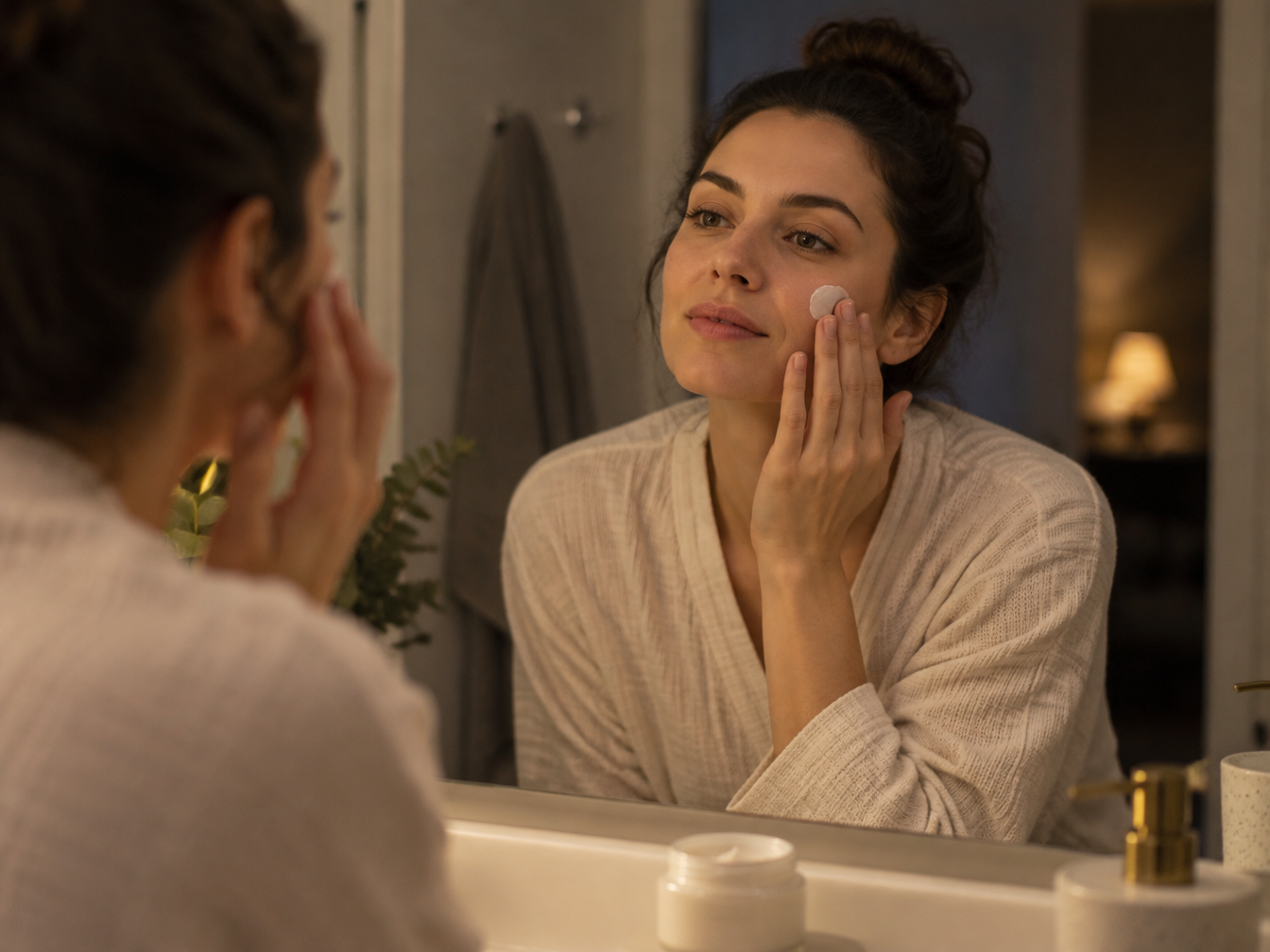
Step three is moisturizer, with a richer cream because winter was arriving and my cheeks were tight. I pressed it into my skin instead of rubbing, and I did the same on my neck. It takes ten seconds and it’s the part that makes me feel tucked in.
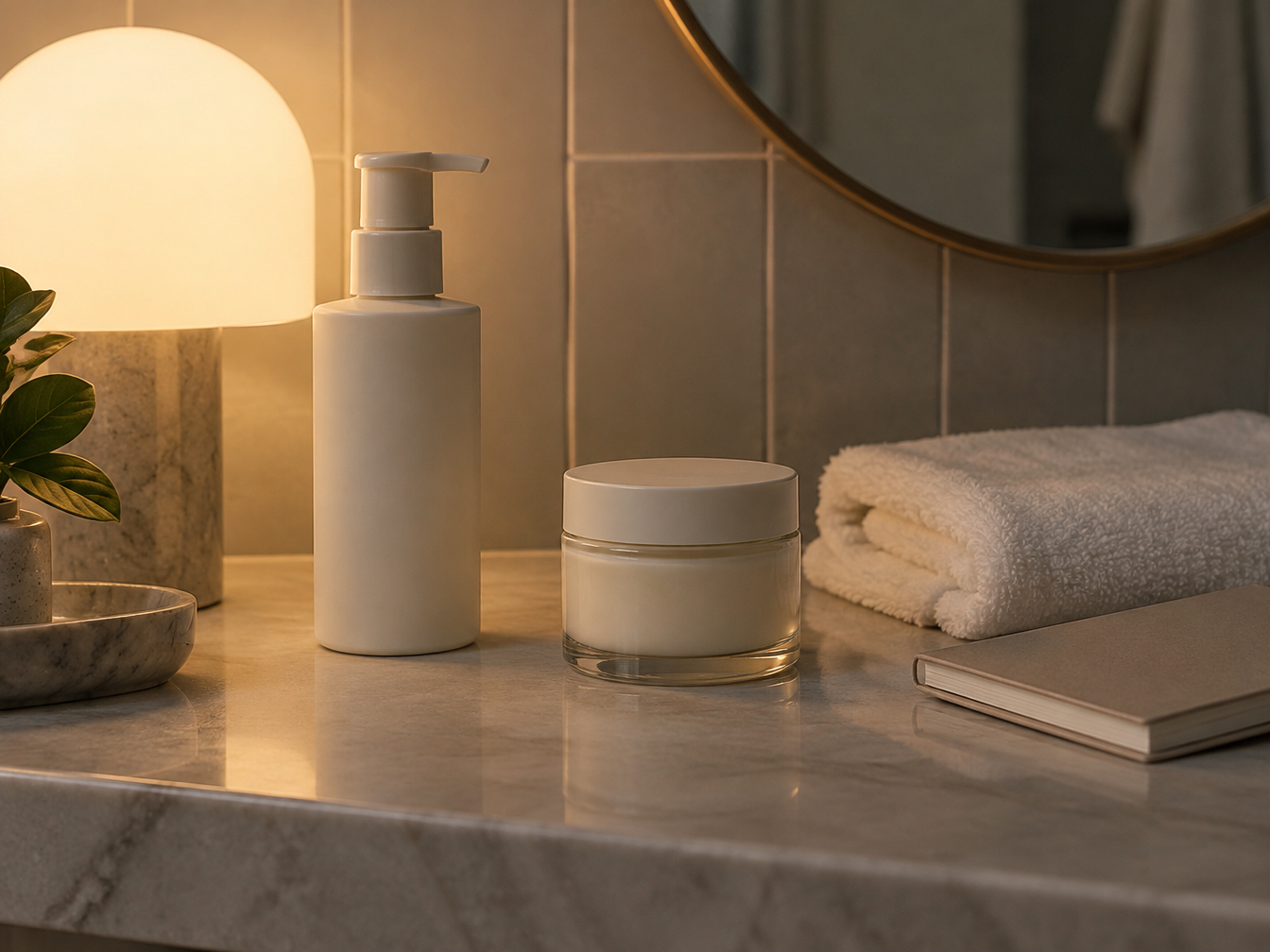
I keep everything within arm’s reach of the sink, in one small tray. When products are scattered across three rooms, I find reasons not to bother. When the cleanser and cream sit together under the lamp, the whole thing takes about as long as brushing my teeth, and I treat it with the same lack of drama.
That’s it. No ten-step ritual, no tools, no gadgets. If you’ve read about the skincare routine that made me realize I was treating myself like a project, this is the quieter second chapter.
What Sleep Has to Do With Skin
I’d always thought of skincare and sleep as separate departments. It turns out they talk to each other constantly.
A clinical study from University Hospitals Case Medical Center, commissioned by Estée Lauder, looked at 60 women between the ages of 30 and 49, half of them poor sleepers [2]. Poor sleepers showed more signs of intrinsic skin aging, scoring 4.4 on one skin-aging scale versus 2.2 for good sleepers, and their skin recovered more slowly after stressors such as barrier disruption and sun exposure [2]. Seventy-two hours after a barrier test, the good sleepers’ skin had recovered about 30 percentage points more than the poor sleepers’ [2]. Poor sleepers also rated their own appearance lower [2].
I want to be careful here. That’s one study, it was industry-funded, and it shows a correlation, not proof that bad sleep alone ages your face. I’m not going to promise that a moisturizer will fix your insomnia.
I’d rather give you the smaller, truer claim. A few minutes of predictable, gentle care once the day winds down gives your nervous system something to hold onto, and your skin barrier gets the moisture it needs while you rest. Those two things together are plenty, and neither requires a miracle.
But it changed how I thought about my evenings. If rest and repair really are connected, then my routine wasn’t only about my skin. It was about handing my body a signal that the day was over. That’s also why I started pairing it with a few minutes of quiet, the kind I wrote about in can meditation help you sleep better.
Week One Felt Like a Small Mutiny

I expected to feel better right away. What I felt instead was resistance. On night three I was exhausted, my feet ached, and every part of me wanted to flop onto the bed. The sink felt miles away.
I did it anyway, mostly out of stubbornness, and afterward I felt a tiny flash of pride. Not the loud kind, the quiet kind that says “I kept a promise to myself.”
By night five, something shifted. I started to look forward to it. The routine became a threshold between the part of the day that belongs to everyone else and the part that belongs to me. I put my phone on the dresser, charging, face down. I turned on a lamp instead of the overhead light. I noticed I was humming.
My skin looked about the same, but the way I treated it had changed. I was no longer pulling at my cheeks in the mirror or scanning for flaws. I was just taking care of a face that had spent the whole day holding my expressions. If you’ve ever felt your cheeks tighten at the first cold snap, you know how soft a little gentleness can feel.
Week Two and Three Brought the Real Change

By week two I was sleeping better, or at least falling asleep faster. I can’t prove the routine caused it. It might have been the earlier bedtime, the phone on the dresser, or the lamp. But the routine was the anchor that held all of those habits together.
That’s the thing about small rituals. They rarely change your life by themselves. They give the other good habits a place to attach, like a hook by the door that finally gets your keys in the same spot every day.
My skin got calmer, too. The redness around my nose settled down, and the tight, flaky patches on my cheeks softened. I added the gentle treatment on two nights a week and kept an eye out for irritation. When I felt a slight sting one night, I skipped it the next and went back to basics, which I’d never allowed myself to do before. Skipping used to feel like failure. Now it felt like listening.
That flexibility turned out to be the secret. A routine that bends survives a bad week, a trip, a cold, a breakup. A routine that demands perfection survives until the first missed night and then collapses, and then you feel guilty on top of tired. I’d rather be the kind of person who skips a step and comes back than the kind who quits for a month.
The biggest change, though, was emotional. I stopped bargaining with my reflection. For years my relationship with my face had been a negotiation: if I used this serum, then maybe I’d like what I saw. Now there was no deal. I just washed my face, and the person in the mirror looked back like she was glad to see me.
I also started doing something I’d never have predicted, which was to keep my hands soft on my own skin. I stopped scrubbing. I stopped squeezing. I treated my face like I’d treat a friend’s. If you want a longer look at how rest and ritual fit into a week, my self-care Sunday that sometimes feels like a chore is the sibling to this one.
What I’d Tell Anyone Starting Tonight
If you’re reading this at midnight with makeup still on, here’s the kindest advice I have.
Start smaller than you think you should. Cleanse and moisturize. That’s a full routine, and anyone who says otherwise is selling something. Do it for a week before you add anything, and add one thing at a time so you can tell what your skin likes and what it doesn’t.
Be patient. Skin changes slowly, and so do habits. Don’t judge the routine by whether you look different in the mirror after four days. Judge it by whether you showed up.
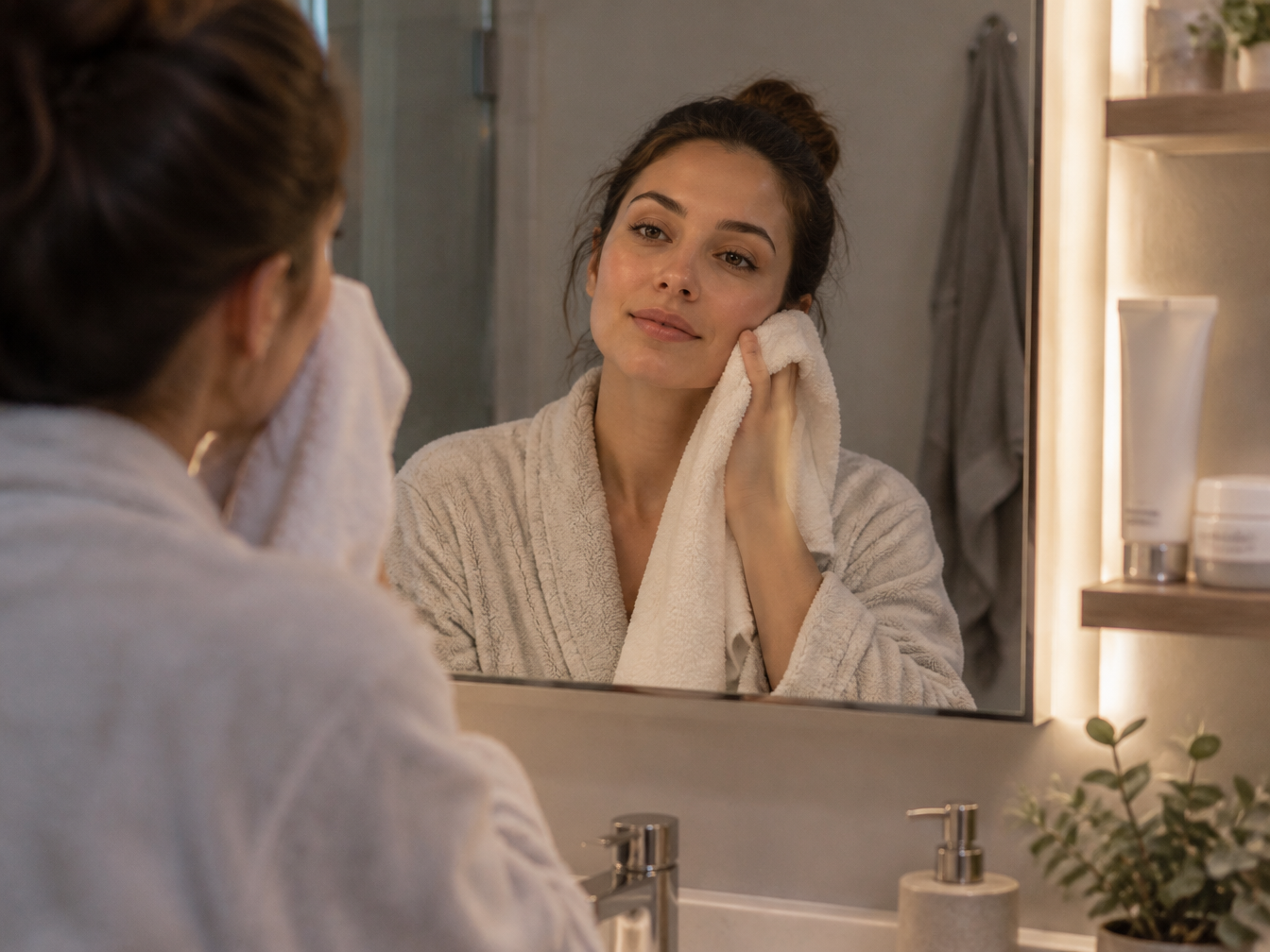
Make it pleasant. Warm water, a soft towel, a lamp instead of a ceiling light, a song you love. If it feels like a punishment, you’ll quit. If it feels like a small lullaby, you’ll stay. And if you want a bedtime companion for it, the idea behind manifesting before sleeping pairs nicely with a calm face and a quiet room.
Finally, see a dermatologist if you have persistent irritation, breakouts or anything that worries you. I’m someone who writes about this, not someone who can diagnose it.
On the last night of my three weeks, I stood at the sink with a towel against my cheek and noticed something strange. I wasn’t looking for what was wrong. I was just looking, and what I saw was a person who’d had a long day and was about to rest.
For the first time in a long time, I went to bed in my own skin, and it felt like home.
Sources
- Nighttime, A Dermatologist Evening Skincare Routine, Dr. Heather D. Rogers, Doctor Rogers Skincare. https://www.doctorrogers.com/blogs/blog/dermatologist-nighttime-skincare-routine
- Clinical trial finds that sleep quality impacts skin function and aging, University Hospitals Case Medical Center via News-Medical. https://www.news-medical.net/news/20130724/Clinical-trial-finds-that-sleep-quality-impacts-skin-function-and-aging.aspx
Leave a Reply