
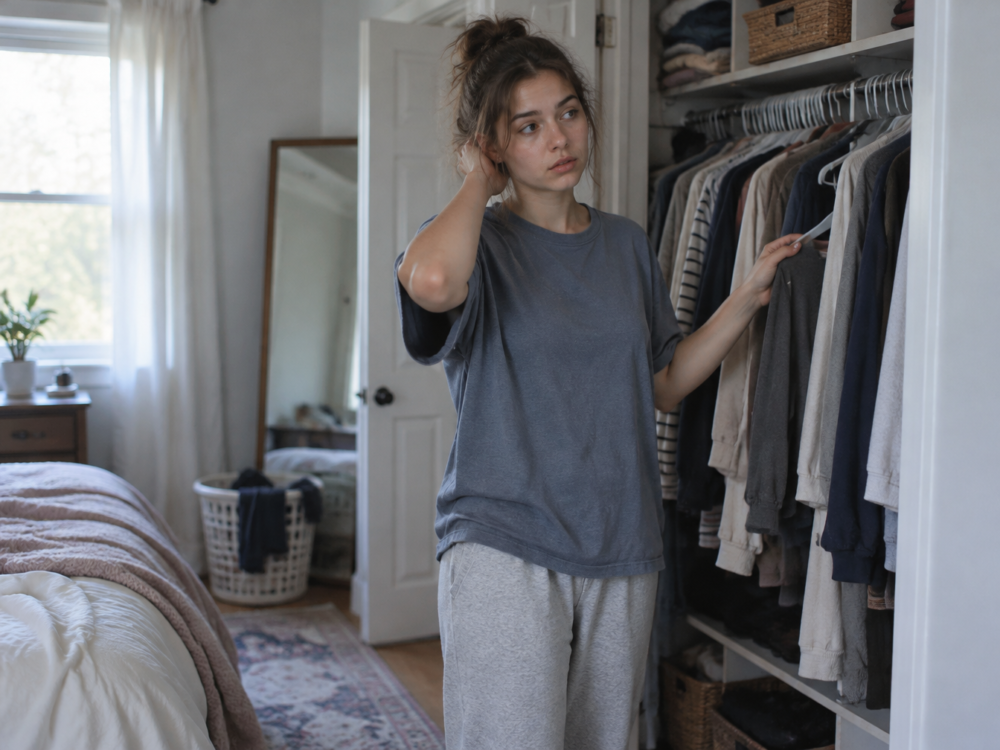
There was a Tuesday last spring when I stood in front of my closet for twenty minutes and cried a little about a pair of jeans.
Not because they didn’t fit. They fit fine. They just looked like they belonged to someone else, someone I’d been pretending to be for a few weeks, someone with a calmer inbox and a better plan. Every hanger in that closet felt the same way. Cute, fine, forgettable, and not me.
I want to be careful here, because “I had nothing to wear” is the oldest lie in the book. I had plenty to wear. What I didn’t have was a version of myself I recognized in the mirror.
So I did something that sounds silly. I stopped looking for a good outfit and started looking for my outfit. The one I put on when the week has been too long and I need to feel like me again. It took a while to find, and it taught me more about getting dressed than ten years of fashion advice.
The Day Nothing in My Closet Felt Like Me
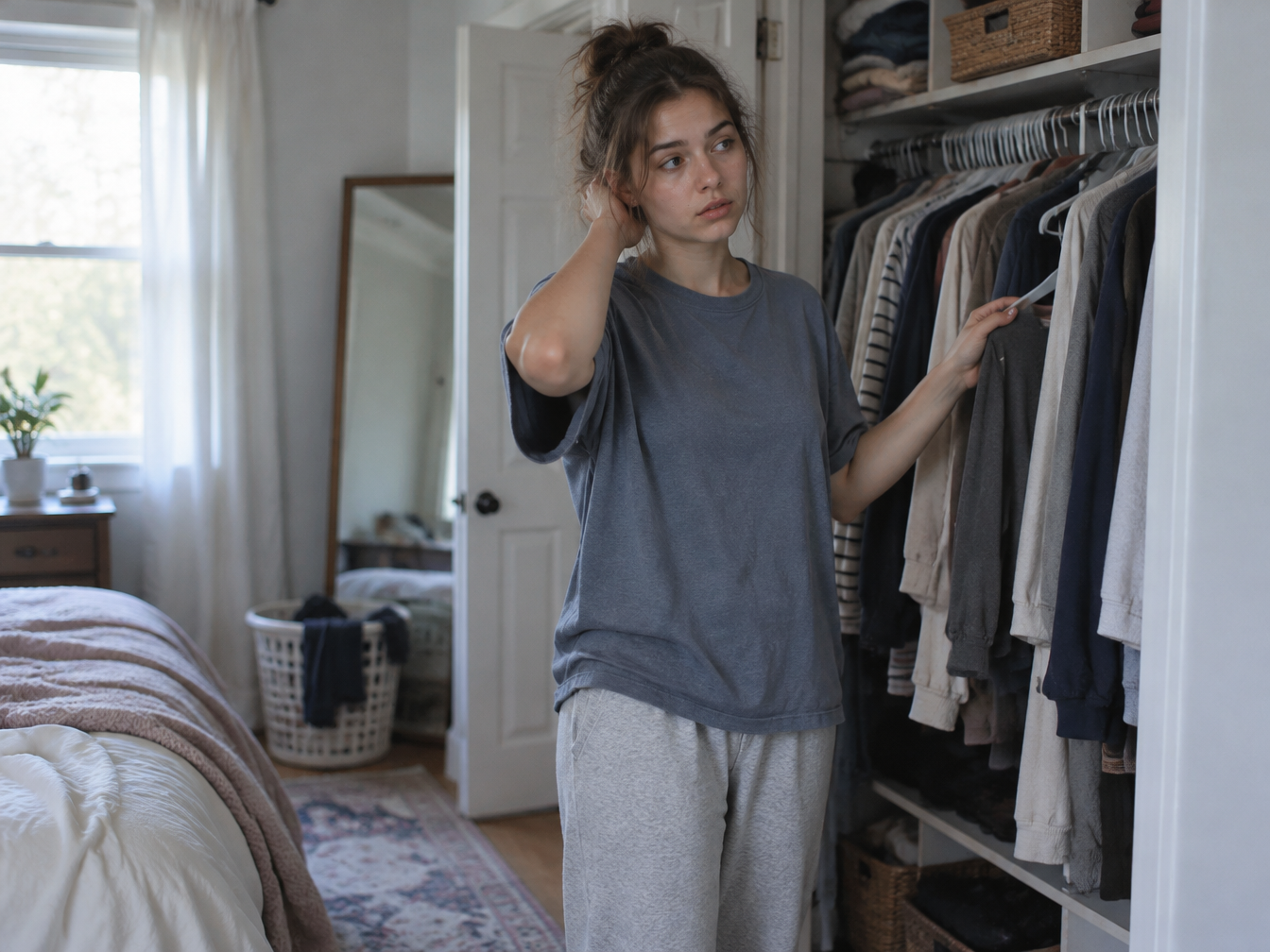
Let me describe that Tuesday properly, because I think you’ve had one too.
You wake up already tired. You open the closet and nothing sparks. You try on three things, hate all three, and end up in whatever is on the chair. By nine a.m. you feel faintly like a stranger wearing your own life, and the day hasn’t even started. That Tuesday I ended up in the same soft knit I always grab, a lot like these classic white sweater styles, and I noticed I felt a little better the second it was on.
It isn’t a vanity problem. It’s a disconnect problem. Your clothes are the first thing you show the world every day, and when they say something you don’t mean, it throws off the whole morning.
That’s the day I started paying attention to what I wore when things were going well, and what I reached for when I wanted them to.
Why Clothes Can Change How You Feel

I went looking for whether this was real or just me, and the research is more interesting than I expected.
Psychologists Hajo Adam and Adam Galinsky coined the term enclothed cognition in a 2012 paper. Their idea is that clothing affects the person wearing it through two things at once: what the garment symbolizes and how it physically feels to wear it [1]. In their lab coat experiments, people who wore a coat described as a doctor’s coat showed better sustained attention than people who wore the same coat described as a painter’s coat [1]. Same fabric, different story, different result.
I’m not going to oversell that. It was a lab coat and an attention task, not a sundress and a Monday. But the underlying point holds up: what we think an outfit means changes how we behave in it.
There’s softer evidence too. In a University of Hertfordshire survey of 100 women, 96% said they believed what they wear affects how confident they feel [2]. The same report found that 51% of the women said they’d wear jeans when sad or depressed, compared with 33% when happy [2]. Some stylists pushed back on that reading, pointing out that jeans mean different things to different people [2], and they’re right to. Clothes aren’t a mood ring.
Fashion psychologist Dawnn Karen, who popularized the term dopamine dressing in her book *Dress Your Best Life*, puts it more gently. She’s said it isn’t medicine, but that people’s moods shift when their clothes reflect who they really are [3].
That’s the line I kept coming back to. Who they really are. Not what’s trending, not what’s flattering, not what someone on a screen told you to buy.
What Feeling Like Yourself Actually Means

Here’s the thing no one tells you. “Feeling like yourself” is not the same as feeling good.

You can feel good in a borrowed outfit. A killer dress, a perfect blazer, something that earns compliments all night. And still go home feeling like you attended a party as someone else.
Feeling like yourself is quieter. It’s the specific relief of looking down and thinking, yes, that’s right. The fit feels familiar. The colors feel like your voice. Nothing is performing.
For me, it turned out to be built from small, boring ingredients. A certain softness. A certain kind of structure. A few colors I’d been wearing since I was a teenager without ever noticing. It’s often closer to your comfort clothes than your best clothes. Mine started with a soft knit, because that’s the shape my body relaxes in. Even small calls, like whether gold or silver jewelry feels right on you, either sound like your voice or they don’t.
If you don’t know what yours is, that’s normal. You find it by paying attention, not by shopping.
How to Find Your Reset Outfit
This is the part I wish someone had handed me. It’s a three-step exercise, and you can do it tonight with your actual closet.
Remember a Time You Felt Like Yourself
Dawnn Karen suggests a lovely starting point: think back to a childhood moment when you felt happiest, then look for a similar outfit in your closet [3]. I adapted it. I picked a recent day when I felt completely at ease, and I tried to remember exactly what I was wearing.
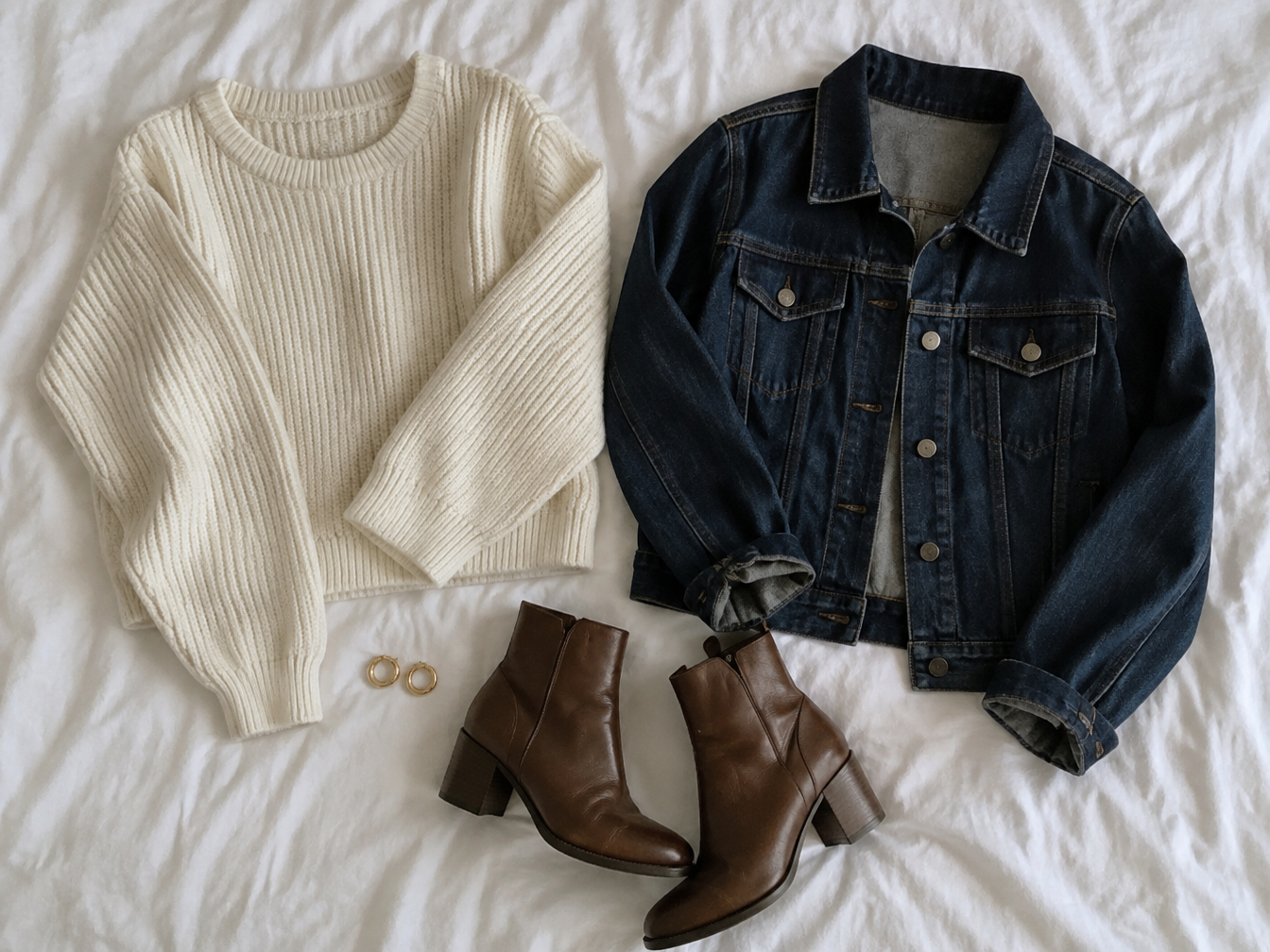
It wasn’t a Saturday-night outfit. It was an old sweater, soft pants and boots I’d stopped noticing years ago. That told me something.
Look for the Pattern
Now lay out three or four things you’ve loved wearing and look for what they share. It might be the texture, the color family, the way they sit on your shoulders, or how they move when you walk.
Mine had three things in common: soft fabric, a slightly oversized shape, and one thing that looked a bit sharp. That mix of cozy and structured is apparently my whole personality.
Keep It to Three Pieces
A reset outfit should be nearly impossible to get wrong. That’s the whole point. When you’re having a bad day, you don’t have the energy for a styling experiment. Choose three pieces that always work together, and keep them somewhere easy to reach. If you want to test the idea first, try it on a low-stakes day. Wear the three pieces to run errands, notice how you carry yourself, and see whether anyone in your day treats you differently. Usually the biggest change is how you treat yourself.
The Formula Behind My Reset Outfit
Once I knew my pattern, I turned it into a formula. You can borrow it and swap in your own pieces. It’s one anchor, one texture and one detail.
The Anchor
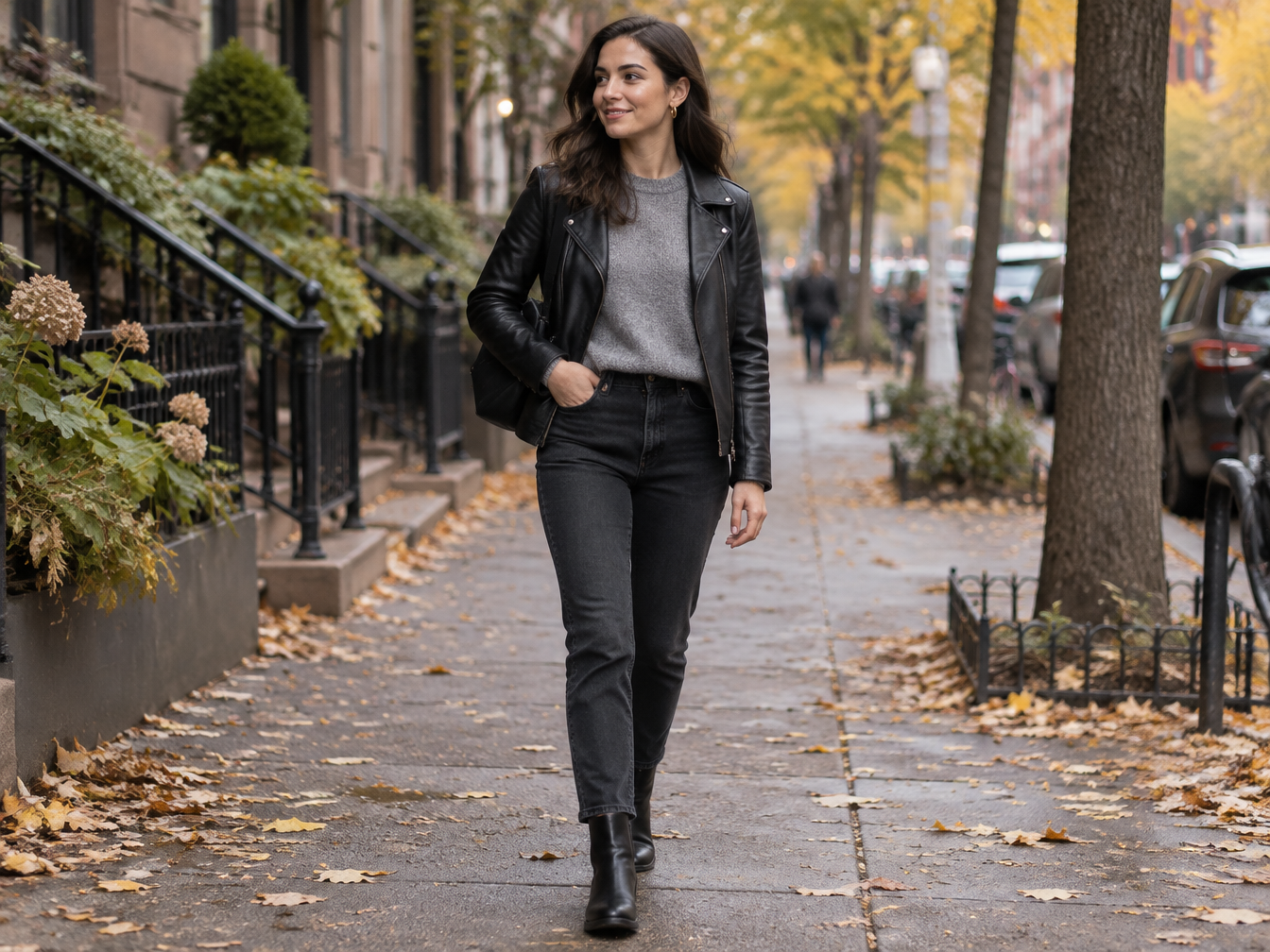
This is the piece that does the talking. For me, it’s a jacket. A good jacket makes everything under it look intentional, and it works like armor on days I’d rather not be looked at too closely.
If you want ideas, start with the easy looks in these leather jacket outfits. Whatever your anchor is, it should feel like you from the first second you put it on. If it takes convincing, it’s the wrong one.
The Texture
This is the piece your body actually enjoys. Soft cotton, a thick knit, a worn-in tee. It’s the part of the outfit that says “relax,” so the anchor doesn’t have to do all the work.
Texture matters more than people admit. A lot of what we call “comfort” is really about fabric against skin, and you feel that all day long.
The Detail
This is the small thing no one else needs to notice. For me, it’s earrings. A pair I’ve worn for years, small and gold, a bit scratched. When I put them on, a little voice says, okay, we’re doing this.
If jewelry is your detail, the options in these earrings ideas are a good place to browse. But it might be a ring, a scarf, a watch, a color on your nails. The detail is where the outfit stops being generic and becomes yours.
Reset Outfits for Every Kind of Bad Day

Not every bad day needs the same fix. Here are the versions I rotate through, and the feeling each one is built for.
A quick note on color before we start. People often say blue calms and yellow cheers, but psychologists cited in one overview point out that these associations vary from person to person [4]. So trust your own reaction over any chart. If a color makes you feel like yourself, it’s the right one.
When You Feel Invisible
Wear a color you’d normally talk yourself out of. Dawnn Karen leans toward purples, leopard prints and bold monochromatics [3], and I’ve found that one confident color can pull a flat day into focus. If you want a place to start, these plum outfits show how to wear a deep, rich shade without feeling like you’re trying too hard.
When You Feel Scattered
Go for calm, layered and tactile. Soft knits, worn-in tailoring, something that feels like a quiet afternoon. The cozy, bookish look in these poetcore outfits is the visual version of slowing down.
When You Need Armor
Pick one strong piece and let it carry everything else. A jacket you love, a pair of boots with some weight to them, a structured bag. The goal isn’t to look tough. It’s to feel held.
When You Feel Like a Stranger
Return to the oldest, most familiar thing you own. The sweater that’s been through everything. The jeans that fit before you ever thought about fit. Familiar pieces are a shortcut back to yourself.
When the Outfit Isn’t Enough

I’d be lying if I said a good sweater fixes everything. It doesn’t, and I don’t want you to think it should.
Sometimes you get dressed in your best reset outfit and still feel flat. That’s okay. An outfit is a nudge, not a cure. If you’ve felt off for weeks, if getting dressed feels impossible, or if you’re noticing sadness that won’t lift, please don’t try to style your way out of it. Talk to a friend, a doctor or a therapist. Clothes can support how you feel, but they can’t carry it all.
What they can do on an ordinary rough day is surprisingly decent. Even a small shift, like layering something warm over something soft on a gray morning, can make you feel put together without making you feel pressured.
One more thing. As one of the stylists in that report pointed out, you can’t judge someone’s feelings from their clothes [2], and you shouldn’t judge your own that way either. Wearing sweats isn’t a failure. It’s just one more piece of information.
Put It Where You Can See It
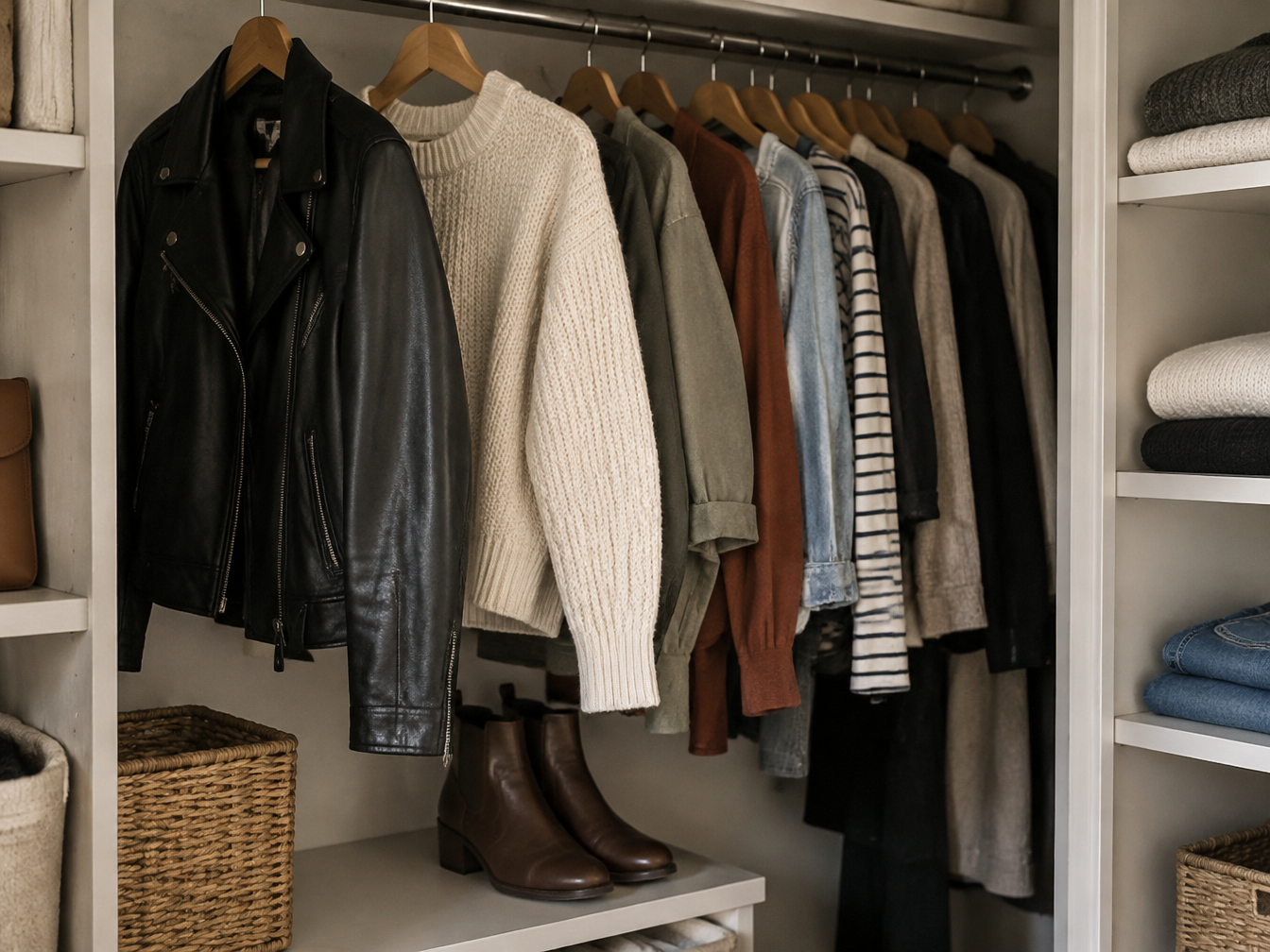
Here’s my favorite part of the whole system. I hang my reset outfit at the front of the closet. Not hidden, not saved for something, right there where my hand lands first.
On the days when I wake up already tired, the decision is already made. No hunting, no twenty minutes of crying about jeans. I put on the three pieces and walk out the door as someone I recognize.
That’s all this is. It isn’t a trend or a transformation. It’s a small, practical kindness to the person who has to get dressed tomorrow morning.

Find the clothes that sound like your voice. Keep them close.
Then, on the days you forget who you are, let your closet remind you.
Sources
- University of Bath Research Portal. “Enclothed cognition” (Adam, H. and Galinsky, A. D., *Journal of Experimental Social Psychology*, 2012). researchportal.bath.ac.uk/en/publications/enclothed-cognition
- GoodTherapy. “The Link Between Clothing Choices and Emotional States.” goodtherapy.org/blog/link-between-clothing-choices-and-emotional-states-0330124
- TODAY. “What is ‘dopamine dressing’? This mood-boosting fashion trend is taking over.” today.com/today/amp/rcna32740
- The Bubble. “The Psychology of Fashion.” thebubble.org.uk/?p=50831
