The sweater is not good. I want to say that first, so you do not picture something soft and perfect. It is a mustard-yellow cable knit with a collar that never lies flat, sleeves that run a full two inches too long, and a pill problem that no amount of careful washing has ever solved. If you saw it on a thrift store rack, you would keep walking.
I have kept it for eleven winters. I have moved it across four apartments and two cities. I have turned down closet purges, friends who swear by the one-year rule, and one extremely patient professional organizer. The sweater stays.
It stays because my aunt Ines gave it to me, wrapped in tissue paper she had clearly saved from another gift, on the first cold morning of my first year away from home.
The Morning She Handed It to Me
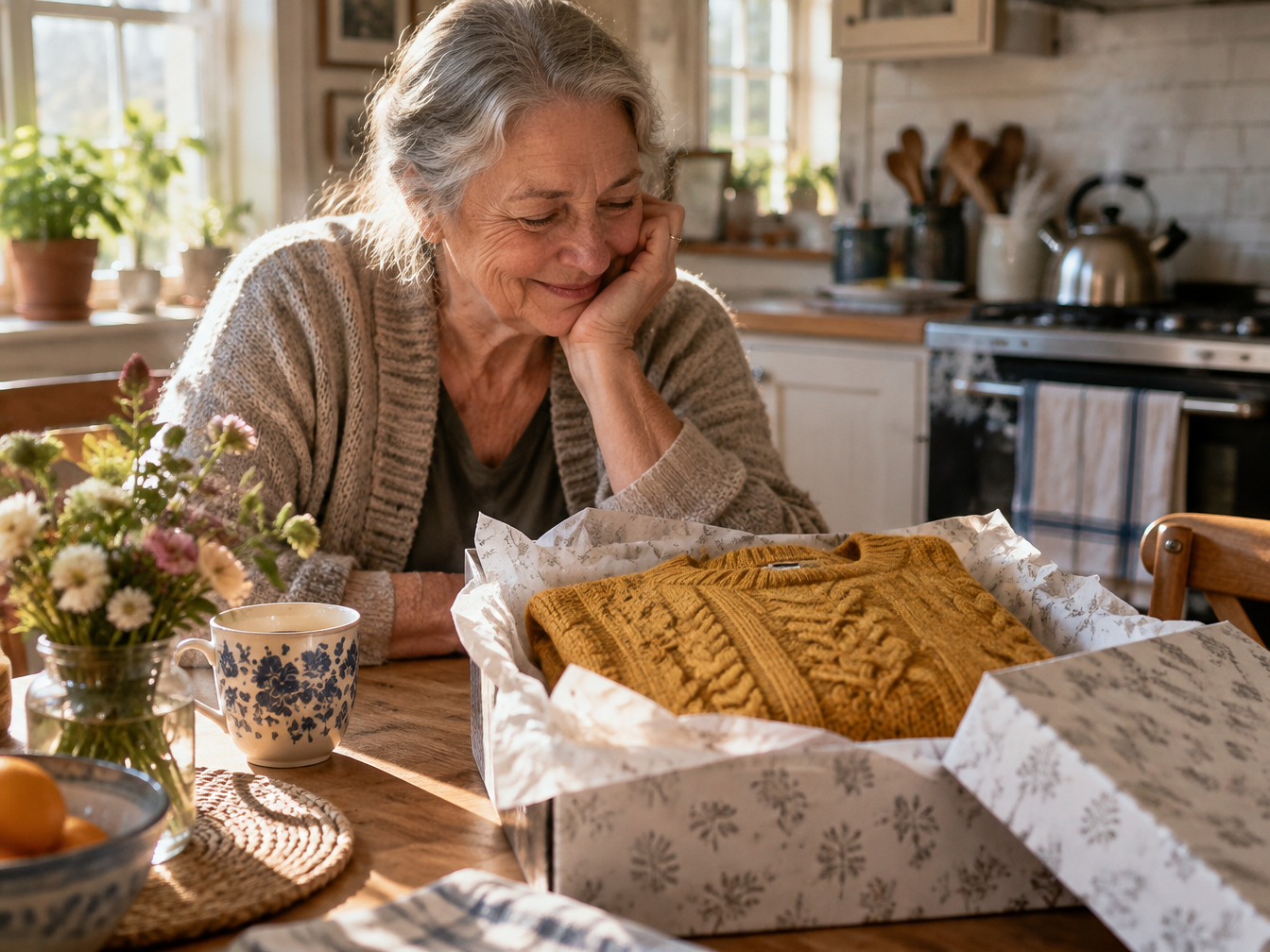
She did not make a speech. That was never her style. She pushed the box across her kitchen table and said, “Try it, it’s warm,” and then pretended to be busy with the kettle while I put it on over my pajamas.
It was too big. She had bought it for the person she hoped I would grow into, not the one standing in front of her, and the cuffs hung past my knuckles. She laughed and rolled them up twice. “There,” she said. “Now it fits.”
It did not fit. It still doesn’t, really. I have tried tailoring it, taking in the sides and shortening the sleeves, and each time I abandoned the idea halfway because shortening the sleeves felt like erasing her hands. But it was the first time an adult had looked at my skinny, uncertain self and decided I was worth buying a warm thing for, and I have carried that exact feeling in the fibers ever since.
Why Some Clothes Become Containers for Stories
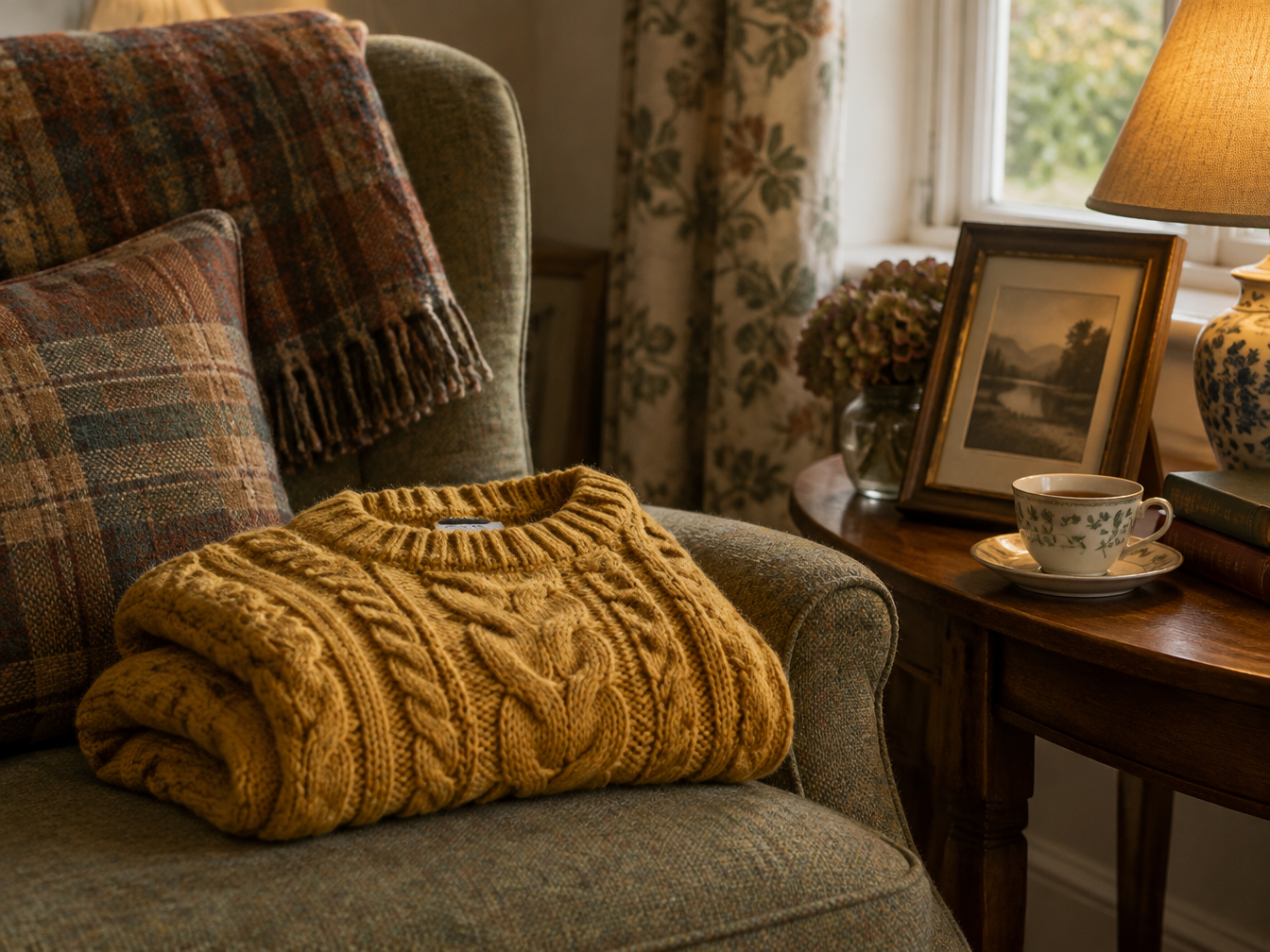
When Ines died three winters ago, I learned something I had not expected about objects. A grief counselor I spoke to once said that the things we keep are not really things at all. Robert Neimeyer, who directs the Portland Institute for Loss and Transition, calls them “containers of stories” [1].
That phrase landed in my chest like a key in a lock. The sweater is a container. When I put it on, I am not wearing wool. I am standing in her kitchen again, smelling cardamom and burnt toast, listening to a kettle she is pretending to watch.
Psychologist Sherry Cormier, author of the book “Sweet Sorrow,” explains it plainly: clothing helps reinforce the idea that this person was here, that this person lived [1]. A photograph can do that too. But a sweater has weight. It has warmth. It has a smell that fades slowly and then returns on a rainy day when you least expect it.
The Closet Rule I Broke on Purpose

I love a good wardrobe edit. I have written about why I stopped buying trends and started building a wardrobe that sounds like me, and a big part of that practice is being ruthless about what earns a hanger. If I have not worn something in a year, it goes.
The yellow sweater breaks every rule I made. It is the wrong shape, the wrong color for my skin in winter, and it does not go with anything I own. By the logic of a tidy closet, it is clutter.
But a tidy closet and an honest one are different animals. Somewhere in the middle of my last purge, I held the sweater over the donation bag and realized I was not asking whether it was useful. I was asking whether I was allowed to keep something purely because it made me feel loved. The answer, I decided, was yes. A wardrobe that only contains the practical is a wardrobe that has forgotten what clothes are for.
I also noticed how much lighter I felt after saying that out loud to myself. Guilt had been sitting on that sweater like a second layer. Once I gave myself permission, the guilt evaporated and what remained was just the soft, ordinary affection I had been trying to protect all along.
How to Decide Which Sentimental Pieces Deserve Space
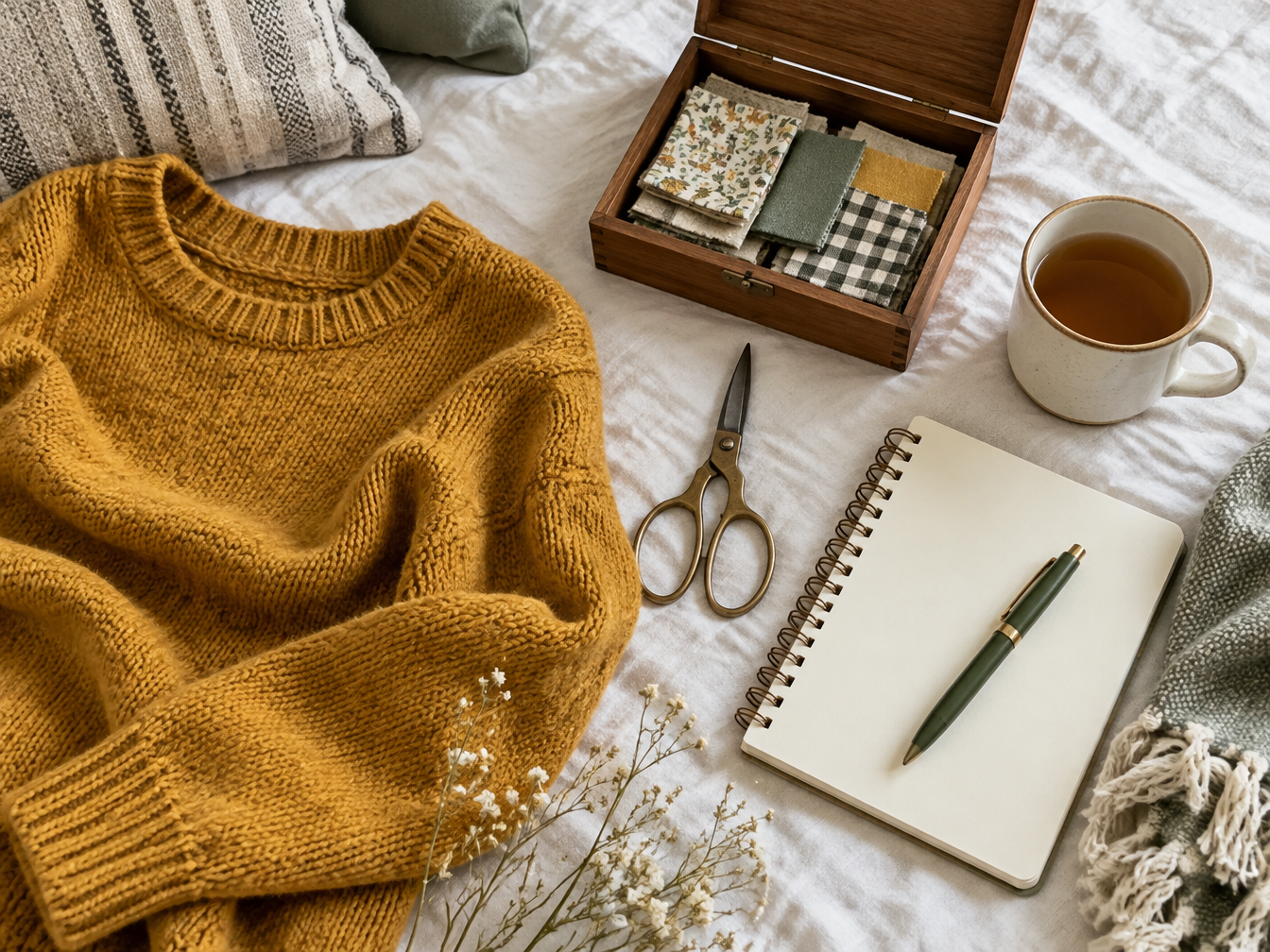
If you have a sweater of your own that is begging for a verdict, I do not want to hand you a universal rule. People grieve and remember differently, and there is no neat, linear way through it [1]. But these are the questions that helped me.
First, does it bring warmth or does it bring dread? Some pieces carry a story that hurts in a way that is not healing. You are allowed to let those go, gently, without guilt.

Second, can you wear it, or does it need a different kind of home? A beaded dress might live in a keepsake box. A cozy sweater can live on your body. Both are valid ways to love an object.
Third, have you kept a version of it that is smaller? A lot of people turn a favorite garment into a cushion, a quilt square, or a scarf. If the whole thing is too much, a piece of it might be just right.
Fourth, ask who you are keeping it for. I once returned an entire shopping haul because I realized none of it was for me, and I wrote about it in the Black Friday haul I returned and what I actually wanted. Keeping a sentimental piece should feel like the opposite of that. It should feel like something you want, not something you owe.
I decided mine would stay a sweater, because Ines would have rolled her eyes at the idea of putting it in a box. “It’s for wearing,” she would have said. And she would have been right.
If you are still unsure, give yourself a trial period. Wear the piece once a week through the cold months, or keep it on a hook where you can see it. Notice whether you reach for it, whether you smile when your hand lands on it. The answer usually arrives without any drama, in the quiet space between putting it on and taking it off.
Learning to Style the Unstylable

Here is the funny part. Once I stopped treating the sweater as a problem, I started experimenting with it, and it turned out to have hidden talents. I tried it belted, tucked into a long skirt, and bunched at the waist over wide trousers. Most of those experiments failed in a funny way, and a few of them were quietly wonderful.
The too-long sleeves look intentional when I push them to the elbow. The oversized shape works beautifully over a slim black turtleneck with dark jeans. The mustard color, which clashes with my winter skin, comes alive against deep charcoal and the olive of an old coat. I borrowed a few ideas from these cardigan and jeans outfits for days when nothing feels right, because the proportions are close cousins, and I found that the awkward collar relaxes once I fold it down on purpose.
If you are building your own version of this, a sentimental sweater pairs well with quiet neutrals. Classic white sweater looks show how a chunky knit can sit on top of crisp basics, and the same logic applies to a yellow one. Let the old piece be the star and keep everything else calm. I also learned to stop apologizing for it. When someone says “cute sweater,” I say “thank you, it was a gift,” and that is the whole story I owe anyone.
How I Care for a Sweater I Cannot Replace
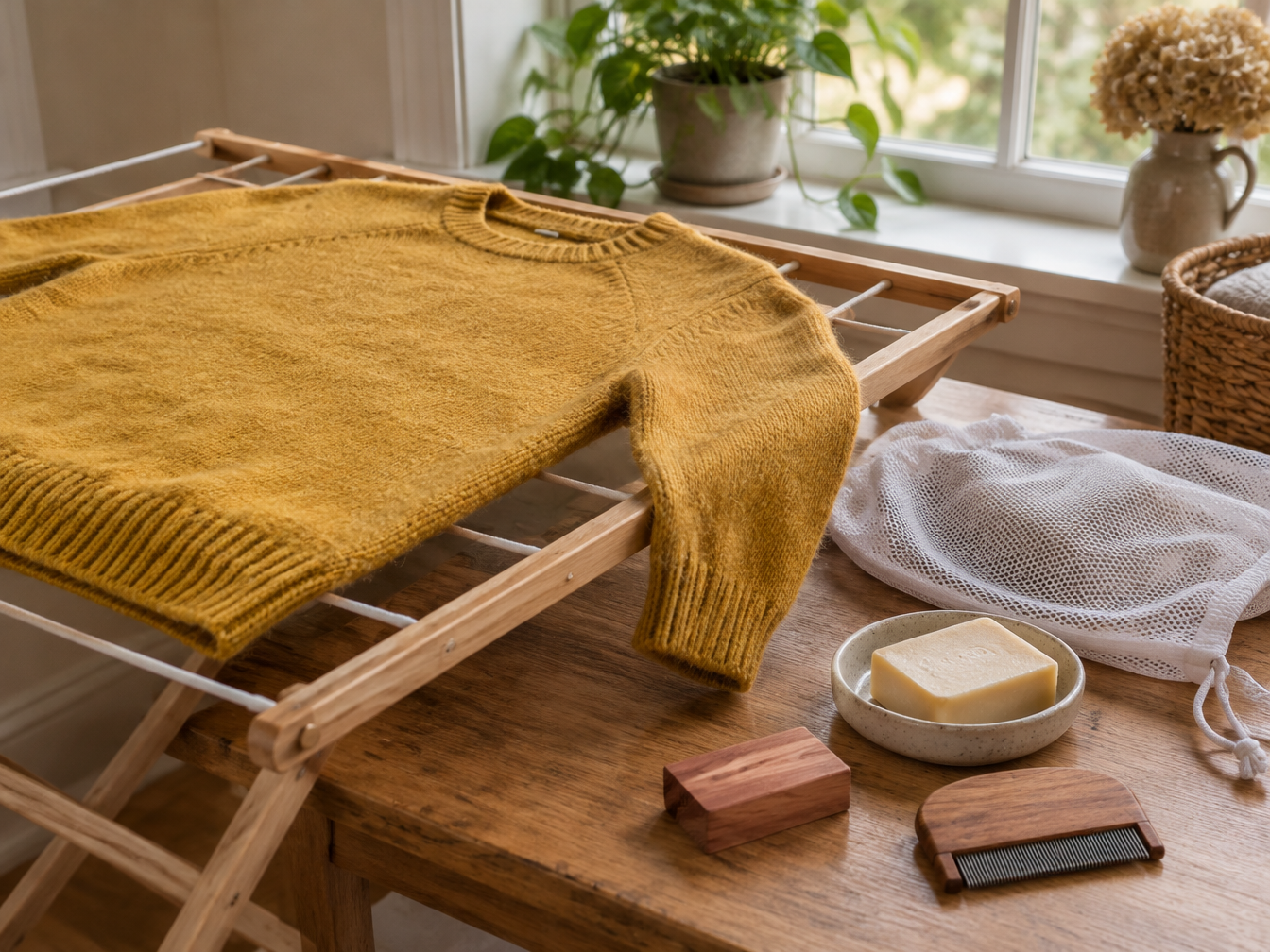
If a piece is irreplaceable, it deserves better care than the rest of your laundry. I learned most of this from a professional knitwear repairer, who explained that cleaning is the single most important thing you can do for wool. Oils, fragrance, and body products attract moths and other critters, and the sweater that arrives at her shop in November usually got its holes the previous July [2].
My routine is simple. I wash the sweater by hand in a gentle wool wash or on a delicate cycle inside a mesh bag, and I dry it flat on a rack. I never hang it, because hangers stress the shoulders and the weight of the fiber can stretch the body out of shape. I fold it like a T-shirt instead [2].
I also use a sweater shaver, carefully, on a flat surface. Removing pills makes the knit look fresher and removes some of the proteins that moths and silverfish like. At the end of every season, I check for snags and holes before the sweater goes to bed in a breathable bag with a cedar block tucked beside it [2]. It is a small ritual, and I look forward to it. Taking care of the sweater feels like the closest thing I have to taking care of her.
What I Wore It To the Day I Needed Her

Last December I had a bad week. A rejection email, a canceled trip, a long night of the kind of quiet that makes everything sound too loud. I came home, dropped my bag by the door, and without really deciding to, I pulled the yellow sweater over my head.
I sat on the floor with my back against the couch and pulled the cuffs down over my hands, the way I did at nineteen. Nothing was fixed. The email was still in my inbox. But my shoulders came down about an inch, and I let out a breath I had apparently been holding since Tuesday.
I thought about my grandmother’s coat and the style lessons it keeps teaching me, and how many of us are quietly wearing the arms of someone who loved us. We rarely say that out loud. We call it “just an old sweater.”
That is the part nobody tells you about sentimental clothes. They do not stay in the past. They keep showing up in the present, doing small jobs, like keeping your neck warm on a bus.
But nobody stands in front of a closet at the end of a hard day and reaches for just anything. We reach for the thing that already knows how to hold us.
What I Want to Be True When I Am the One Giving the Gift
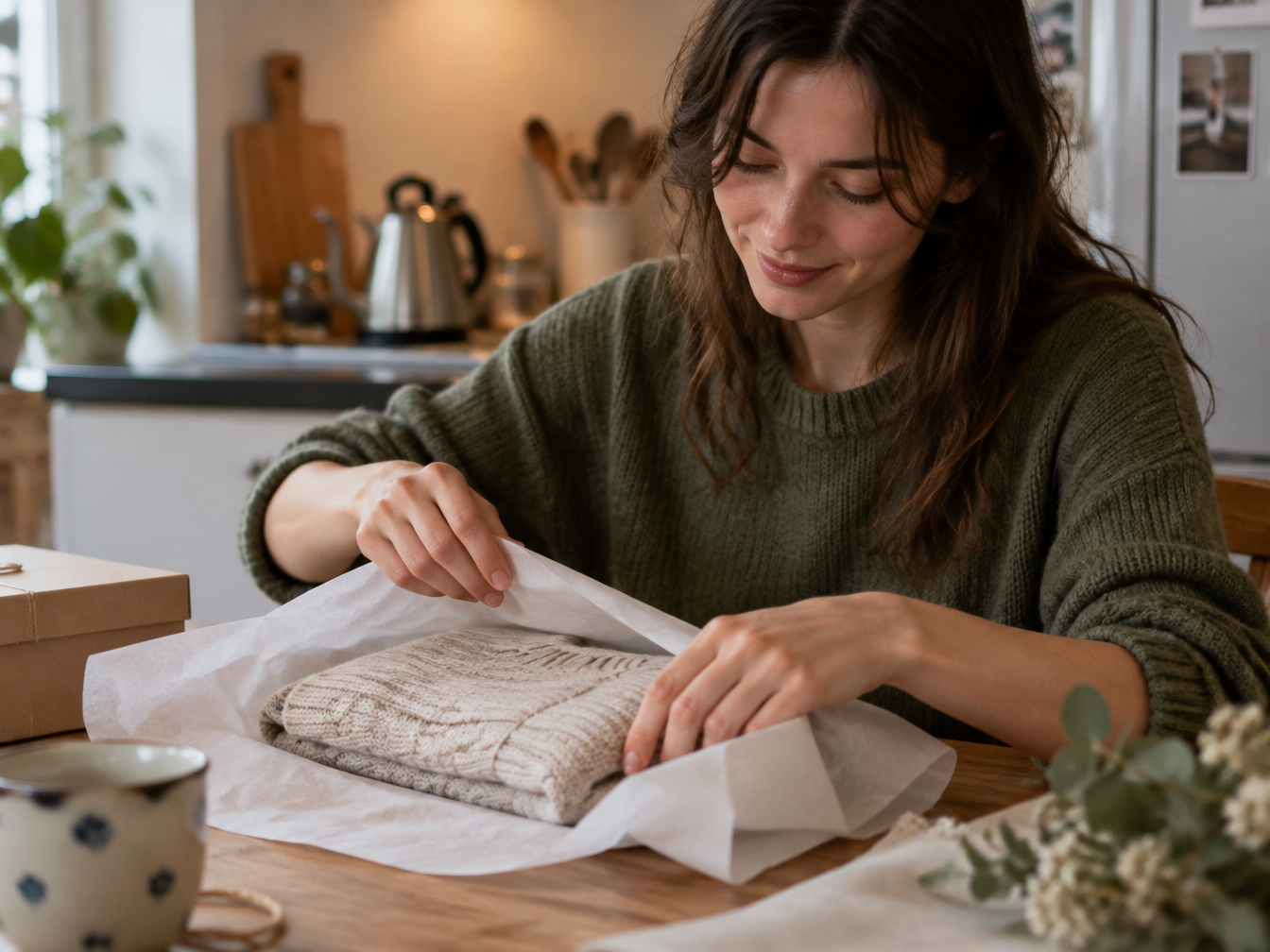
Some nights I think about the version of me who will hand a gift across a table to someone who is still figuring out who they are. I want to remember that the best gifts are not the ones that fit perfectly. They are the ones that say, I believe in who you are going to be, even if you have not met her yet.
Maybe that is the real work of a wardrobe. It is not only a place to store outfits, it is an archive of the people who dressed us when we could not yet dress ourselves.
I want to buy someone a warm thing too big for them and roll the cuffs up twice. I want to turn to the kettle so they can feel safe being moved.
And when I take the holiday card photo this year, I already know what I will wear underneath the nice coat. It will be yellow, it will be too long in the sleeves, and it will be the best-dressed thing in the picture.
Sources
- The Profound Way That Keeping a Loved One’s Clothes Can Help You Grieve, HuffPost via Yahoo, https://sg.news.yahoo.com/profound-way-keeping-loved-one-130612881.html
- How to Care for Sweaters and Knitwear by an Expert, Wardrobe Oxygen, https://www.wardrobeoxygen.com/?p=25004
Leave a Reply