I once cancelled coffee with a friend I adored because my hair would not curve the way it had curved the day before. I told her I was “swamped.” I was not swamped. I was standing in my bathroom at 8:40 in the morning, holding a round brush like a tiny weapon, losing an argument with a section of hair behind my left ear.
Nobody tells you how personal that kind of morning feels. It is not vanity. It is the sudden, sinking sense that the version of you who walks out the door is going to be the wrong version, and everyone is going to see it.
So I started paying attention. Not to the hair, but to the mornings. What was happening on the days my hair “failed”? Why did the same flat, frizzy, sideways mess feel like a shrug on Saturday and a catastrophe on Tuesday? The answer was never in the hair. It was in everything the hair was standing in for.
What Research Found About Bad Hair Days
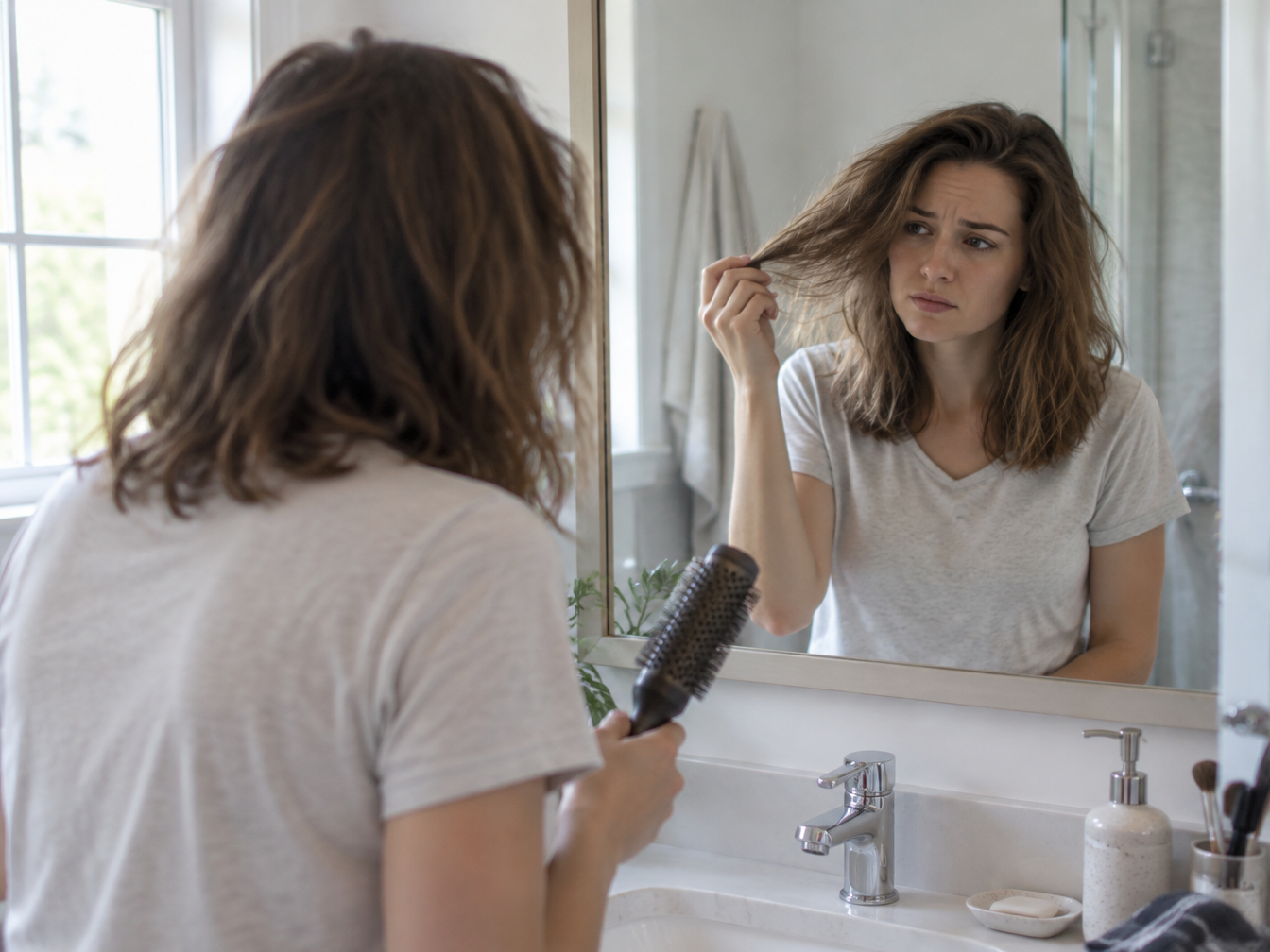
Let’s start with the part that made me feel less ridiculous. A bad hair day has been studied, in an actual university, with actual participants.
In 2000, Yale psychologist Marianne LaFrance ran a study with 120 young adults, 60 men and 60 women between 17 and 30. One group was asked to think about times their hair had gone wrong. A second group thought about leaky, badly designed product packaging, and a third was asked to think about nothing negative at all. Then everyone took basic tests of self-esteem and self-judgment [1].
The group that remembered their bad hair days scored lower. They felt less smart, less capable, more embarrassed, and less sociable [1]. And here is the twist that surprised even other researchers: men were more likely than women to say they felt less smart and less capable when their hair misbehaved [1].
A few honest caveats belong here. The study was paid for by Procter & Gamble, a company that sells shampoo, and the participants were mostly Yale students [1]. It was a small sample, and it measured people remembering bad hair, not people living through it. I would not build a worldview on it.
But I would build a little compassion on it. The feeling you get when your hair refuses to cooperate is not silly. It is common enough that a university studied it, and it reaches well past hair.
The Day Is Rarely About the Hair

Here is my theory, and I want to be clear it is mine, not a finding from any study. A bad hair day is a reasonable-looking container for a feeling that has nowhere else to go.
Think about the last time you hated your hair. What else was happening? I can usually name it. A deadline I was scared of. A text I had not answered. A party where I would know almost nobody. A body that felt unfamiliar after a rough week. The hair was just the part of me that I could see, grab, and blame.
That is why the hair feels like the culprit. It is the one problem in the room that has a mirror attached. You cannot stare at a looming conversation with your mother and fix it with a flat iron. You can stare at a cowlick and, for ten frantic minutes, believe that fixing it will fix the day.
I have started asking myself one question when the panic hits: what am I actually afraid of today? Sometimes the answer comes instantly. Sometimes it takes a walk around the block. But it almost always arrives, and once it does, the hair shrinks back to its real size, which is a few thousand strands doing their best. I felt the same thing when I stopped wearing makeup for 30 days: the face I was hiding was never really the problem.
How One Mirror Moment Rewrites the Whole Morning
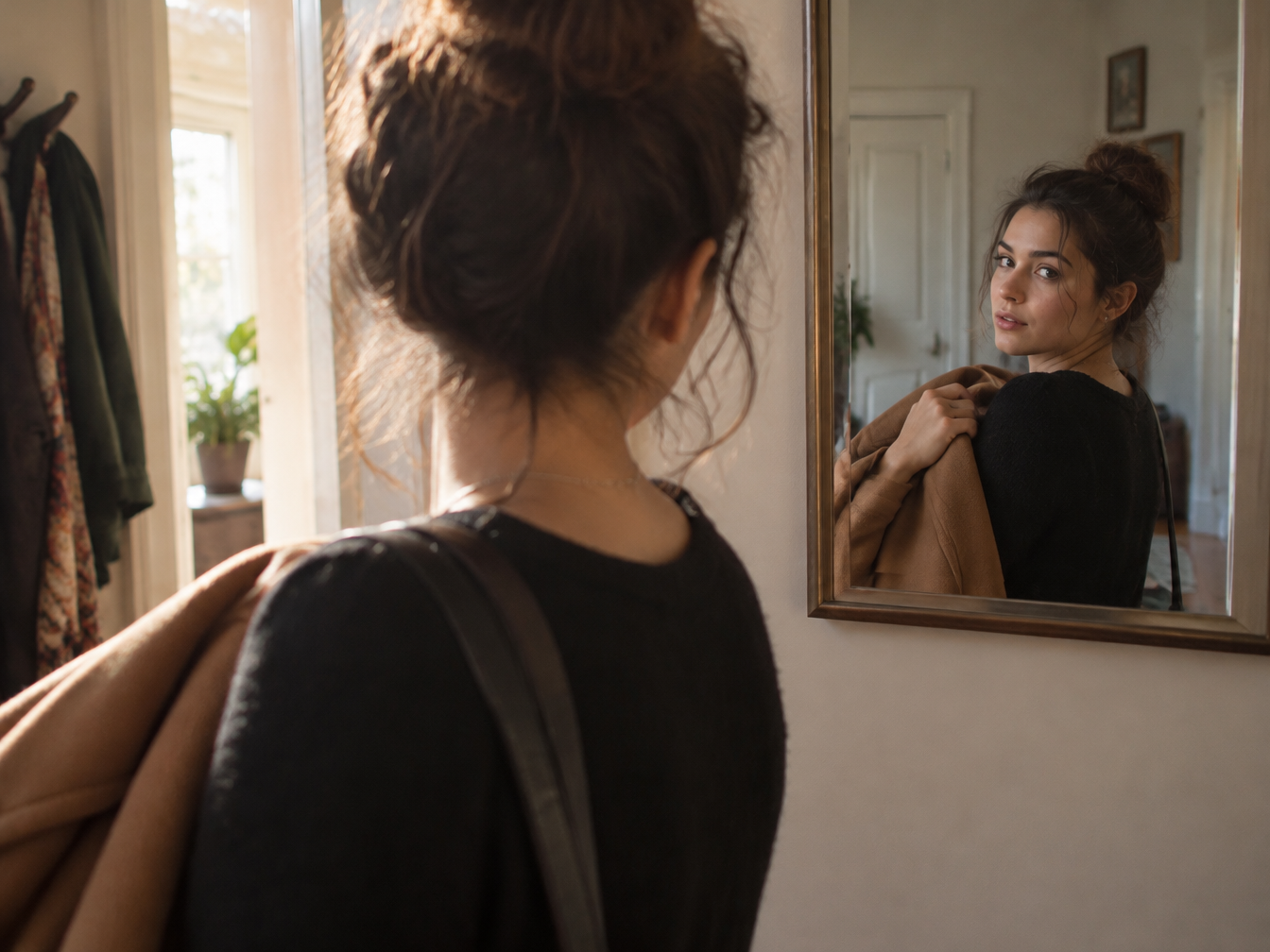
The research I mentioned measured how people felt after thinking about bad hair, but my own life has a quicker test. It takes about four seconds.
You glance at the mirror. Something is off. In those four seconds a whole story assembles itself: I look like I did not try, people will think I do not care, I should have washed it last night, I always do this. By the time you reach for the brush, you are not fixing hair. You are defending yourself against a jury that exists only in your head.
Psychologists have a related idea about clothes. In a well-known 2012 study, Hajo Adam and Adam Galinsky found that students who wore a white lab coat, which people associate with careful scientists, made fewer errors on an attention test than students who wore their own clothes [2]. They called it enclothed cognition, and they argued it depends on two things: what a piece of clothing symbolically means, and whether you are actually wearing it [2].

Hair is not a lab coat, and nobody has run that experiment on a ponytail. But I suspect the same logic travels. We attach meaning to how we look, then we wear that meaning around all day. A smooth, deliberate head of hair says “I have it together.” A wild one says something else, and we hear it loudest from ourselves.
Seeing that has changed how I handle the first hour. I try to spot the story before I start styling. Once I can say “I’m telling myself I look careless,” the story loses a little grip. Not all of it. A little. That little is often enough to get me out the door. If you want a gentler look at how big moments change what we do to our heads, I wrote about what women do to their hair before a big life moment, and it turns out the pattern holds even when the moment is small.
The Tricks I Reach For and What They Fix
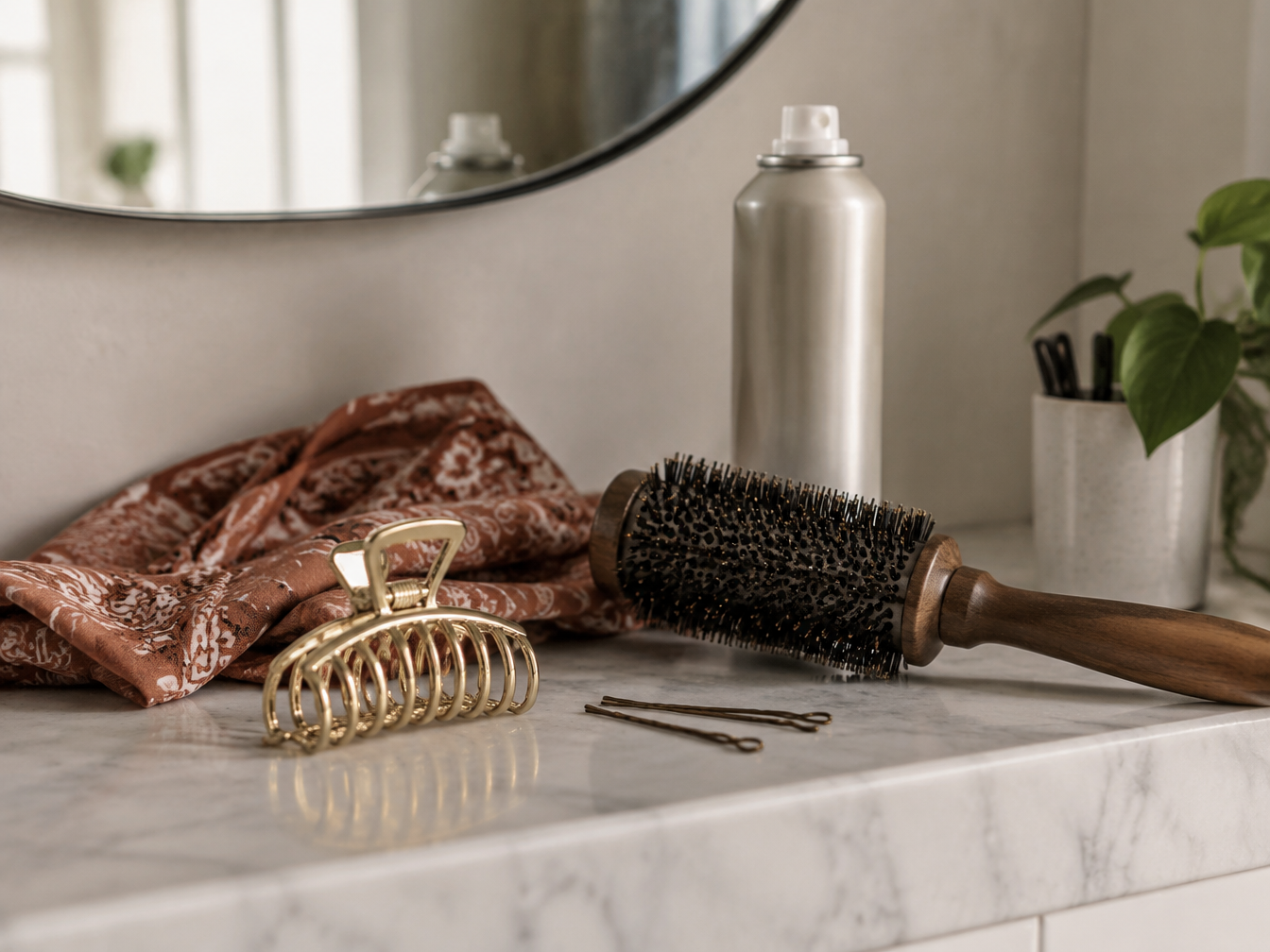
I am not above a good rescue. I have a dry shampoo that lives in my bag like a fire extinguisher, a claw clip with a gold hinge, and a very specific bandana fold. I am not telling you to stop reaching for the tools. Tools are great.
What I am telling you is to notice what the tool is actually doing. Sometimes a clip solves a practical problem: the front section is greasy, the humidity has won, the cut is growing out. Great. Clip it up and move on.
Other times the tool is a way of avoiding the real feeling. I once spent twenty minutes redoing a blowout before a presentation I was dreading, and by the time I finished the hair looked perfect and I was ten minutes late and rattled. The blowout had fixed nothing that mattered.
My rule now is a time limit. I give a hair problem one honest attempt and one backup plan. If the second plan fails, I let it be. If you want practical help with the first attempt, this guide to fixing a puffy, flat, or fried blowout covers the mechanics well, and a good reference like that saves you from guessing at the stove-hot end of a round brush.
The limit works because it forces a decision. Either the hair gets handled, or the feeling gets handled. Pretending the first can substitute for the second is how a morning disappears.
Why Hair Carries So Much of Who We Think We Are
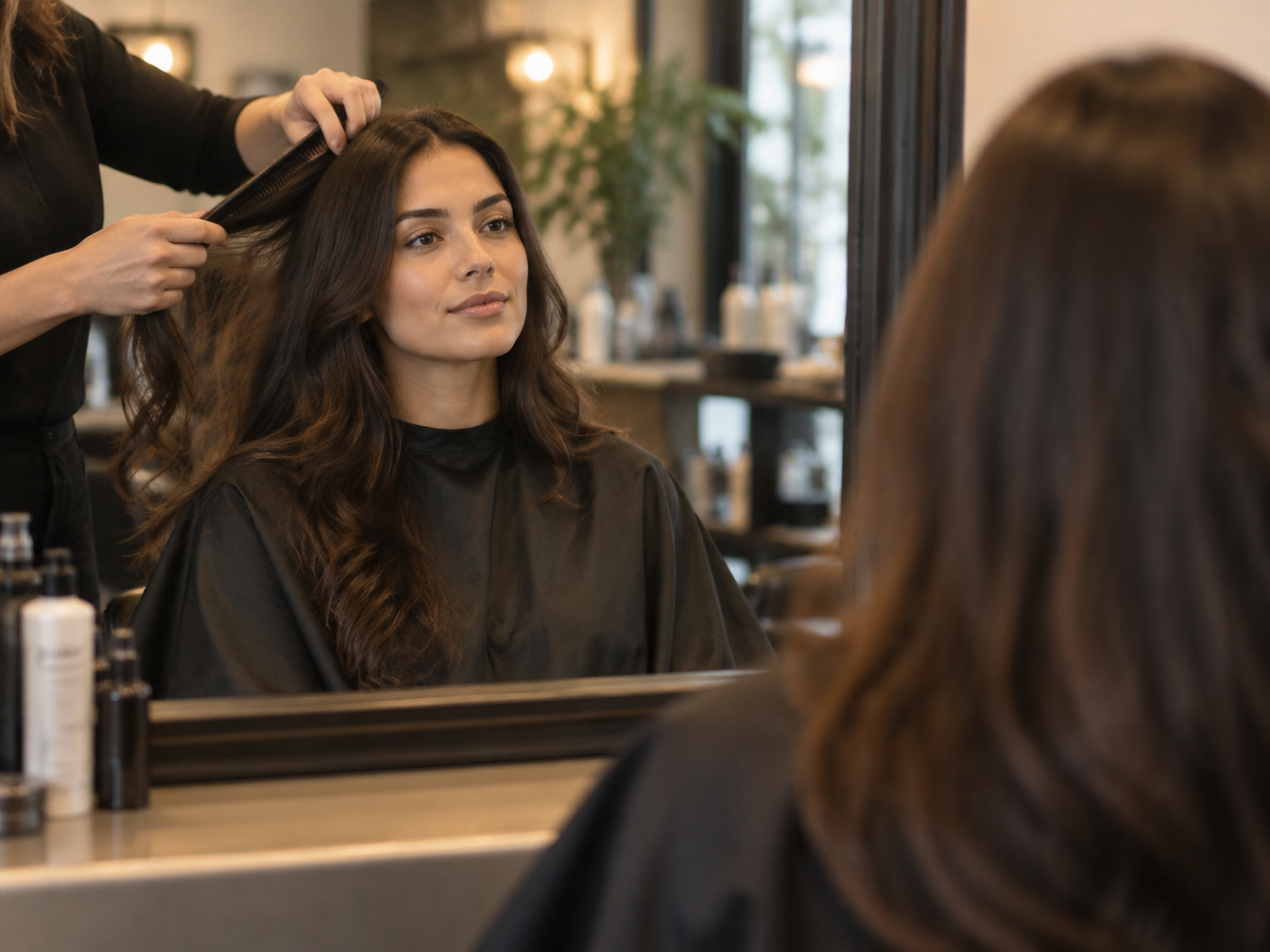
There is a reason hair gets the blame so often. It is one of the few parts of our appearance that we change on purpose, and that other people read like a headline.
Think about how much hair gets used as an announcement. A breakup haircut. A new color before a new job. A shaved head, a chop, a grown-out shade that finally matches who you are now. We do not treat hair as a trivial accessory. We treat it as a sentence about ourselves, and we expect people to read it.
That is also why a bad hair day can feel like a bad sentence. If my hair is a statement, then a messy statement feels like I have said something wrong in public. It is a heavy way to treat a few thousand strands.
I think this is why hair color changes feel so loaded. I looked at the same pattern in what a hair color change is actually about, and the thread is the same: we are rarely changing the hair. We are changing the story that hair tells.
Knowing this does not make the bad days vanish. But it does help me decide whether a day is a hair problem, a sentence problem, or a me-problem. Most of the time, it is the second one wearing the first one’s clothes.
Small Rituals That Make a Bad Hair Day Smaller
Over the past year I have collected a handful of tiny things that help. None are glamorous. All are real.
First, I say the fear out loud. In the bathroom, to the mirror, in a flat voice: “I’m scared the meeting goes badly.” It sounds embarrassing and it works, because the fear moves from being a vague weather system in my chest to being a specific sentence I can answer.
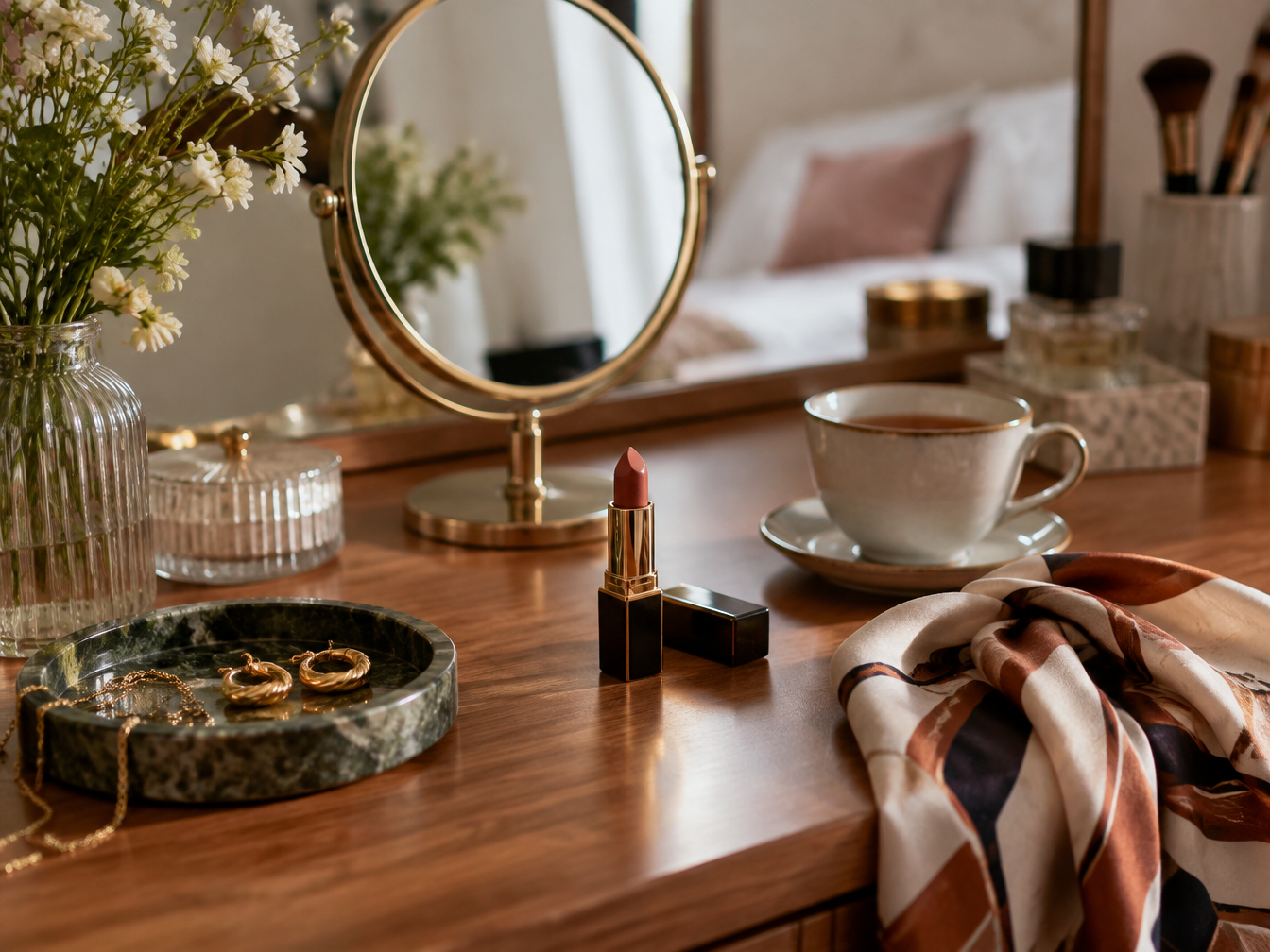
Second, I change one other thing. A lipstick I love, a pair of earrings, a scarf I got on a trip. It gives my eyes somewhere else to land, and it reminds me that I am more than a head of hair.
Third, I treat the outfit as part of the plan. There is a particular piece of clothing I reach for when I need to feel like myself again, and I wrote about it in the outfit I wear when I need to feel like myself again. Good clothes can carry the confidence the hair is not supplying that morning.
Fourth, I plan the exit. If I know I can leave the party early or take a walk after the meeting, the stakes drop, and so does the pressure on my hair to be perfect.
None of this fixes the strands. All of it fixes the day.
The Day I Let My Hair Do Whatever It Wanted

A few months ago I had one of those mornings. Humidity had turned my hair into a shape I can only call architectural. I had a dinner that night with people I wanted to impress.
I did the usual: one honest attempt, one backup, then I stopped. I put on a dress I loved, swiped on a lip color that made me feel like a person, and I walked out with hair that looked like it had opinions.
Here is what happened. Nobody mentioned it. Not once. A woman at the table told me she loved my energy. Someone else asked where I got my earrings. The thing I had been so afraid of, the verdict I had been rehearsing in the mirror, never came.
I thought about all the mornings I had given away to that fear. All the cancelled coffees. All the times I rushed through a day feeling smaller because of how my hair sat behind my left ear.
The getting-ready part of a night out can actually be a pleasure when the pressure comes off, which I explored in why getting ready for a party is my favorite part of the night. It is one of my favorite things about going out, and I was close to losing it to a bad hair day mindset.
Your hair is going to misbehave. That is its job. What you do with the feeling underneath is yours.
Wear it messy. Wear it loud. The room is not grading you nearly as hard as you are.
Sources
- Associated Press, “Bad-hair days affect men, too, study finds,” Deseret News, January 27, 2000. https://www.deseret.com/2000/1/27/19487744/bad-hair-days-affect-men-too-study-finds/
- Christian Jarrett, “Introducing ‘enclothed cognition’ – how what we wear affects how we think,” The British Psychological Society, March 1, 2012. https://www.bps.org.uk/research-digest/introducing-enclothed-cognition-how-what-we-wear-affects-how-we-think
Leave a Reply