The Text That Said Picture Day

The text came in on a Tuesday. It was from my sister, and it said, “Holiday card photo on the 14th, 2 p.m., wear something coordinated but not matchy.”
I looked at it for a long time. Then I put my phone face down on the counter like it had said something rude.
I know how this sounds. It’s a card. It goes in an envelope with a stamp and a sprig of fake holly on the front. Nobody is going to frame it. And yet something in my chest did the small, familiar drop that happens when a camera is about to point at me and I have to decide, in under a second, who I’m going to be.
For three years I had dodged this photo. I had a rotating list of excuses, a “work thing,” a “weird cold,” a “bad hair week” that somehow lasted all of December. This year my sister didn’t ask. She just put it on the calendar, and I didn’t have a good reason left.
So here’s the story of a single photograph, and what it showed me about the version of myself I keep trying to edit out.
Why I Hate the Girl in the Photo
First, a small comfort: you are not imagining it. Most of us really do dislike photos of ourselves, and there is actual research on why.
Social psychologist Madeleine Fugère, writing in Psychology Today, points to two big culprits. The first is something called self-enhancement, the habit of judging our own traits more kindly than is objectively warranted. In studies she cites, people shown their real photo alongside versions digitally altered to look more attractive tended to pick the altered ones as the “real” them, while strangers could spot the genuine photo just fine [1].
In other words, the person in my head is a little shinier than the person who exists. The camera doesn’t lie so much as it refuses to flatter.
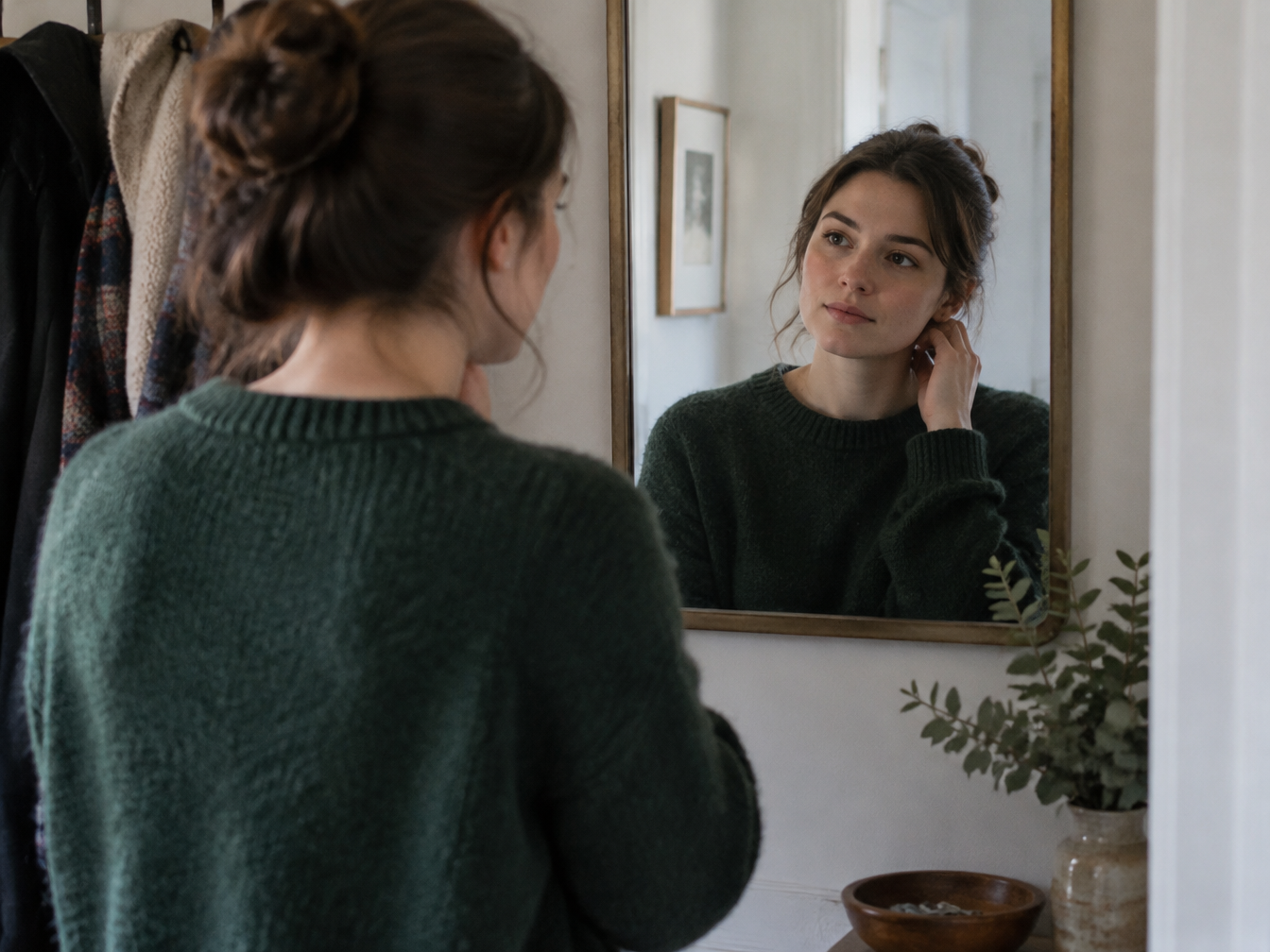
The second culprit is the mirror. The mere exposure effect says we tend to like what we see often, and we see ourselves most in the mirror, where our face is flipped left to right. A photograph shows the un-flipped version, which looks slightly off to us. Fugère notes that people tend to prefer their mirror image, while friends and strangers prefer the “true” one [1].
Read that again, because it’s quietly lovely. The face you wince at in photos is the face everyone you love has been looking at the whole time. They aren’t seeing a flaw. They’re seeing you.
That didn’t fix my dread. But it moved it. The problem wasn’t that I looked bad. It was that I looked unfamiliar, and unfamiliar feels like wrong.
I know that feeling well, because I lived inside it for a month. When I stopped wearing makeup for 30 days, the strangest part wasn’t how I looked. It was the first week of not recognizing myself in every reflective surface, the toaster, the dark phone screen, the window of the bus. Familiar is a habit. So is unfamiliar. Both change if you give them time, and a holiday photo is a very small, very public way of giving yourself that time.
A Brief History of Everyone Pretending Everything Is Fine
The holiday card has been a little bit of theater from the start.
According to Smithsonian historian Daniel Gifford, the tradition began in the 1870s, when printing entrepreneur Louis Prang saw a business opportunity, and by 1905 Christmas postcards were hugely popular [2]. The point was always to send a small, tidy sign that your life was in order.
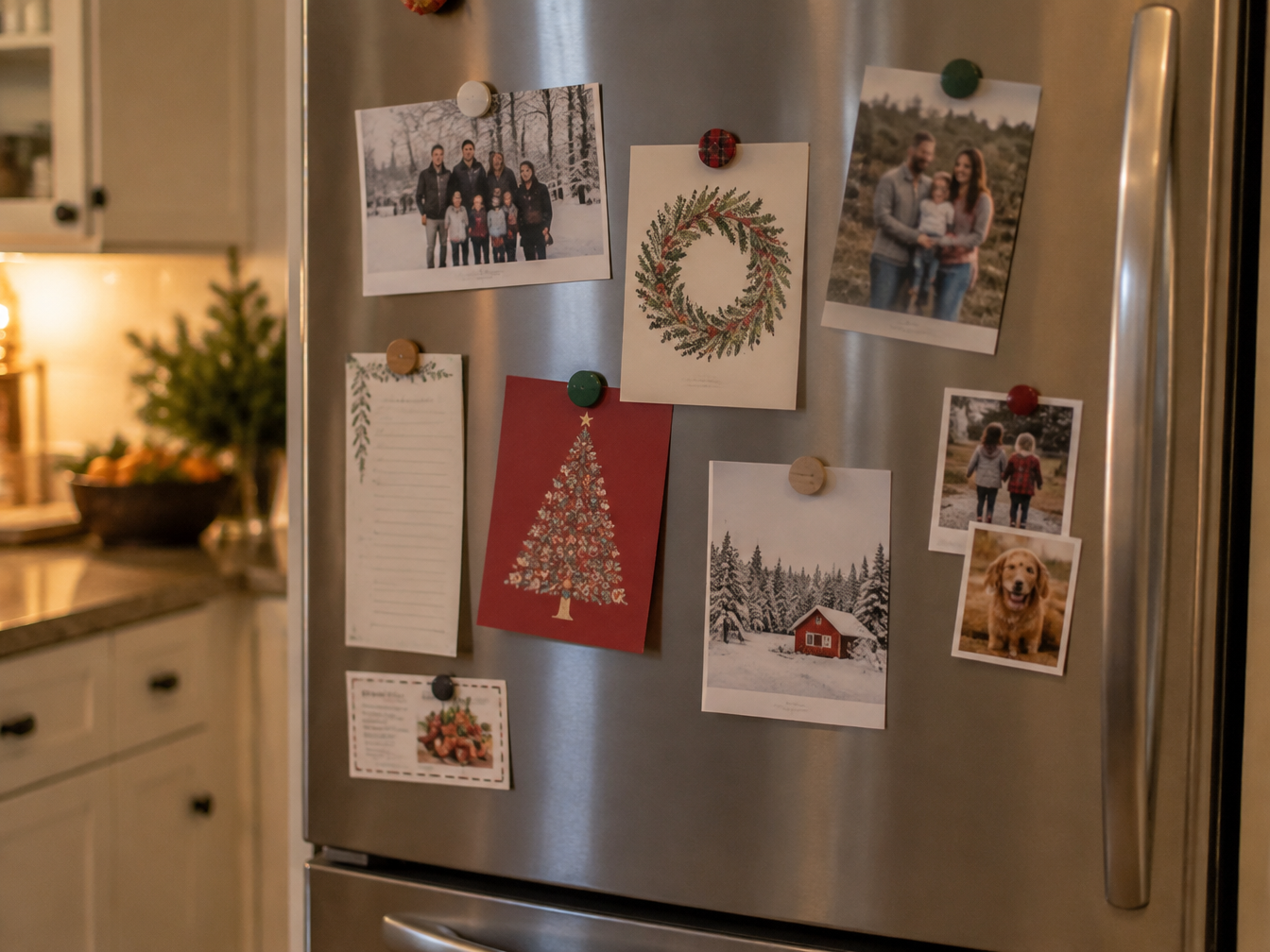
I thought about that while I stood in front of my closet. Every card on my fridge is a highlight reel. The kids in coordinated plaid. The couple on a beach in linen. The dog in a tiny scarf, looking more relaxed than any of us. Nobody sends the card from the year the marriage ended, or the job fell through, or the apartment flooded. We send the version that says, “We’re doing great!” in a font that looks like handwriting.

I don’t think that’s dishonest, exactly. It’s more like a social handshake. But a handshake can still be a lot of pressure when you’re the one trying to look like a person who has it together.
An older Associated Press survey, quoted by CBS Minnesota, found that people under 30 were far less likely to send holiday cards than people over 65, and that younger senders leaned toward photo cards over letters [2]. So if you’re a woman in your twenties or thirties who feels strangely responsible for the picture, you’re not alone. The photo card is basically our generation’s version of the Christmas letter, except the letter is your face.
What I Wore and Who I Was Dressing For
The outfit took longer than the photo did.
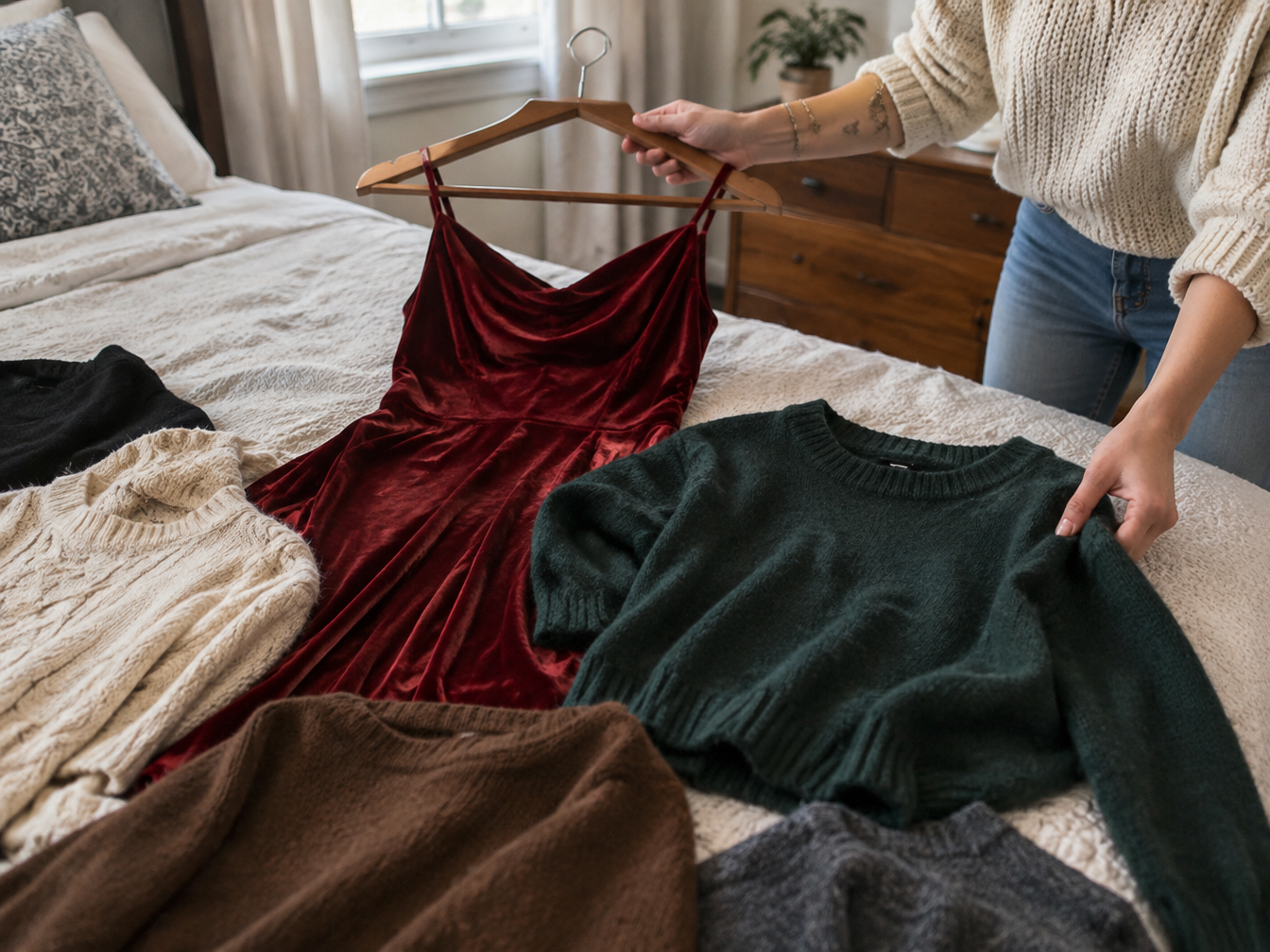
I tried on eleven things. Not because nothing fit, but because every outfit asked a different question. The red velvet dress asked, “Are you the festive one?” The camel sweater asked, “Are you the effortless one?” The black turtleneck asked, “Are you the one who’s quietly sad?” (I put that one back fast.)
What I finally understood is that I wasn’t choosing an outfit. I was auditioning for a role in my own family. And the role I kept reaching for was a girl who looked easy and polished and a little bit untouchable.
That should sound familiar if you’ve read about the holiday party dress I bought to impress someone who wasn’t even invited. Same trap, different season. I was dressing for an imaginary audience, and the real audience, my actual people, was going to open an envelope and just feel glad to see my face.
So I did a small experiment. I asked myself a different question: what would I wear if I were allowed to be comfortable on camera?
The answer was a forest green sweater with a slightly too-wide neck, dark jeans, and my good boots. Nothing coordinated. Nothing matchy. Just something I’d actually wear to my sister’s kitchen on a cold afternoon.
I’m telling you this because the outfit that felt like me ended up photographing better than any of the eleven that tried to be someone. Being at ease has a look.
My sister, who is far more photogenic than she believes, told me later that she’d had the exact same thought and had changed out of a cream blouse at the last minute because it felt like “dressing for a magazine.” We stood there in the doorway, two grown women who had each secretly rehearsed a different outfit for an audience of relatives who just wanted us to show up. It was the first time in years we had laughed about it instead of quietly spiraling.
The Hair and Makeup Negotiation

Then came the face part.
I have a complicated relationship with makeup, and I won’t pretend otherwise. After my thirty days without it, I learned that a lot of what I called “getting ready” was really “hiding,” and I’ve been trying to keep that honesty alive ever since. But a holiday photo is a different animal. There’s flash. There’s a sibling with a phone zoomed in. There’s a version of you that’s going to be on your aunt’s refrigerator until March.
So I made a deal with myself. I’d wear makeup that looked like me on a very rested day, not me in costume. If you want a version of that idea, soft glam makeup for holiday parties is the closest thing I’ve written to my own rules: a little color on the cheeks, a defined eye, a lip I’d actually reapply. Nothing that needs a tutorial.
Hair was harder. Mine had its own agenda that morning, in that way hair does when you need it to behave. I fought it for twenty minutes. I used heat. I used more heat. Then I stopped, tied it back loosely, and let two pieces fall around my face on their own.
Those two pieces ended up being the best part of the picture. They made me look like a person who was caught in a good moment instead of arranged for one.
Here’s what I’ve come to believe about getting ready for a photo: the goal isn’t to look flawless, it’s to look findable. Like someone who could be recognized across a room by a person who loves you.
The Version of Me It Showed
We took about forty pictures. The first fifteen were bad. I could feel it. My smile was the one I use for strangers in elevators, tight and slightly apologetic.
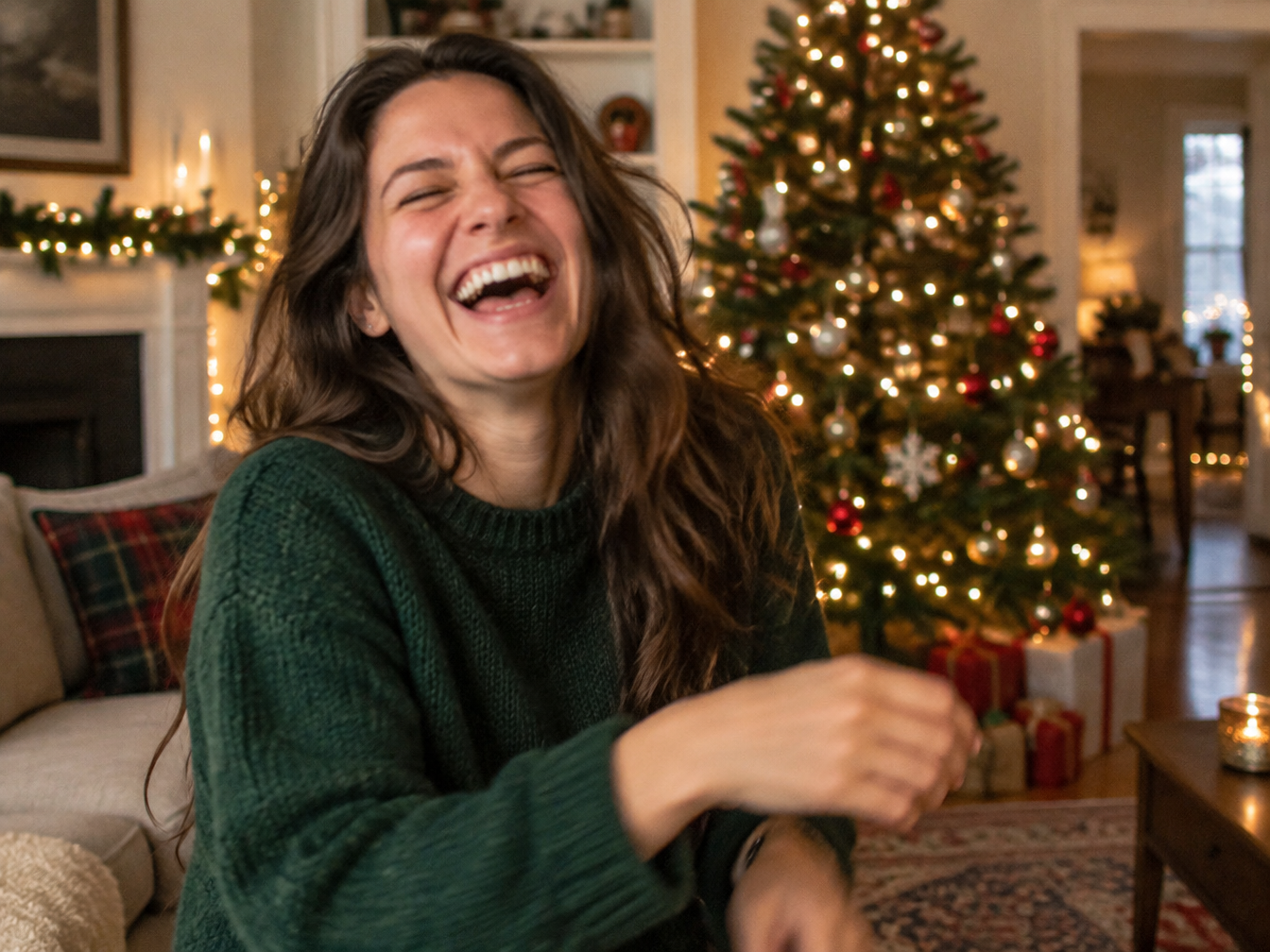
Somewhere around photo sixteen, my brother-in-law said something ridiculous about the dog, and I laughed. A real laugh, mouth open, eyes squeezed shut, the kind I’d normally delete on sight.
That’s the one that made the card. Looking back, that whole morning was a lesson in why a bad hair day is never really about your hair. My frustration had very little to do with the strands and a lot to do with wanting to control how I’d be seen.
When my sister sent me the proof, I braced for the wince. It didn’t come. What I saw was a woman who looked tired in a warm way, who was clearly about to say something, who looked like she was actually standing next to people she liked. My face wasn’t perfect. It was recognizable. It was mine.
I thought about the mirror, about the flipped version I’d trained myself to prefer. And I realized the photo wasn’t showing me a worse version of myself. It was showing me the one everyone else gets, and that version, it turns out, is allowed to be loved.
That’s the quiet gift in a holiday photo you dread. The camera catches the person who is actually in the room. Not the polished one in your head. The one who showed up.
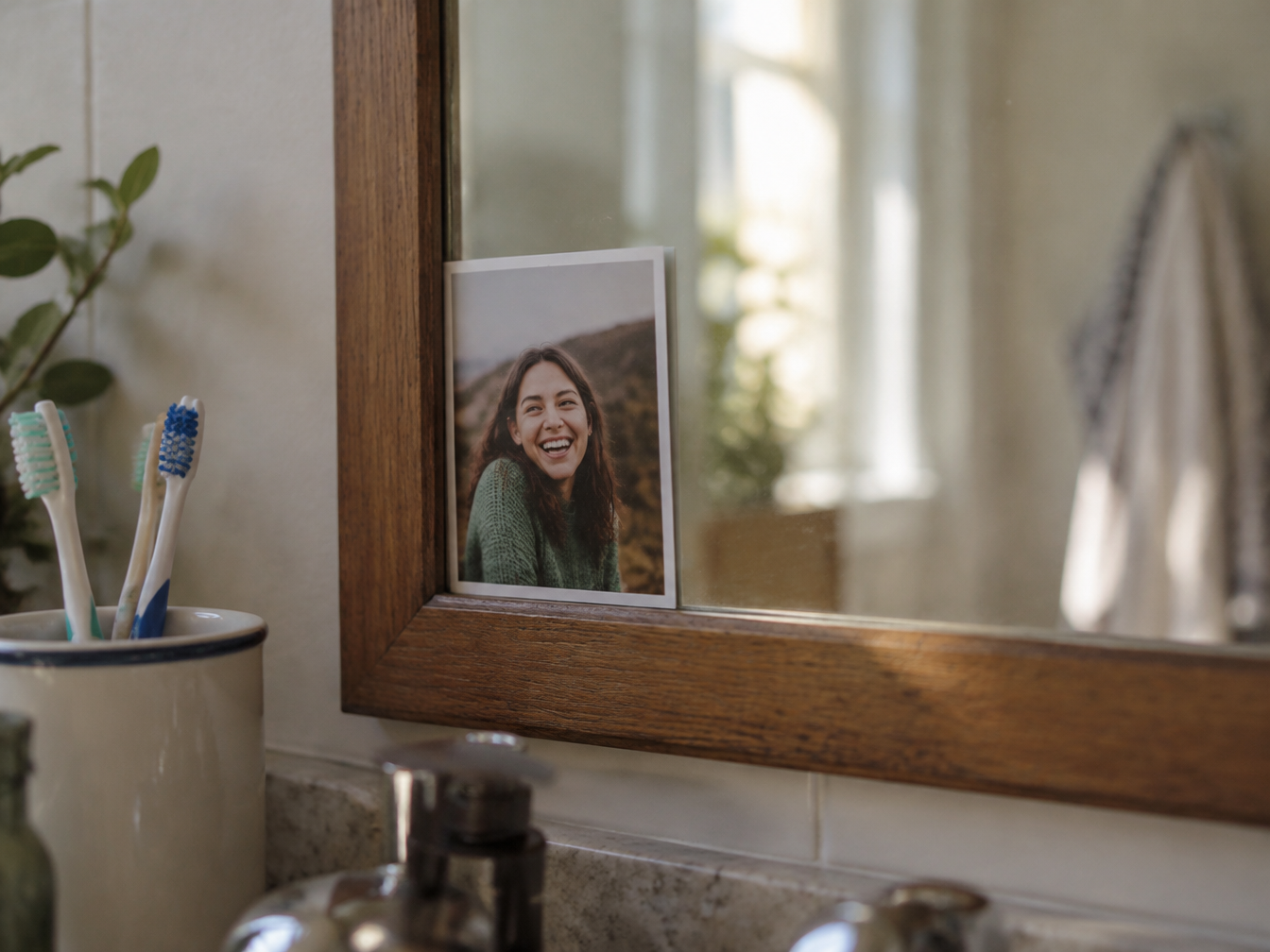
I’ve since printed that photo small and tucked it into the corner of my bathroom mirror, where I used to stick reminders about deadlines. Every morning I see a woman mid-laugh, a little tired, a little windblown, entirely herself. It’s the most useful thing on that mirror.
How I’ll Handle the Next One
If you’ve got a photo on the calendar and your stomach is already tight, here’s what I’d pass along, from one reluctant model to another:
- Dress for the kitchen, not the catalog. Wear what you’d choose on a good ordinary day. Comfort reads as confidence.
- Pick one feature to love and let the rest be. Mine is my eyes. I put a little extra care there and left the rest alone.
- Take more photos than feels reasonable. The first fifteen are for nerves. The good ones come after you forget you’re being photographed.
- Get someone to make you laugh. Hire your funniest cousin if you have to.
- Look at it again in a week. Distance helps. Fugère’s own advice is to look through old photos, and she suggests going back about ten years, because we nearly always like the way we looked then [1].
That last one is the one I think about most. Somewhere in a box, there’s a photo of me that I hated at the time, and I would give a lot to look that rested again.
I also keep a small ritual for the days I feel least like myself: I put on the outfit I wear when I need to feel like myself again and let the day catch up. It sounds silly, but a familiar sweater can do more for your posture than any pose.
The card went out on the first of December. My aunt put it on her fridge, right at eye level, between a coupon and a grocery list.
I walk past it and I don’t look away anymore.
Sources
- Madeleine A. Fugère, Ph.D., “The Surprising Reasons We Dislike Photos of Ourselves,” Psychology Today, October 10, 2017. https://www.psychologytoday.com/us/blog/dating-and-mating/201710/the-surprising-reasons-we-dislike-photos-of-ourselves
- “Good Question: Why Do We Send Holiday Cards?,” CBS Minnesota (WCCO), reporting an older Associated Press survey and comments from Smithsonian historian Daniel Gifford. https://www.cbsnews.com/minnesota/news/good-question-why-do-we-send-holiday-cards
Leave a Reply