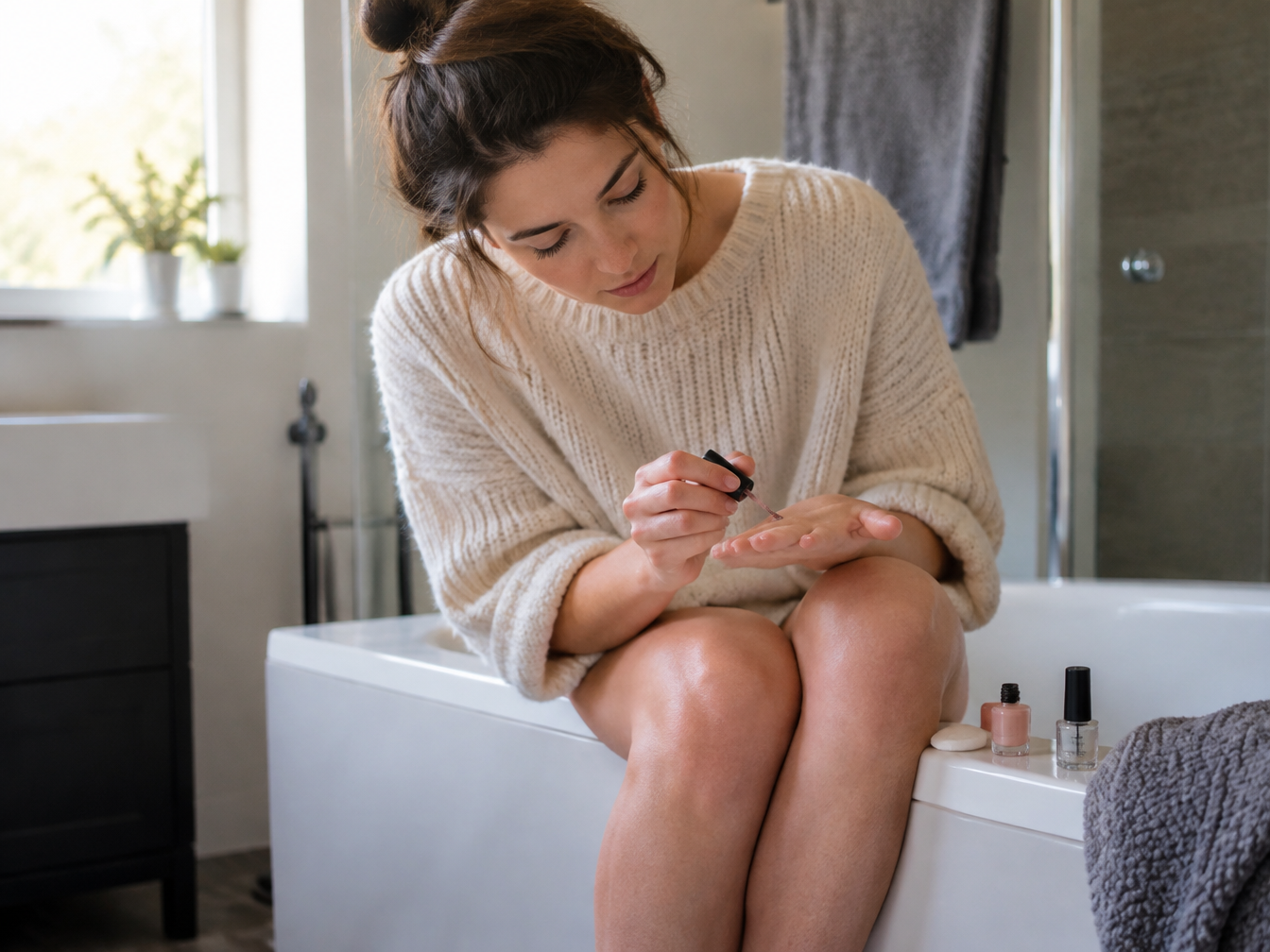
I was crying in a bathroom stall at a work party when I noticed my nails. They were a perfect, glossy cherry red. I had painted them that morning at 6:40, sitting on the edge of my bathtub, humming along to nothing, convinced that if my hands looked like they belonged to a woman with her life together, the rest of me would eventually fall in line.
It did not work. The promotion went to someone else. The boy I liked left early. My hands, however, looked incredible.
I think about that stall a lot. Not because it was my worst moment, but because of what I did next. I wiped my face, fixed my mascara, looked down at those red nails, and felt a tiny, ridiculous flicker of okay. Not fixed. Not healed. Just okay. And I have been trying to understand that flicker ever since.
The Lie We Tell Ourselves at the Nail Salon
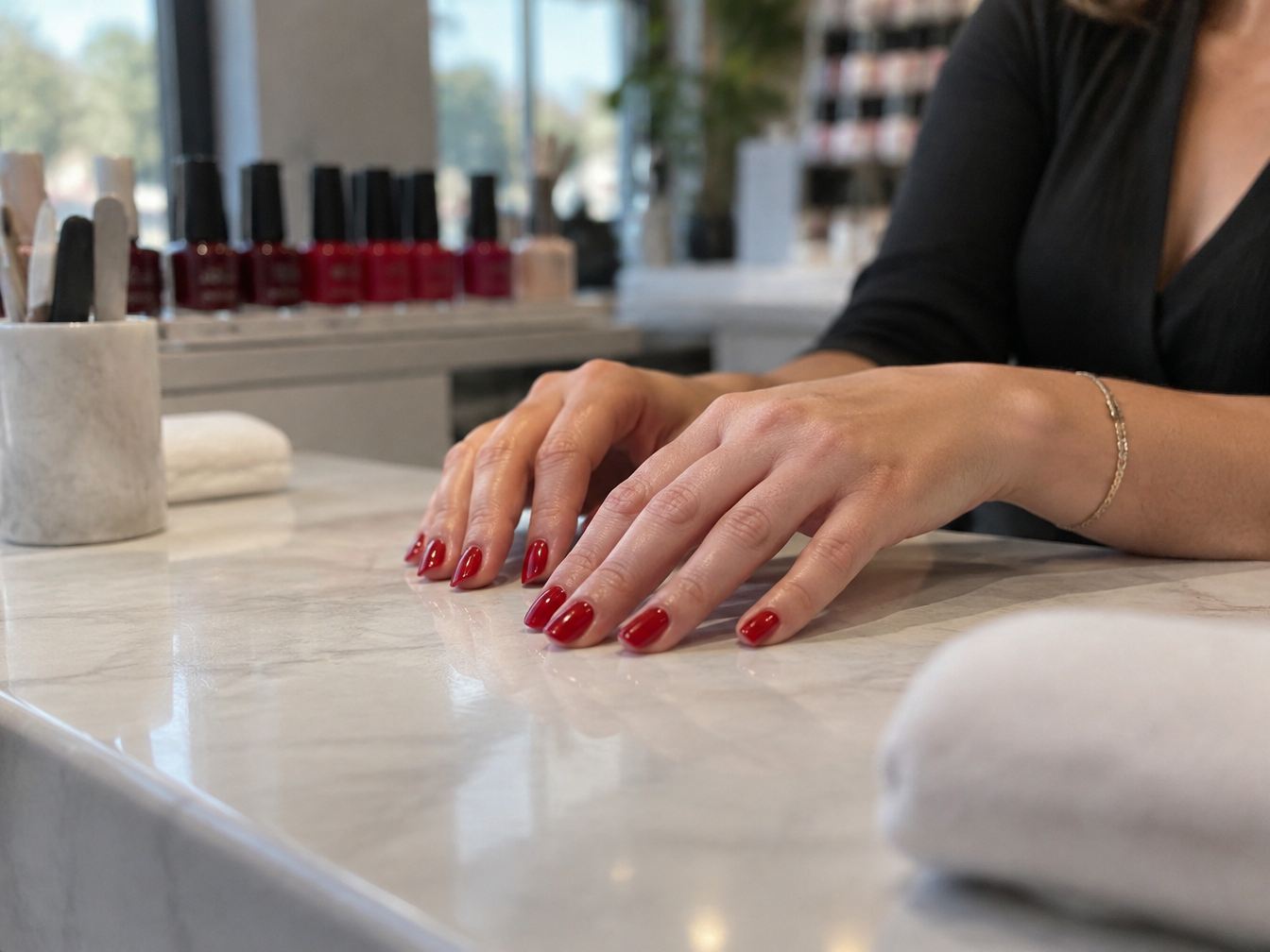
Let me say the quiet part out loud. A manicure will not fix your life. It will not get you the job, bring back the ex, or make your mother stop asking when you’re going to settle down.
And yet we keep doing it. We book the appointment during the worst weeks, not the best ones. We scroll through shade names like they are small prayers. Soft Landing. Mind Over Matter. Bare Minimum. (I made up that last one, but you know a brand is thinking about it.)
Here is what I eventually figured out. We are not trying to fix our lives with nail polish. We are trying to fix the next ten minutes, and sometimes that is the only thing available to fix. A life is too big to repair on a Tuesday. A thumbnail is not.
I used to think this made me shallow. I had read enough think pieces about women and beauty maintenance to feel a low hum of shame every time I booked an appointment. Then a friend who had just lost her father showed up to his funeral reception with immaculate, pale nude nails and said, almost to herself, “I needed one thing to be in order.” Nobody in the room judged her. Most of us were quietly jealous that she had found one.
What a Small Study Quietly Admits
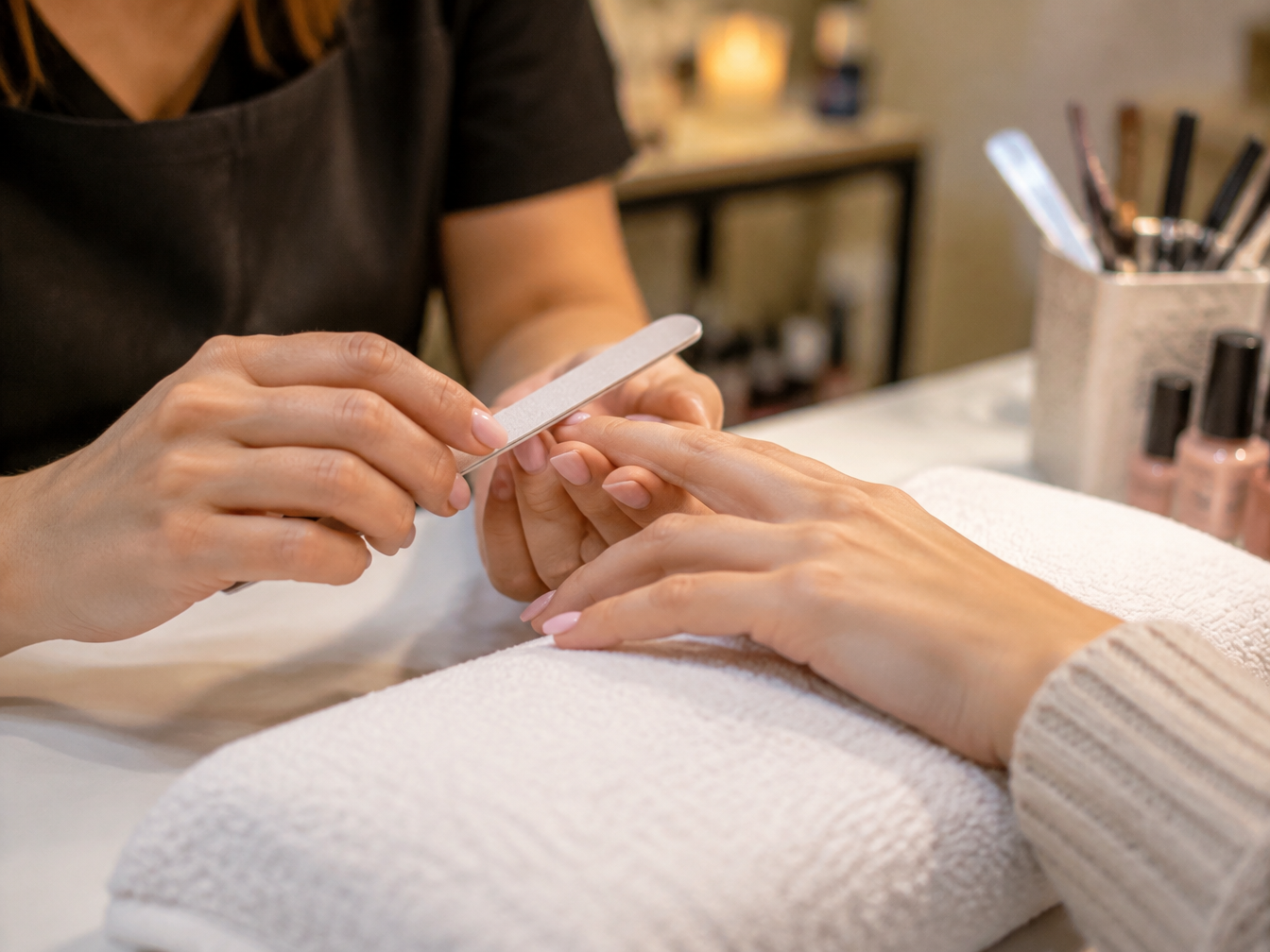
If you want a reason to feel less silly about all this, there is a surprisingly tender piece of research. Two Japanese psychologists, Atsushi Kawakubo and Takashi Oguchi, surveyed 334 women in the Tokyo area, half of whom had their nails done at a salon and half who did their own. Their conclusion was that nail care positively elevated three things: positive emotions, relaxation, and a sense of vitalization [1].
Salon visits scored higher for positive emotions and relaxation than doing it yourself at home. That makes sense to me, because part of what you are buying is an hour where somebody else is paying attention to your hands and you are not allowed to do anything useful.
There is a caveat, and the researchers are honest about it. The study was a survey, not an experiment, so it cannot prove that polish caused the good feelings. Happier women might simply be the ones who book manicures. It also covered a narrow group of women in one part of one country. Still, one detail stuck with me. The people who chatted about light things, like hobbies and daily life, got more out of the appointment than people who unloaded something heavy on their manicurist [1].
Which explains a lot about why we like the nail chair. It is one of the few places where small talk is the whole point.
I noticed this the last time I went. The woman next to me was a nurse coming off a double shift, and the whole appointment she talked about her dog’s terrible haircut. She left lighter. Nobody asked her about the shift. Nobody had to.
The Ten Minutes You Actually Own
There is a version of self-care that is secretly a to-do list. Drink the water. Do the stretches. Journal the feelings. Optimize the sleep. I love a good routine, but some days a routine is just another thing to fail at.
Nails are different because they ask for so little. You pick a color. You sit still. You wait. There is a built-in reason to stop moving, and for a woman who spends her days answering messages and managing everyone else’s mood, being unable to touch her phone for fifteen minutes because her thumbs are wet is a kind of gift.
I have a friend who calls it “legal doing nothing.” She schedules her fills around the weeks when her schedule is most brutal, not because she needs the nails, but because she needs the excuse. Her hands are the proof that she took the time.

If you have ever felt guilty about resting, notice how you rarely feel guilty about a manicure. That tells you something about what you will allow yourself when it comes with a result you can show people.
I do not love that about us, but I understand it. Rest that leaves a mark feels earned. So maybe the manicure is a loophole, a way of sneaking a break past the part of your brain that keeps score. If so, I say use the loophole. Then, if you can, try to notice that the break was the good part, and take one without the polish sometime.
Your Hands Are the Part of You Everyone Sees First

Think about how much your hands do in public. They hold the coffee, tap the table, wave in the meeting, gesture in the story you are telling. They are on display more than your face, and unlike your face, they are in your control.
This is part of why a nail color can feel like armor. Not because anyone is staring, but because you know what is at the end of your own arms. When I wore that cherry red, I felt more deliberate, like a woman who makes decisions. When I wear a bare, pale pink, I feel quieter, like I am letting the day come to me.
There was a stretch last winter when I wore dark green for six weeks straight. I could not have told you why. It felt like pulling a heavy blanket up to my chin, and when I finally switched to a sheer peach, a coworker said I looked like I had slept. I had not. The color just told a different story about me, and for a day or two I believed it.
I wrote more about that quiet kind of dressing in a post about the outfit I wear when I need to feel like myself again. The pattern is the same. The thing you put on is a message to the person who is about to walk into a hard room, and that person is you.
Why Clothing and Color Might Really Change How You Act
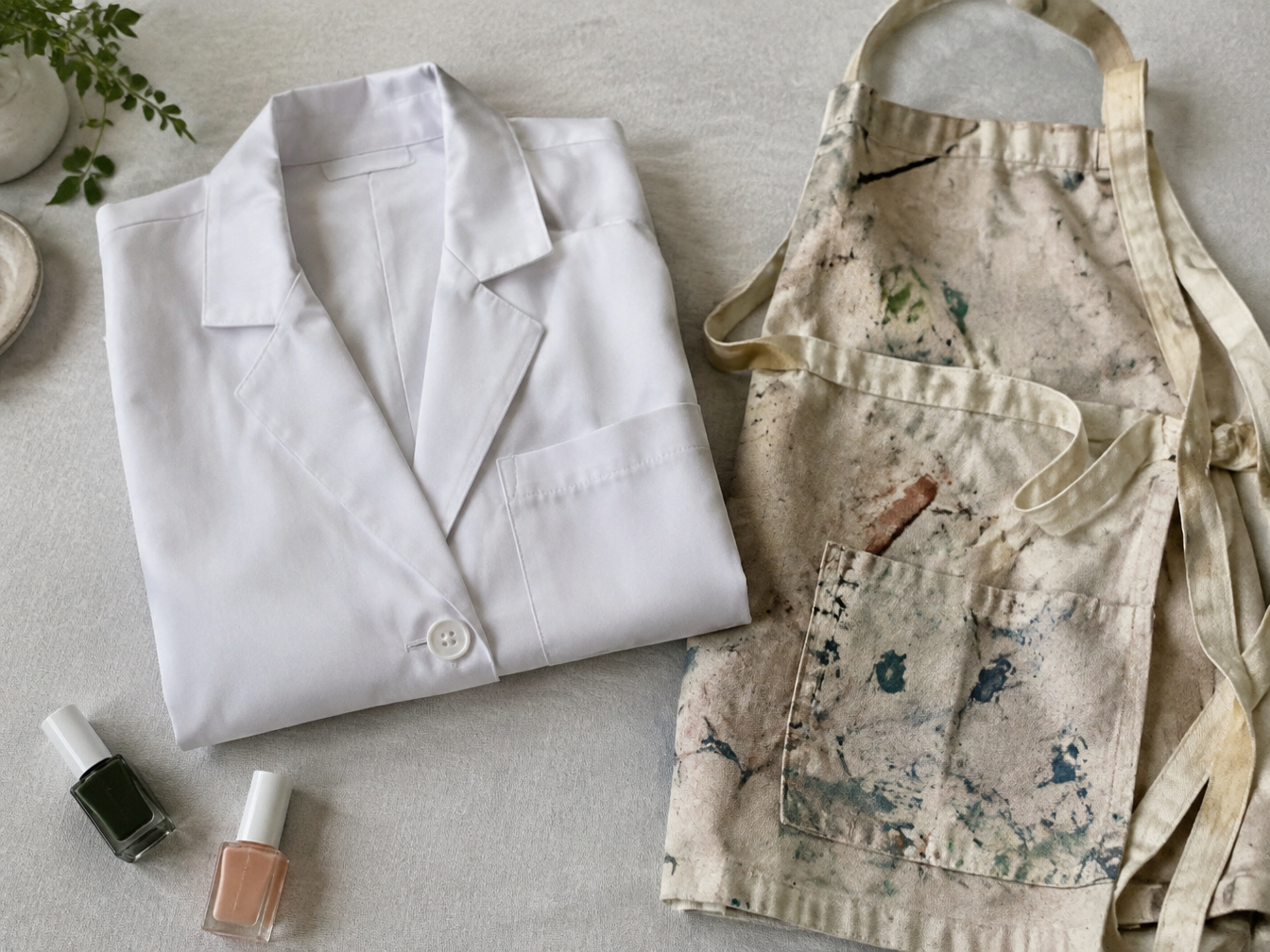
Psychologists have a name for the way what we wear affects the way we think. Hajo Adam and Adam Galinsky called it enclothed cognition in 2012, after an experiment in which students wearing a white coat described as a doctor’s coat did better on an attention task than students wearing the same coat described as a painter’s [2].
I should be careful here, because this research has had a rocky road. Some later studies did not reproduce the original lab coat results, including a preregistered replication in 2019, and the original authors have argued that the broader idea still holds [2]. So I will not tell you that red nails will make you more assertive in a meeting. That would be a lie of the exact kind this whole essay is about.
What I will say is that the symbolic meaning of an item matters, and a nail color is a small symbol we get to choose. The act of choosing may do more than the color itself. You looked at yourself, decided what you wanted to signal, and carried it out with your own hands. That is practice at being someone who decides.
And deciding is a muscle. Plenty of us go weeks without making one choice that is purely for ourselves. We pick the restaurant everyone can agree on, the shirt that will not draw attention, the answer that keeps the peace. A nail color is a rare decision with almost no consequences and no committee. Nobody needs to approve it. If you hate it, it grows out.
Seasonal nails make this very obvious. People who go all in on Halloween nail designs are not secretly believing the spiders will protect them. They are playing, and play is its own kind of medicine.
When a Manicure Carries a Bigger Meaning
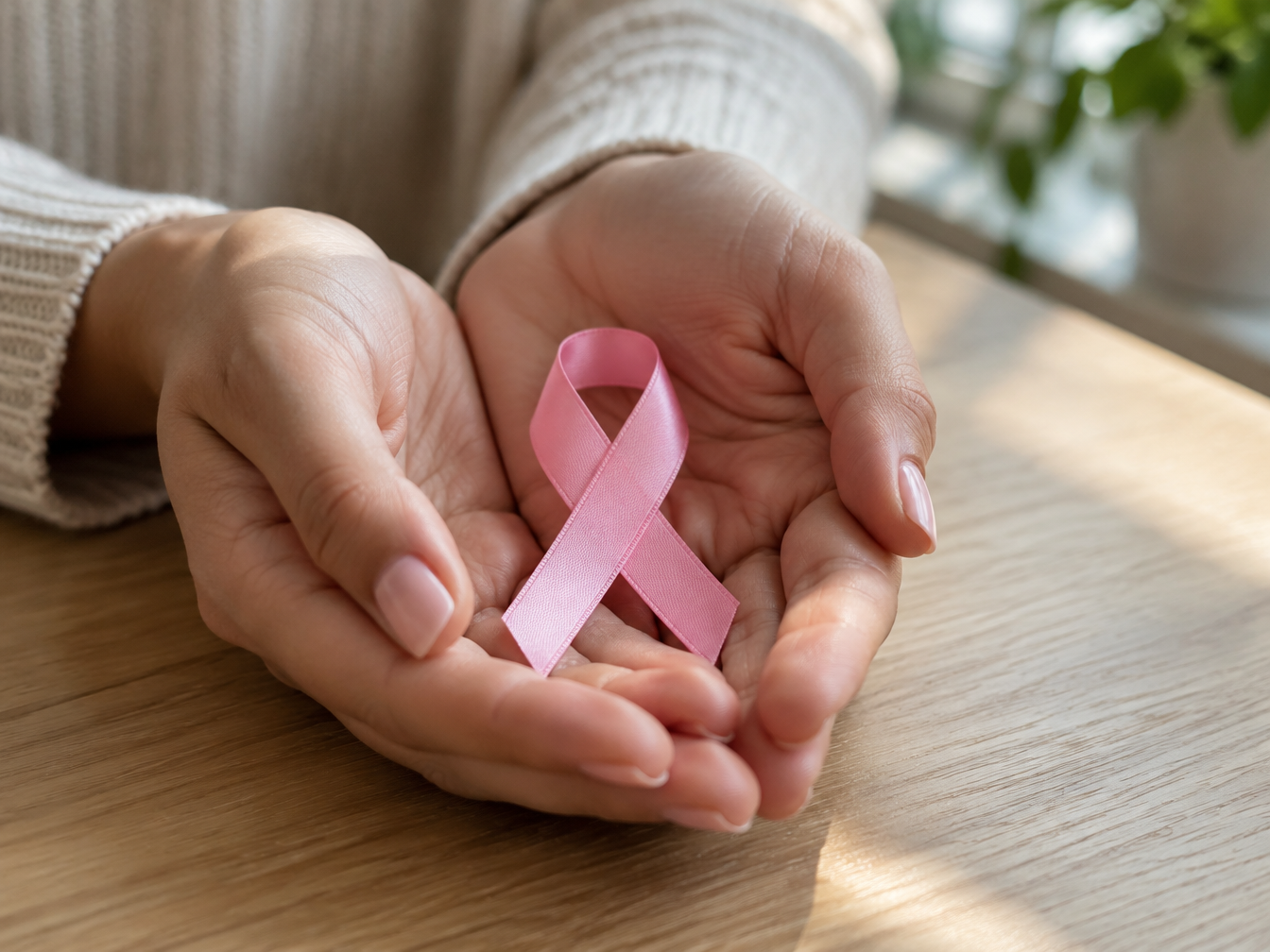
Some nail colors do carry weight. A pink ribbon manicure in October is rarely just a manicure. It can be a way of saying a name out loud, or of carrying someone into a room with you. I put together some ideas in a list of breast cancer awareness nail ideas for exactly that reason, because the best ones are personal.
The same goes for the nails women do before something big. A job interview. A wedding. A court date. A funeral. The weeks before a major life moment are full of small rituals, and the hair appointment and the nail appointment are the most common ones. I wrote about the hair side of that in what women do to their hair before a big life moment, and the logic transfers. When everything important is out of your hands, you grab the thing that is literally in your hands.
So Why Does Everyone Keep Doing Them
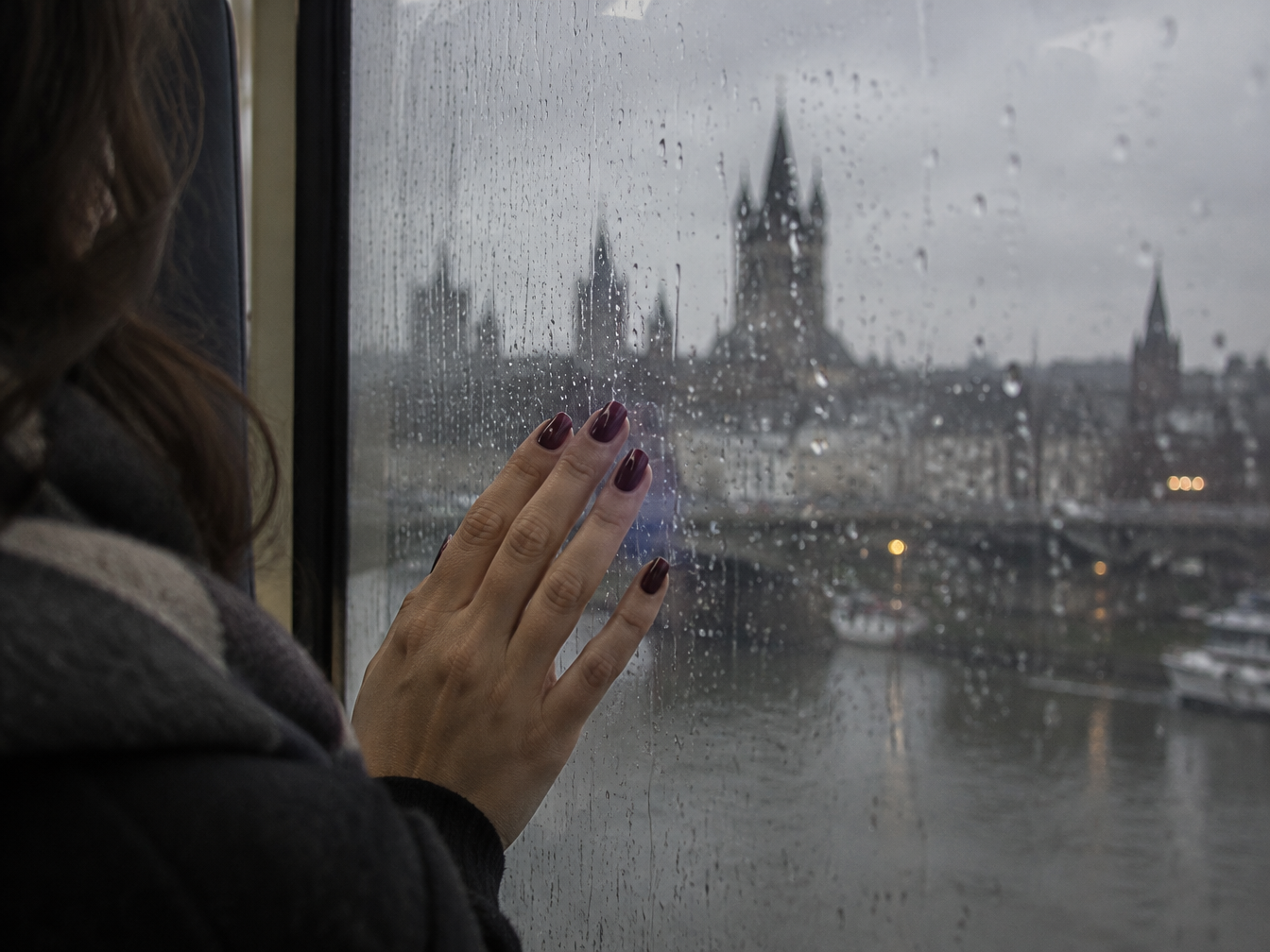
Because the loop is short, and the reward is visible. Because you can change your mind in two weeks and nothing is ruined. Because it is one of the few forms of control that costs less than a therapy session and takes less time than a workout.
Because we are tired, and a beautiful thumbnail catches the light on a gray day. Because someone on the train says “love that color” and it is the only kind thing anyone said to you all week.
And because, quietly, we know the polish is not the point. It is the proof that for one hour, someone looked after you, even if that someone was you.
There is a thing I noticed after I stopped hiding behind everything for a month. I wrote about it in my 30 days without makeup. I expected to miss the foundation. What I missed was the ritual. I missed having a reason to sit with my own face. Nails are the ritual I kept.
Keep the Color, Drop the Pressure
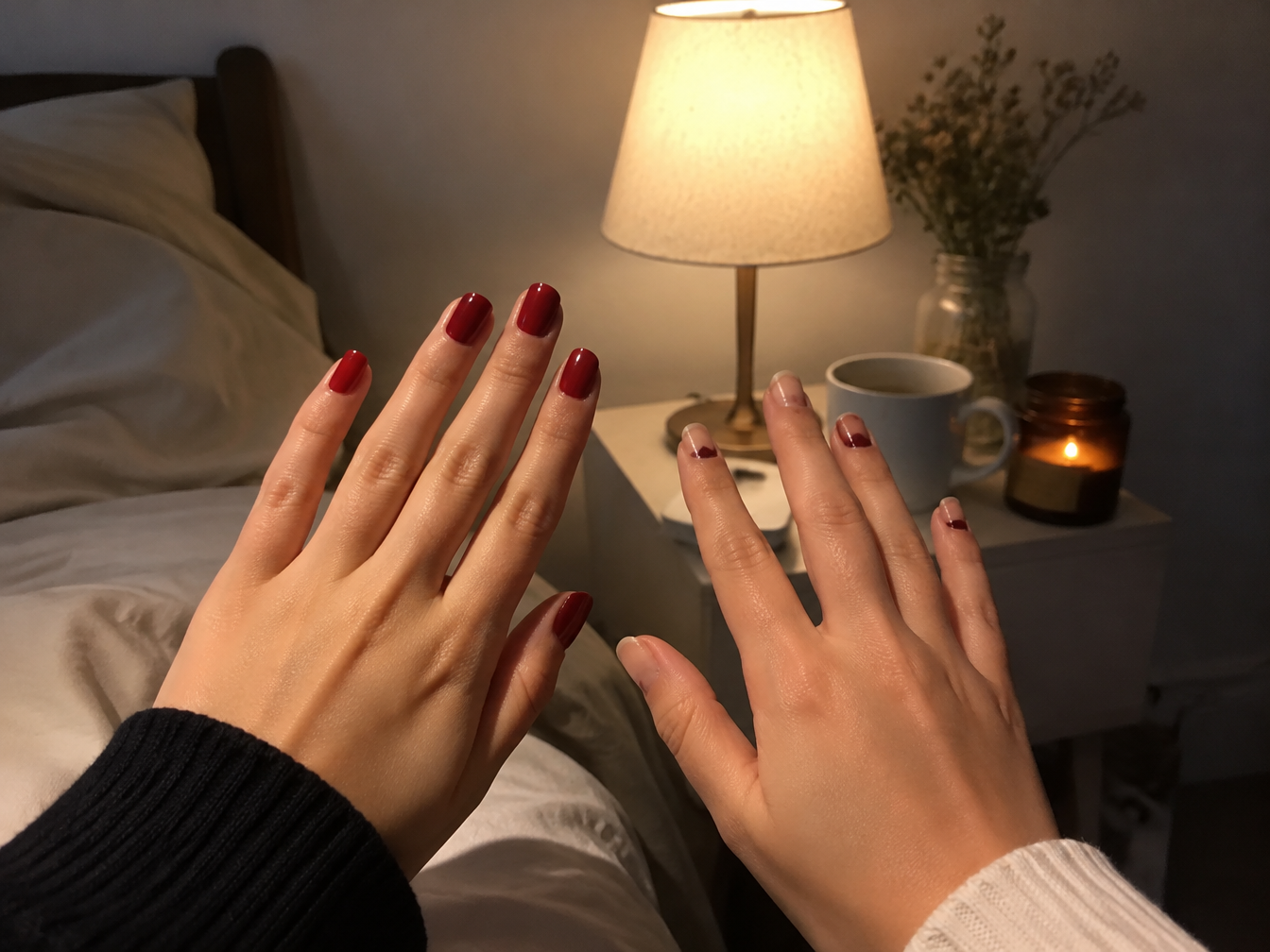
So here is where I landed, in the bathroom stall and since.
Paint your nails because you like them. Paint them in the bad weeks without apology. Pick the color that matches the woman you want to be on Thursday, or the one that matches the woman you are right now, whichever feels kinder.
But do not hand your whole life to a bottle. The color is a small door, not the house. Walk through it, take a breath, and then go do the harder thing with your freshly dry hands.
My cherry red chipped by Friday. I was still okay.
Sources
- Kawakubo, A. and Oguchi, T. “Salon nail care with superficial self-disclosure vitalizes psychological state.” Frontiers in Psychology, 2023. https://www.frontiersin.org/journals/psychology/articles/10.3389/fpsyg.2023.1112110/full
- “Enclothed cognition.” Wikipedia, citing Adam and Galinsky (2012) and later replications. https://en.wikipedia.org/wiki/Enclothed_cognition
Leave a Reply