I took my hat off in the lobby of my own office building and watched a stranger’s eyes travel upward. Not to my face. Over it. To the halo of hair lifting off my head like it had somewhere better to be.
I knew before I touched it. The crackle against my palm. The strands that followed my hand away from my scalp like they were begging for a ride. Underneath, the part that had been squashed by the hat lay flat against my skull with a crease running through it like a seam. Flat on top, wild at the ends, a lopsided little crime scene.
I did what I always did. I speed-walked to the bathroom, bent over the sink, wet my fingers and tried to erase it before anyone could see. Four minutes later I came out looking exactly like a woman who had just wet her hair in a bathroom sink.
That winter I started noticing how much of my morning energy went into one specific fear, which was that someone would catch my hair doing something I hadn’t approved. Static, frizz and hat hair are tiny problems. They are also a surprisingly accurate map of how I felt about being seen.
The Morning My Hair Stood Up Against Me
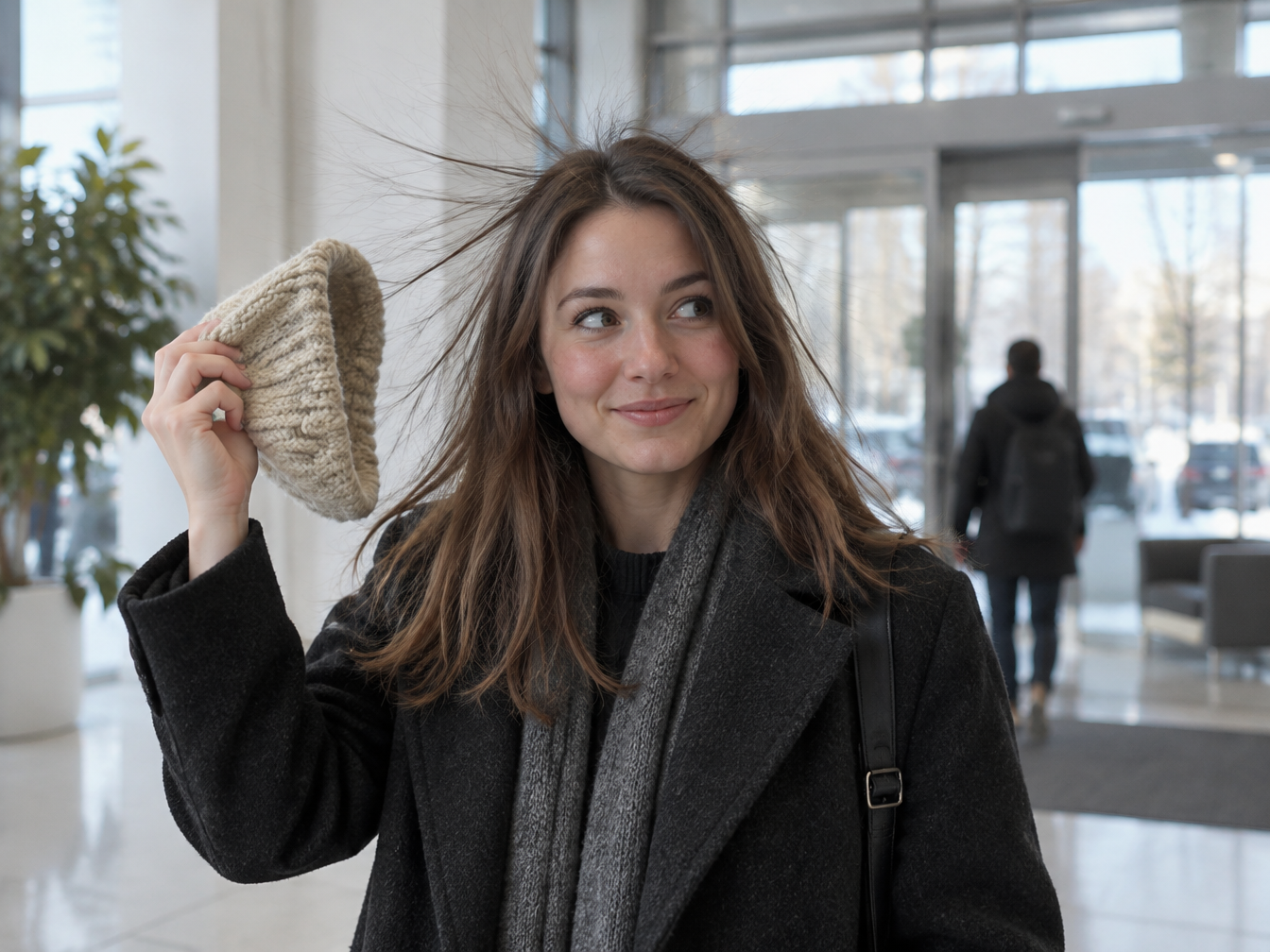
The worst one happened in January, on the day of a presentation I had been dreading for two weeks. It was nine degrees outside. I had blow-dried my hair into a smooth, shiny curtain, put on a wool beanie because my ears were going numb, and walked eleven minutes to the train with my head down against the wind.
By the time I sat down at my desk, the curtain was gone. The top was flat. The sides were electric. Every time I moved my head, a few strands floated toward my laptop screen and stuck there, waving at me.
I had done everything right, and my hair had gone off-script anyway. Forty minutes of work, undone in eleven. It felt personal, like the weather had read my notes and decided to disagree.
A friend of mine, the kind who says things out loud that other people think quietly, looked at me across the desk and said, “You look like you just got off a roller coaster. It’s kind of cute.” I did not find it cute. I found it humiliating. She found it hilarious. We were both looking at the same hair.
That gap between her reaction and mine is the whole story, really. But I didn’t see that yet. First I needed to understand why my hair was doing this.
What Static Actually Is and Why Winter Makes It Worse

Here is the part that made me feel slightly less betrayed. Static hair is not a sign that you did something wrong. It is physics.
Static electricity happens when two different materials rub together and electrons move from one to the other. One side ends up with a positive charge and the other with a negative charge. Hat hair is the textbook example: your hat rubs against your strands, they swap electrons, and a charge builds up on your hair [1].
In humid air, that charge drains away without you ever noticing. In dry winter air, it has nowhere to go. Electric charges don’t travel well through water, and winter strips the water out of everything, including the air and your hair. So the strands, all carrying the same charge, push away from each other. That is the halo. Your hair is, in the most literal sense, so full of electrons it can’t stand itself [1].
I read that and felt something loosen in my chest. My hair wasn’t misbehaving. It was reacting to a cold, dry room the way my skin was reacting to it, the way my lips were, the way my whole body gets a little tight and brittle in January. I had been angry at my hair for something my entire life was doing in the winter. I wrote about that other version of the season, the cracked hands and the tears in the bathroom, in the story about winter skin that finally got help, and the hair was the same story in a different costume.
Hat Hair and the Lie of the Perfect Walk-In

Hat hair deserves its own small funeral.
According to the stylists at one salon brand, a hat presses your strands flat against your head and creases them in place, while the natural oils at your roots collect and glue everything down even more. Meanwhile, the friction of the hat against your hair builds static, lifting pieces and creating flyaways [2]. So you get flat and fuzzy at the same time, which feels like a personal insult, but is just two separate things happening at once.

One thing worth saying, because I spent years half-believing it: hat hair does not cause hair loss. That old belief has been around forever, but thinning is caused by things like genetics, medical conditions and hormonal changes, not by your beanie [2]. If thinning worries you, that is a conversation for a dermatologist, not a reason to freeze your ears off out of fear.
What does matter is the hat itself. Stylist Kien Hoang told HuffPost that skull caps, beanies and tight trapper hats are the worst offenders because they force hair tight against the head, which can make the scalp sweat and the hair even flatter. Looser shapes like berets and floppy styles are kinder, and synthetic materials make static worse [3]. Another brand recommends silk or satin linings so hair can glide instead of grab [1].
I bought hats based on how they looked in the store mirror, then blamed my hair for what happened on the walk home. The hat was always going to do what it did. The surprise was mine.
The Small Rescues That Actually Worked

Once I stopped being mad and started being curious, I collected a handful of tricks. Some are boring. All of them worked better than the bathroom-sink method.
The first was making sure my hair was completely dry before a hat went anywhere near it. Even slightly damp hair is soft and moldable, and it will dry in the exact shape of whatever is sitting on top of it [2][3]. That meant a final blast of the dryer, which I resented, and a result I did not.
The second was a loose braid or a sleek ponytail under the hat. It keeps the strands from molding to the hat, and it takes ten seconds to undo when you arrive [2]. I started pairing this with a claw clip in my bag so I could pin things back up if the day required it. There is a whole world of claw clip hairstyles that look intentional if you want ideas for what to do when you take the hat off.
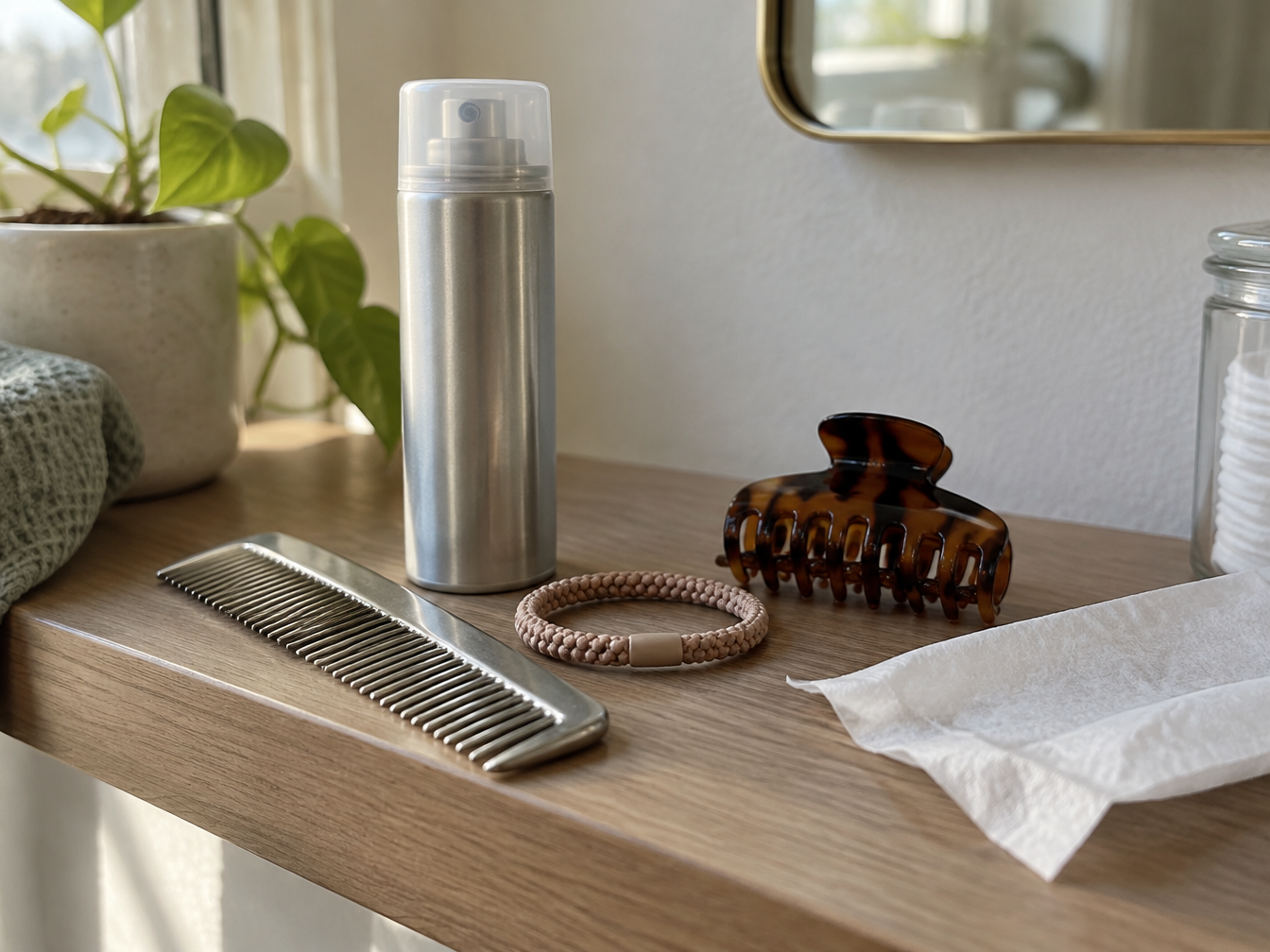
The third trick is the one that made me feel like a witch. Spray a little flexible hairspray on a metal comb and run it from root to tip. The hairspray tames flyaways without crunch, and the metal pulls the static charge into itself instead of leaving it in your hair [1]. I swear the first time I did it, I heard the crackle stop.
Two more live in my bag now: a small leave-in for the ends, because moisture is the long-term fix for static [1][3], and a dryer sheet wiped lightly over the top layer when the hat comes off [2]. And never brush it out. Dry brushing just creates more static, while fingers and a flip of the head do better [2][3].
What Frizz Was Trying to Tell Me
Frizz is the one I took the most personally, because it showed up on the days I least wanted a witness. Before a date. Before a job interview. In every group photo where I was trying to look like the kind of woman who has her life together.
For years, I read frizz as evidence. Evidence that I was careless, or not trying hard enough, or too much of something. If my hair was smooth, I was a person with a plan. If my hair was frizzy, I was a person who had lost the plot.
The thought stopped making sense after a day when I spent so long taming my hair that I arrived late, tense and sweaty, and the only thing anyone remarked on was how stressed I seemed. My hair was fine. I was a wreck.
That is when the real pattern came into focus. The frizz had not been announcing my failure. My own reaction to it had. Everything I did to prevent it, the extra forty minutes, the three products, the cancelled plans on humid days, was costing me more than the frizz was. I wrote something similar about the days when everything seems to go wrong with your hair in why a bad hair day is never really about your hair, and I think what I figured out here is the same lesson with a smaller audience: the hair is rarely the problem.
The Version of Me Who Fixed Everything Before Leaving the House

There was a woman I used to be, and I want to describe her kindly.
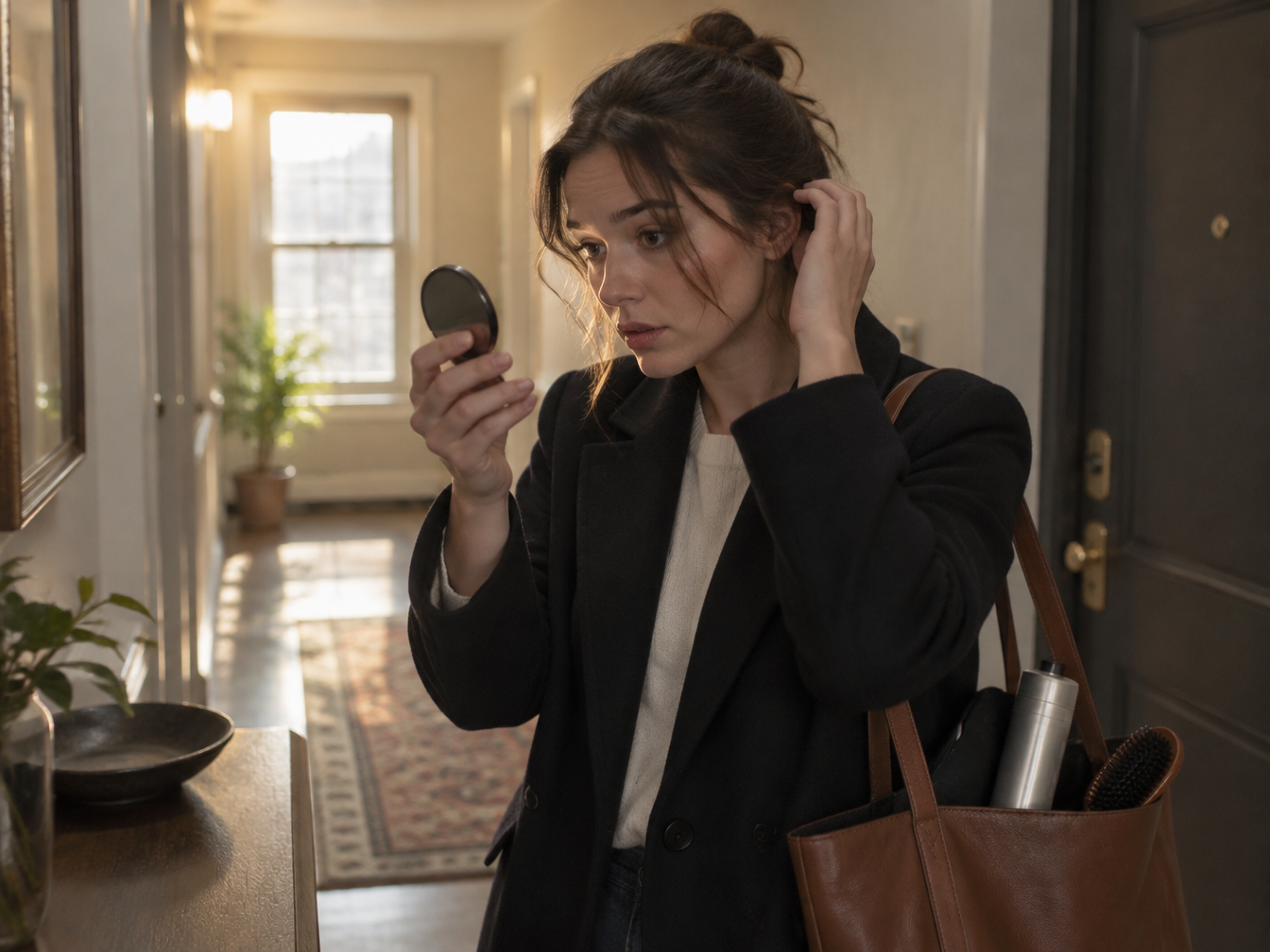
She woke up early so she could fix things before anyone saw them. She carried a travel hairspray, a mini brush, a clip, a hair tie and a tiny bottle of serum, not because she needed all of them but because she needed to feel like she had a plan for every possible version of her hair. She checked reflections in car windows. She touched her head in elevators.
She was not vain. She was scared. She had learned somewhere that a person who looks put together is a person who is allowed in, and she was afraid that one wrong strand could take her allowance away.
I’d just tell her to sit down and have the coffee. A lot of us carry a version of her around, the woman who prepares for the room and forgets she is in it.
This is the same woman who shows up in the way we get ready for big moments in our lives, doing a hundred small things to our hair before the day it counts. I explored that in what women do to their hair before a big life moment, and what struck me was how often those rituals are less about hair and more about asking the universe for a little mercy.
Letting the Mess Walk Into the Room
The change didn’t happen on one dramatic day. It happened on a Tuesday, in February, when I walked into a meeting with my hat hair fully intact and just sat down.
My hair was flat on top and slightly electric at the ends. I could feel it. I waited for the room to react. Nobody did. Someone asked about a budget. Someone else spilled coffee. The world, as it turns out, was busy.
I think that was the first time I understood that most people are too preoccupied with their own hair to carry yours home with them. The spotlight I had been dressing for was mostly in my head. And a lot of what I’d been calling standards was really fear in a nicer outfit.
Looking unbothered and being unbothered feel similar from the outside. Inside, one is exhausting and the other is a day off.
This is also tied to what I wear to feel like myself, not the polished version, but the real one. I wrote about that in the outfit I wear when I need to feel like myself again, and I’d say messy hair has become part of that outfit now. Not a flaw I accept. A feature I have stopped apologizing for.
A Winter Rule for Messy Hair

I still fight static. I’m not a saint. I dry my hair fully, keep the metal comb in my bag, and pick looser hats with a satin lining if I can find one.
But I’ve added a rule on top of the routine, and it’s the only one that really changed things. Give yourself one fix, not ten. If my hair is doing something odd, I get one move: a flip, a comb pass, a clip. Then I’m done. I walk into the room with whatever that leaves me.
It turns out one fix is almost always enough. The other nine were never for my hair. They were for the part of me still convinced that a stray strand could undo a whole person.
So take the hat off in the lobby. Let it crackle. Let someone’s eyes wander up for a second and then drift to something else, because they will.
Your hair is not auditioning. It’s just coming in out of the cold.
Sources
- What Causes Static and How to Fight It, Redken
- How to Get Rid of Hat Hair, Davines
- Preventing Hat Hair: 4 Ways To Avoid A Flattened, Frizzy Mess This Winter, HuffPost
Leave a Reply