The Cart I Kept Opening and Closing

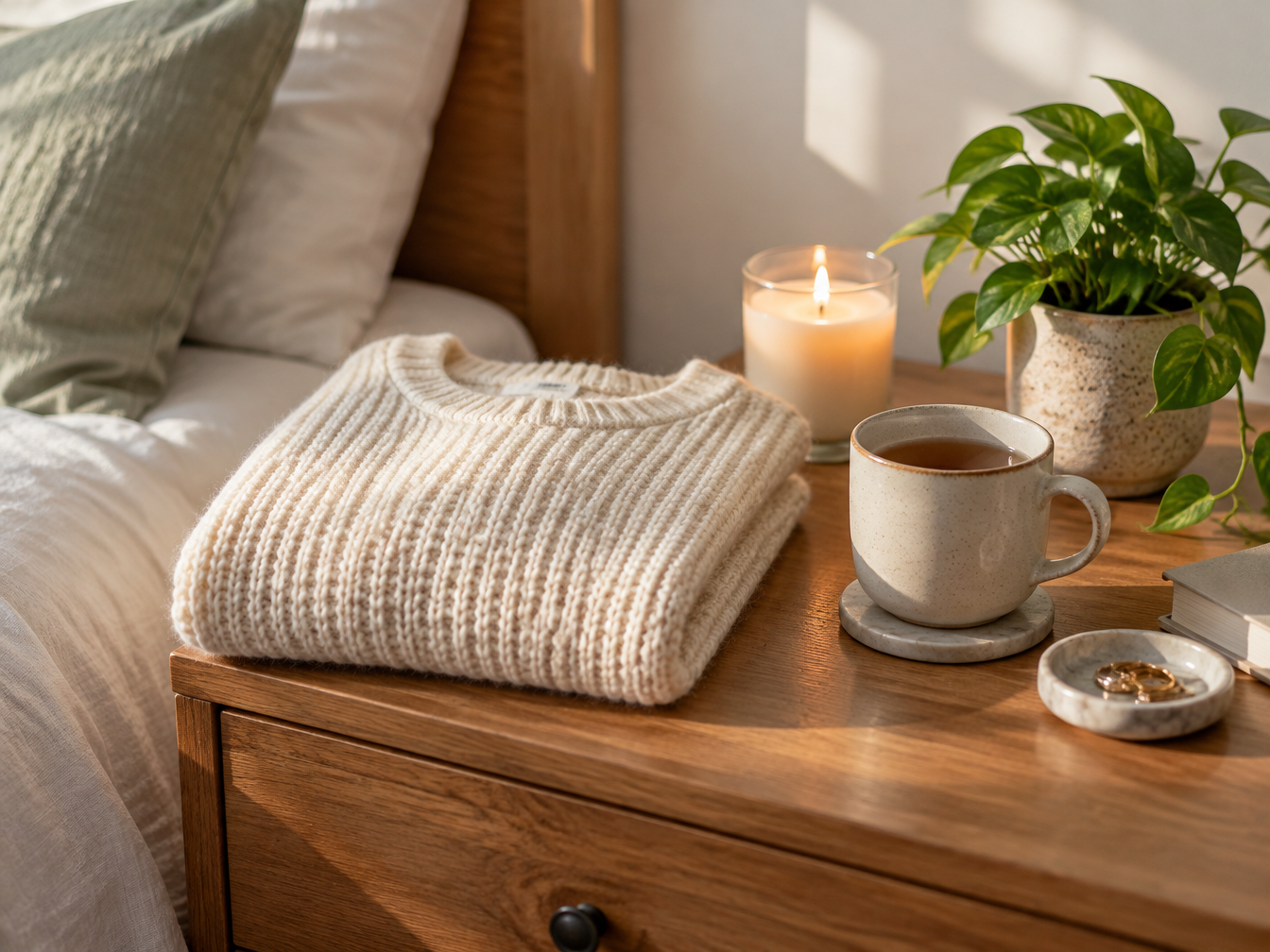
For three Decembers in a row, there was a cream colored sweater sitting in my online cart. Soft, a little oversized, the kind of knit that looks like it belongs to a woman who has her mornings sorted out. Every year I opened the tab, looked at the price, felt my stomach tighten, and closed it again.
Every year I told myself the same thing. Maybe later. Maybe after I buy everyone else’s gifts. Maybe when it goes on sale. Maybe when I have earned it, whatever that means and whoever is keeping score.
This year, on a Tuesday night with a cup of tea going cold beside me, I noticed something that made me put the phone down. I had spent the previous two hours choosing a candle for my cousin, a scarf for my aunt and a book for a coworker I barely talk to. I had researched all three. I had compared reviews. I had been, frankly, magnificent.
And I had not once opened the tab with the sweater in it.
A List of Eleven Names and Zero of Mine

I wrote the gift list the way I always do, in the notes app, with a name and a rough budget next to each one. Eleven people. Eleven little numbers. I read it over and my name was nowhere, which should not have surprised me, and somehow it knocked the wind out of me anyway.
I think a lot of us are trained for this. We learn early that the nice woman is the one who gives first and keeps nothing. We buy the thoughtful thing for everyone and then tell ourselves we are “fine” and “don’t need anything,” which is a lie wearing a cardigan.
There is a whole genre of holiday stress about getting it right for other people. If you have ever panic bought a present because you ran out of ideas, you are in good company, and a ridiculous, funny dirty Santa gift guide is basically a public record of how hard we try to please a room full of near strangers. We put so much care into the exchange for the people we barely know, and so little into the person who has to live in our body every single day.
I did not want to be that woman this year. Or rather, I did not want to be only that woman.
What Shoppers Are Actually Doing This Season

Before I get sentimental, I wanted to know whether I was being strange, so I went looking for numbers.
Deloitte’s 2026 holiday retail survey expects average household holiday spending to reach $1,654, up 4 percent from last year. Gen Z and millennials are expected to account for about half of that spending. The same coverage notes that younger shoppers are more likely to buy gifts for themselves, though it gives no percentage for how many [1]. That caveat matters to me. I will not tell you “everyone is doing it” when the source does not say so.
Other numbers felt very close to home. About 47 percent of shoppers say they would rather give one meaningful, higher cost gift than several smaller ones, and 44 percent say gift shopping is stressful [1]. Which is to say, a lot of us are tired, a lot of us are careful with money, and a lot of us want things to mean something.
So the question was never “can I afford a treat.” It was “would I feel like I was allowed to have one.”
That second question is a social one, and I think it is why December feels so loud. Everyone’s feed is a highlight reel of perfect packages, matching pajamas and a gift for every person, with no visible receipt. I have lost whole evenings to measuring my small, tired holiday against other people’s glossy ones, which is exactly the spiral I picked apart in how I stopped comparing my holiday outfit to everyone’s feed. The sweater tab was the same spiral wearing a different coat. I was waiting to feel deserving, as if deserving were a delivery date.
Why Treating Yourself Feels Hardest When You Need It Most

Here is the part that made me put my tea down. A team of researchers at Cornell, Indiana University and Duke published a paper in the Journal of Consumer Research called “No Bandwidth to Self-Gift.” They found that people who feel pressed for money, time or energy are less interested in giving themselves a treat. They assume they will not be able to focus on it or enjoy it, so they skip it [2].
Here is the twist. When the stressed participants did engage in a self gift, they reported feeling happier and more relaxed, and less stressed and less pressed for time. The researchers call it a paradox: the people who most need the break are the ones who avoid it [2].

That is me. That was the sweater tab, three years running.
I cannot tell you a sweater will fix a tough season. I can tell you that the logic I was using, “I am too stretched to enjoy this, so I will not do it,” is a pattern researchers have actually documented, and that it does not make me strange or selfish. It makes me tired. There is a difference.
The Sweater and the Three Weeks I Argued With Myself

I did not buy it that night. Do not let anyone tell you transformation is tidy.
I opened the tab, looked at it for a full minute, and then closed it again. Then I opened it the next morning. Then I put it in the cart, took it out, put it back. I spent three weeks arguing with myself in a way that would have been funny if it had not felt so heavy.
I think what I was really afraid of was the feeling that came after. I have a history with this. There was a year when I bought myself a whole Black Friday haul, felt electric for about forty minutes, and then returned almost all of it. I wrote about the Black Friday haul I returned and what I actually wanted, and the lesson was simple: buying a pile of things and buying one right thing are two different acts. One is noise. The other is a decision.
So I made a rule. One item. Something I had wanted for longer than a month. Something I would use in the first week of owning it. And I would buy it on a calm day, not on a 2 a.m. spiral.
The sweater passed all three tests. It had been on my mind for three years, which, if you are counting, is a long engagement.
The Strange Thing That Happened After I Bought It

I pressed the button on a Sunday afternoon. My hands were slightly sweaty, which is ridiculous. Then I felt something I did not expect, which was quiet. No fireworks, no guilt storm. Just a small, steady sense of being on my own team.
A few days later, a coworker asked if anyone could cover a shift, and I said yes without the usual internal sigh. I mailed a card I had been putting off for weeks. I picked up a friend’s favorite tea on the way to see her, for no reason at all.
I assumed I was imagining it, so I went looking, and found a 2026 paper in the International Journal of Research in Marketing, summarized by one of its authors at BI Norwegian Business School. Across seven experiments with nearly 2,800 participants, people who freely chose a small pleasure later volunteered more and shared more than people who were handed the same experience. In two studies, self compassion explained the extra giving, and positive mood did not [3].
The authors are careful about limits. The pleasure has to be a real one, and the request afterward has to be modest, because the effect on volunteering faded when it required an hour of travel [3]. I find that oddly reassuring. It means there is no magic trick. It means that choosing something kind for yourself, on purpose, can make it easier to be kind to other people, and that you do not have to go broke or go overboard to get there.
I cannot say my coworker coverage was caused by a sweater. I can say the timing made me think.
What I notice now is how much of my generosity used to come from a kind of low grade panic. I gave because I was afraid of being the person who did not, the same way I once bought a holiday party dress to impress someone who was not even invited, and that is a very different feeling from giving because I had something left over. One of them is a debt payment. The other is a gift. People can usually tell the difference, even when they cannot name it, and so, I suspect, can the giver.
How to Pick a Gift for Yourself That Is Not Just Another Purchase
If you are standing where I stood, here is what worked for me, and none of it requires a big budget.
Choose Something You Have Wanted for a Month or More
Impulse is not the same as desire. A month of wanting is a good filter, and it usually separates the thing you need from the thing a sale email told you to need.
Pick One Thing and Make It a Ceremony
Open it slowly. Wear it, use it or taste it on the first possible day. A treat you shove in a drawer is just storage with extra guilt.
Make It About Rest, Not Reward
Maybe the gift is not an object at all. It might be a morning with no alarm, a blow out, a long bath or a full evening without a phone. I have found that the best self care habits are small and repeatable, which is part of why I keep a self care Sunday even when it feels like a chore.
Say It Out Loud
Tell one person, “I bought myself something nice.” The point is not to ask permission. The point is to practice saying it without flinching.
The Gift I Gave Everyone Else the Same Day

The sweater arrived on a gray Thursday, in a bag that was far too big for it. I put it on in front of the mirror and stood there longer than I would like to admit.
It fit the way I had imagined it would. A little loose, a little soft, warm in a way that felt like a deliberate act of care. I did not look like a different person. I looked like me, only slightly more held.
That afternoon I wrapped the candle for my cousin, the scarf for my aunt and the book for my coworker. I found myself taking my time with the ribbon, which I never do. I think it was because I was not resentful. When you have given something to yourself, you stop handing out gifts as a way to prove you are good.
It reminded me of something I wrote after a long season of trying to take better care of my skin and my nights, in a piece about the skincare routine that made me realize I was treating myself like a project. I used to treat myself like a to do list, always improving, never resting. A gift, I have decided, is the opposite. It is the moment you stop fixing yourself and simply say, you are already worth this.
This season, put your own name on the list. You are allowed to be the person who gets wrapped something soft.
Sources
- Holiday Spending to Rise 4 Percent in 2026, According to Deloitte, Vision Monday. https://www.visionmonday.com/business/research-and-stats/article/holiday-spending-to-rise-4-percent-in-2026-according-to-deloitte/
- This Holiday, Is Self-Gifting on Your Radar?, Cornell SC Johnson College of Business. https://business.cornell.edu/news/2022/12/07/self-gifting-research/
- Treating Yourself Makes You Generous, BI Norwegian Business School. https://www.bi.no/en/research/business-review/articles/2026/10/treating-yourself-makes-you-generous/
Leave a Reply