I was standing in front of my closet on the first of December, holding a green velvet dress I had loved for six weeks, and I hated it. Nothing had changed about the dress. What changed was that I had spent twenty minutes scrolling through other women’s holiday posts, and now my dress looked like a costume from a school play.
Everybody online seemed to have found the perfect thing. Satin slip skirts with chunky knit sweaters, matching sets in colors I didn’t know had names, a whole parade of women who looked like they had been born knowing what to wear to a Tuesday cocktail hour. I put the velvet dress back on the hanger and felt something I hadn’t expected to feel over fabric. I felt behind.
The Night I Dressed for People Who Weren’t Invited

Last year I bought a new outfit for a work party I was already dreading. I didn’t love it. I bought it because it matched a photo I had saved, a woman in a camel coat and tall boots standing in front of a very tasteful Christmas tree. I wanted to look like her, or more exactly, I wanted to look like I had a tasteful Christmas tree.
At the party I spent most of the night adjusting the collar. It was stiff in a way the photo hadn’t warned me about. A coworker I like complimented my earrings, and I realized those were the only part of the look that was mine. Everything else was a rehearsal for an audience that wasn’t in the room. I had written a whole dress I bought to impress someone who wasn’t even invited before, and here I was doing the same thing again with a different dress and a different ghost.
The strange part is how normal it felt. We talk about getting dressed as if it is a private decision, but a lot of us are quietly getting dressed for a jury. The jury is made of strangers with ring lights and good angles, and nobody ever told them they were on it.
I think about my mother at my age, getting ready for the same kinds of parties. She had one good dress, one pair of pearl studs, and a lipstick she bought in 1994. Nobody was comparing her to a thousand other women before she walked in the door. She just walked in. I’m not saying her way was better, only that it was quieter, and I envy the quiet more than I envy any dress.
Seven Minutes Was All It Took
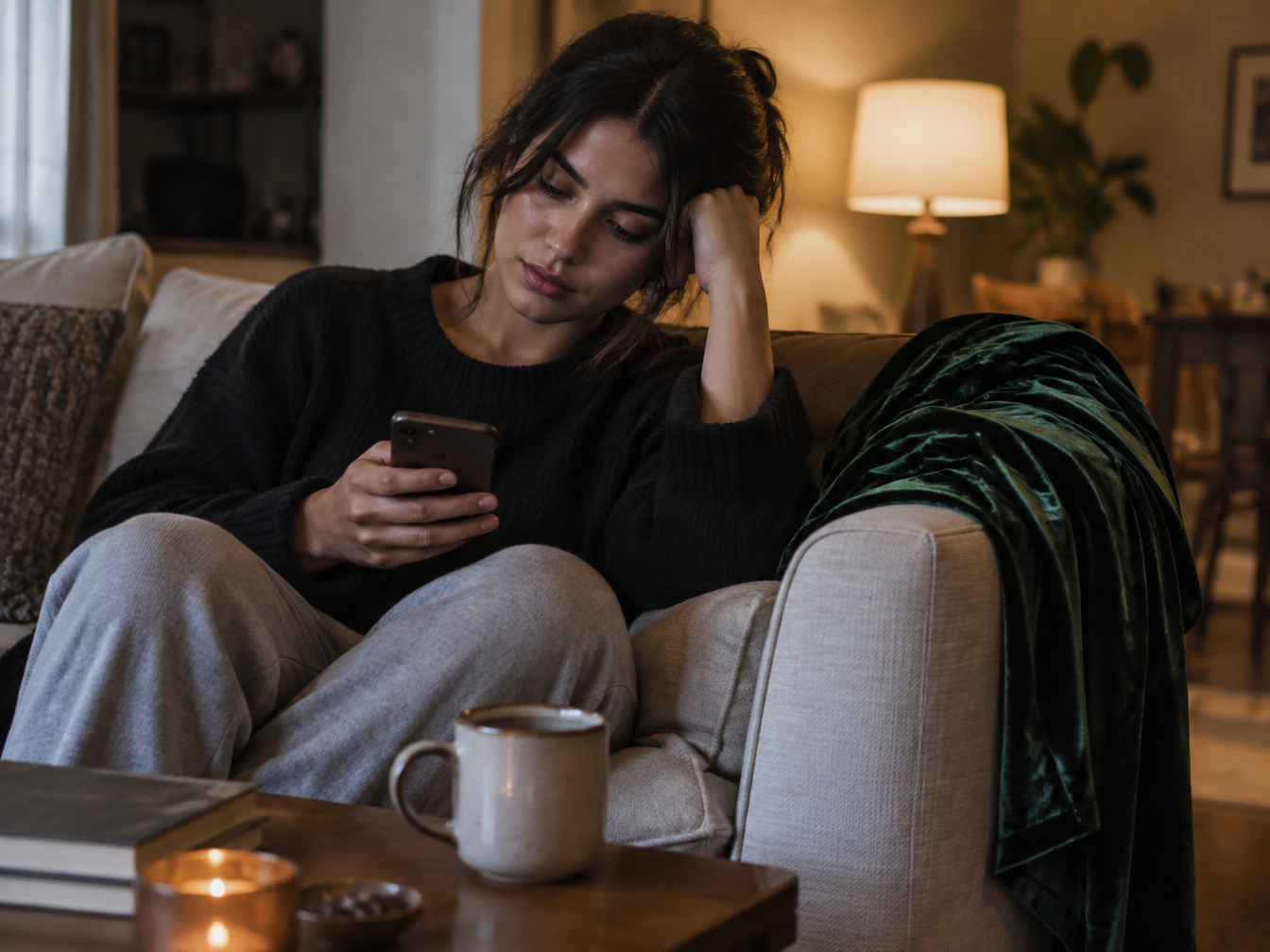
I used to think my comparison habit was a personality flaw, some leftover insecurity I could fix with enough willpower. Then I started reading about how this actually works, and it turns out my brain was doing exactly what the apps were built to make it do.
Researchers at Northwestern University’s Body and Media Lab ran a study in which young women were randomly assigned to spend seven minutes on Instagram or on Facebook. The Instagram group thought about their appearance more, compared themselves to others more, felt worse about how they looked, and reported more negative moods [1]. Seven minutes. That is less time than it takes to find a clean pair of tights.
Another group of researchers asked 150 young women to fill out short surveys five times a day for five days, noting every time they compared their looks to someone else’s. Social media comparisons left women in the worst mood, and they mostly decided the other person looked better than they did [2]. The researchers pointed out something that made me laugh and wince at once: women mostly post the best, most edited version of themselves, so the comparison is rigged before it starts.
It also shows up in the holiday numbers. Healthline reports that nearly nine in ten U.S. adults feel stress during the holidays [3]. Put an endless stream of other people’s perfect-looking evenings on top of that and you have a very efficient way to feel like the only one who is struggling. It is the same trap that pushed me to stop buying trends and build a wardrobe that sounds like me, and I’m still climbing out of it.
What the Feed Leaves Out
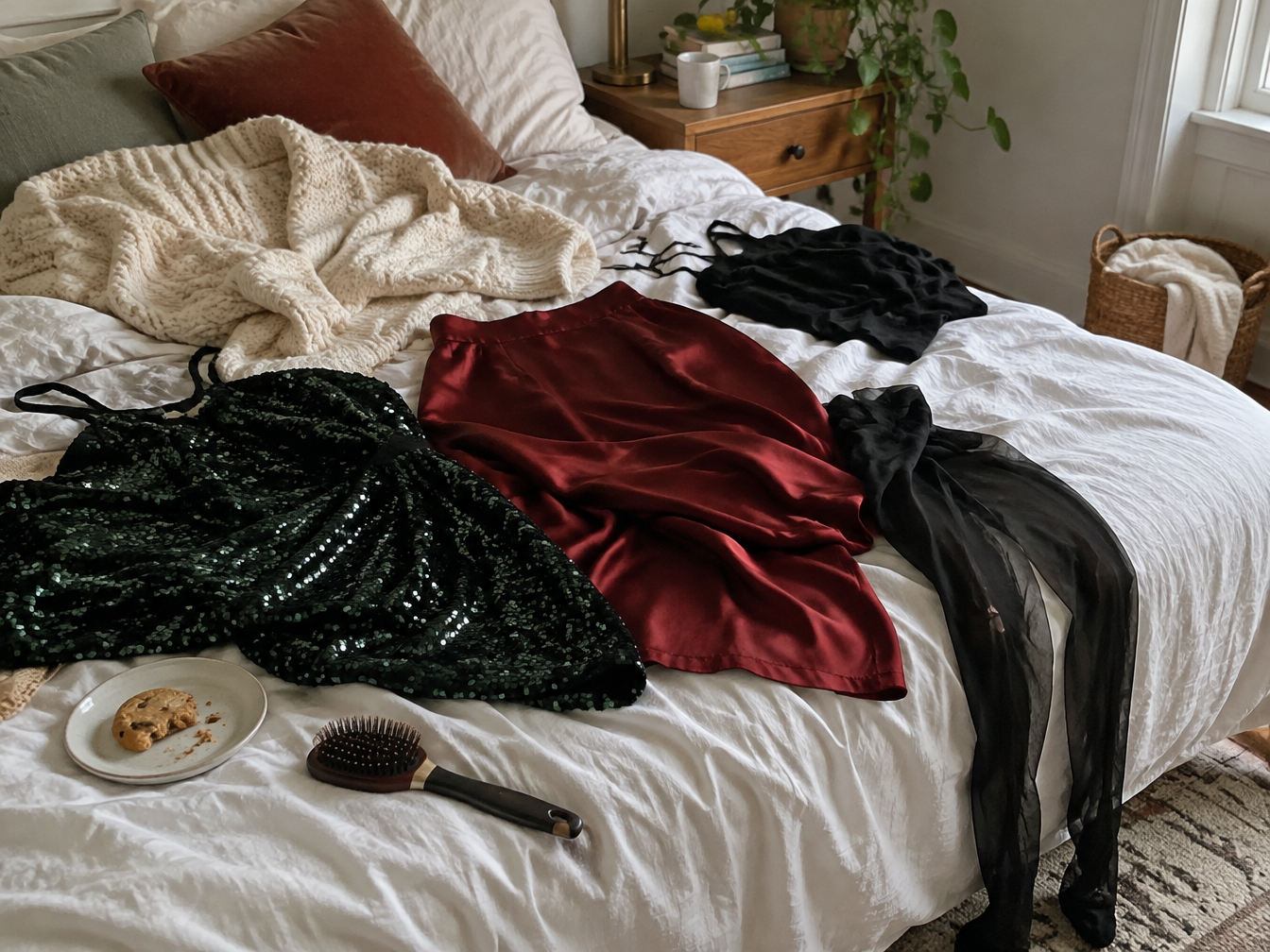
Here is a list of things I have never seen in a holiday outfit post. The woman who changed four times and ended up in the first thing. The tights that ripped in the car. The blow-out that collapsed in the cold between the front door and the party. The spilled red wine, the stuffed-up nose, the three photos she took before one didn’t look tired.
Every outfit I admired online had a whole invisible week behind it, and I was comparing my messy Tuesday to somebody’s highlight reel. It sounds obvious written down. In the moment it doesn’t feel obvious at all, because the pictures are so clean and your own closet is so full of real life.
I started a small experiment. Every time a post made me feel behind, I asked what I was actually admiring. Most of the time the answer was a feeling, not an item. I wasn’t coveting the satin skirt. I was coveting the ease, the confidence, the look of a woman who isn’t worried about being found out. You can’t buy that at any price, which I know because I tried.
There’s a second thing the feed hides, and it is money. A lot of those polished holiday looks are borrowed, gifted, or bought and returned the next morning. The woman in the photo may be wearing something she will never wear again, styled for a three-minute video. Meanwhile I was ready to put a real purchase on a real credit card to match a picture that was never meant to be lived in. Ask me about the Black Friday haul I returned and what I actually wanted underneath it.
The Rules I Made Instead
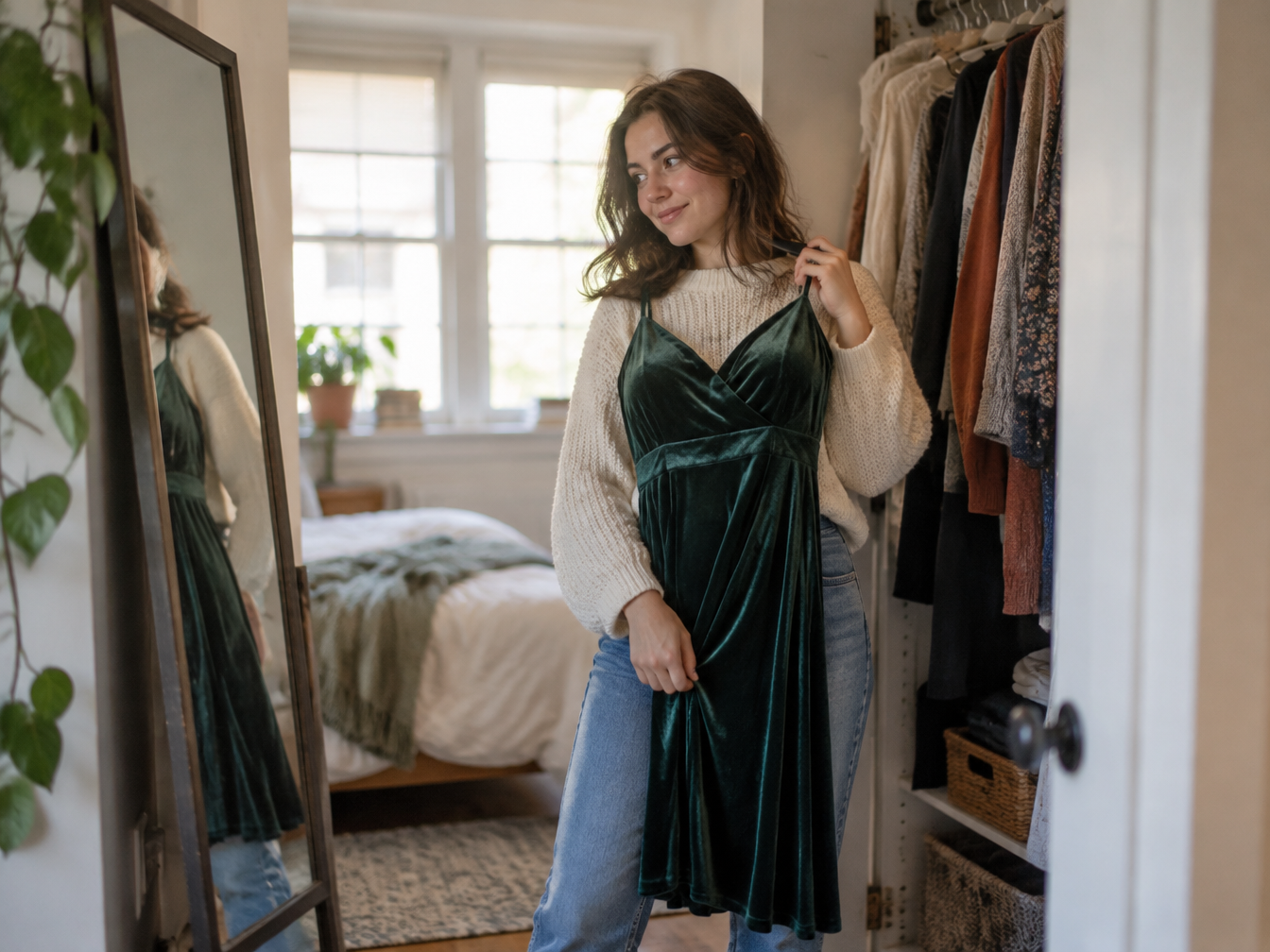
I didn’t delete my apps. I’m not that brave, and the apps are not the villain of this story. I just made a few rules, small enough that I would actually keep them.

Rule one was no outfit research after nine at night. Late-night scrolling is where my confidence goes to die, and nothing I buy at midnight survives daylight. Rule two was unfollowing anyone whose posts made me feel smaller within three seconds. It wasn’t personal, and the Conversation piece I read suggests the same idea, that unfollowing people who post highly edited, idealized images can reduce the sting [2]. Rule three was that every outfit has to pass what I call the “would I wear this if nobody photographed it” test.
That third rule did the most work. When I held up the green velvet dress and asked the question, the answer was an immediate yes. I’d wear it to a quiet dinner. I’d wear it to my sister’s kitchen. I’d wear it on a Sunday just because it feels like being wrapped in a good secret. That’s the part no feed can show you, how a dress feels on the inside.
A friend of mine adds a fourth rule I’ve since stolen. She picks her outfit the day before, tries it on with the shoes, sits down in it, and then leaves it alone. No second-guessing on the day, no last-minute swap after a scroll. Decisions made in daylight with a clear head tend to be kinder than decisions made in a panic with a phone in your hand.
If you’ve been copying other people’s taste for a while, it’s worth going back to the basics of finding your personal style after years of copying everyone else. It gave me a few questions I now ask in front of the mirror, and none of them involve what anyone else is wearing.
Dressing for the Room I’ll Actually Be In

For years I got dressed for an imaginary audience of thousands. This season I tried getting dressed for the actual room, which is usually about eleven people, a lopsided tree, and a dog who wants cheese.
That changes the math completely. The actual room does not care if my skirt is the viral one. The actual room cares if I’m warm, if I can sit on the floor and play cards with my nephew, if I can reach the appetizers without a wardrobe adjustment. When I started with comfort and let the personality come second, I wore my favorite thick tights, a soft sweater the color of oatmeal, and the green velvet skirt from the dress I had given up on, turned into two pieces. I felt like myself in a room full of people who already like me.
There is a quiet kind of luxury in that. I have written before about why getting dressed for your own company is the best holiday gift, and this is the family-sized version of the same idea. You show up warmer, looser, and more present, and people respond to presence far more than they respond to a perfect hem.
It also makes dressing cheaper and faster. I pulled three outfits from what I already owned, laid them on the bed, and picked the one I’d be happiest to sit in for four hours. The whole thing took ten minutes, a record for me in December, and I never once opened an app to decide.
Making Peace With Photos

The hardest test is always the camera. Somebody holds up a phone, everyone squishes together, and my brain goes straight back to the feed. Does my hair look right, is my face doing the weird thing, will this one be the one I regret.
What helped was a small shift in what I thought the photo was for. A holiday photo isn’t a submission to the jury. It’s a note to future me, and future me will not care that my bangs were slightly off. Future me will care that my grandmother is laughing in the corner of the frame. If you still find cameras hard, I think you’ll relate to how I learned to love my face in photos after years of hiding.
I also stopped checking the first photo for flaws. I look at it once, find the person I love most in the picture, and put the phone down. It sounds almost too small to work, but it changed how I stand in group shots. I lean in now instead of hovering at the edge.
The Outfit I Wore Anyway

On the night of the party, I wore the green velvet and the thick tights and a pair of earrings that were my mother’s. I added a soft, slightly smudged glittery eye I’d learned from a soft glam makeup look for holiday parties, the kind that looks like you on a very good night rather than someone else on a very good day.
Nobody gasped. Nobody asked where I got it. Someone did say I looked happy, which is the compliment I would pick over every other compliment if I got to choose. I spent the night talking, not adjusting. At one point I realized I hadn’t thought about my outfit in two hours, and that, more than any fit or fabric, is what I think great style feels like. It’s the moment the clothes disappear and the person stays.
I still scroll. I still see a gorgeous look and feel the old twinge. The difference is that I can name it now. The twinge is information, not instruction. It tells me what I’m hungry for, and it’s almost never a skirt. Some nights it’s rest. Some nights it’s belonging. Once, memorably, it was a nap and a better winter coat, and I’m still annoyed at how right that was.
Wear the green velvet. Nobody at the table is grading it, and the only person who was ever keeping score was you.
Sources
- Why Instagram Is Worse for Body Image Than Facebook, Psychology Today (Renee Engeln, Northwestern University Body and Media Lab)
- Social media shots affect body image because we only show our best side, The Conversation
- 6 Tips for Managing Holiday Stress, Healthline
Leave a Reply