The Mirror in My Parents’ Hallway
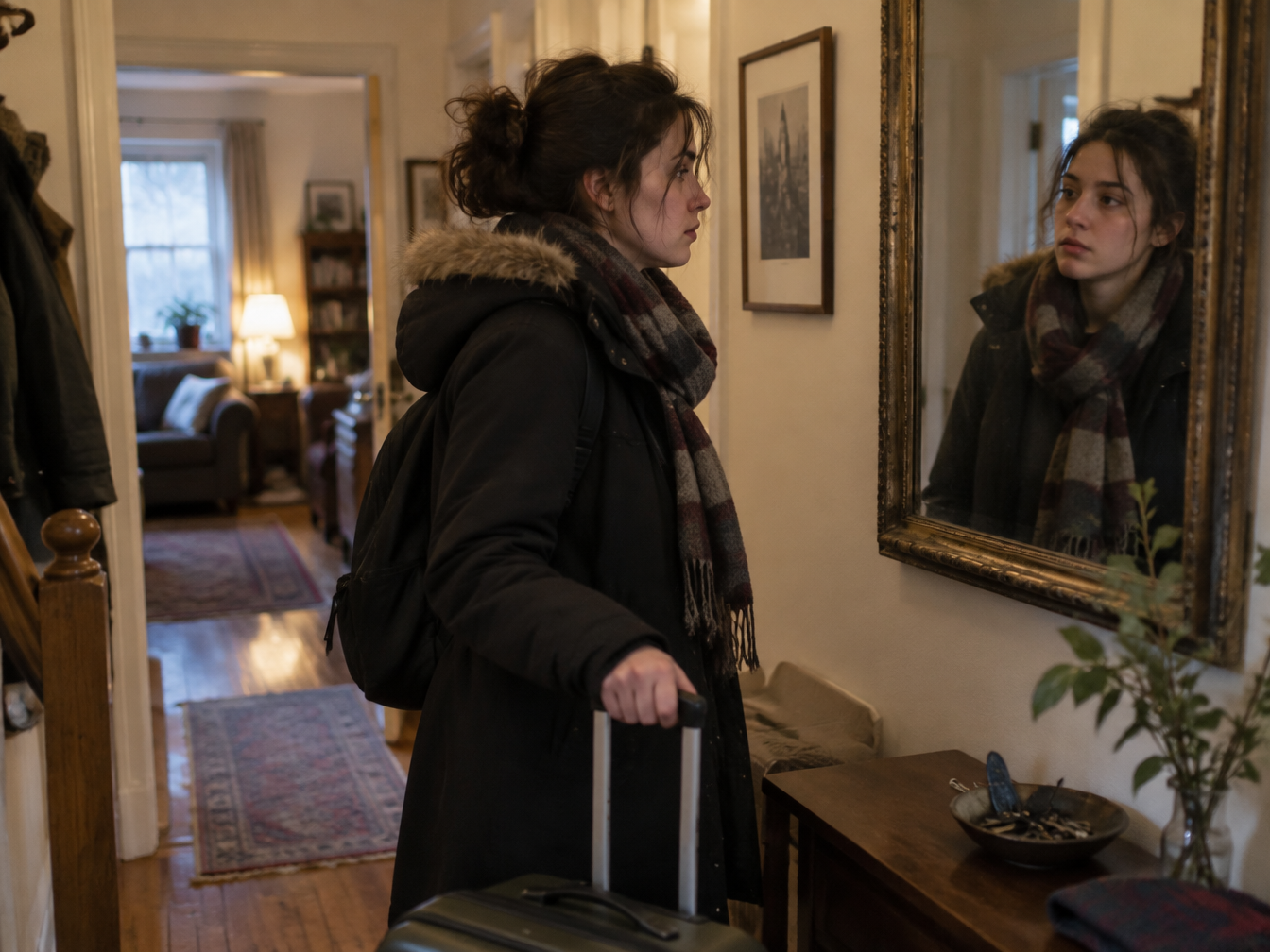
I caught my reflection before I had even put my suitcase down. There it was, in the hallway mirror my mother has owned since before I could read: a woman who had been awake for twenty-two hours, with hair that looked like it had been through something.
The top was flat. The ends were puffed out like a dandelion that lost an argument. A static wisp stood straight up from my part and waved at me.
My first thought was not “I am home.” My first thought was “Nobody can see me like this.” My mother was already coming down the stairs with her arms open, and I was ducking toward the bathroom to fix my face, my coat, my entire arrival.
She hugged the air where I had been. That is the moment I started wondering who exactly I was fixing my hair for.
What a Long Flight Does to Your Hair
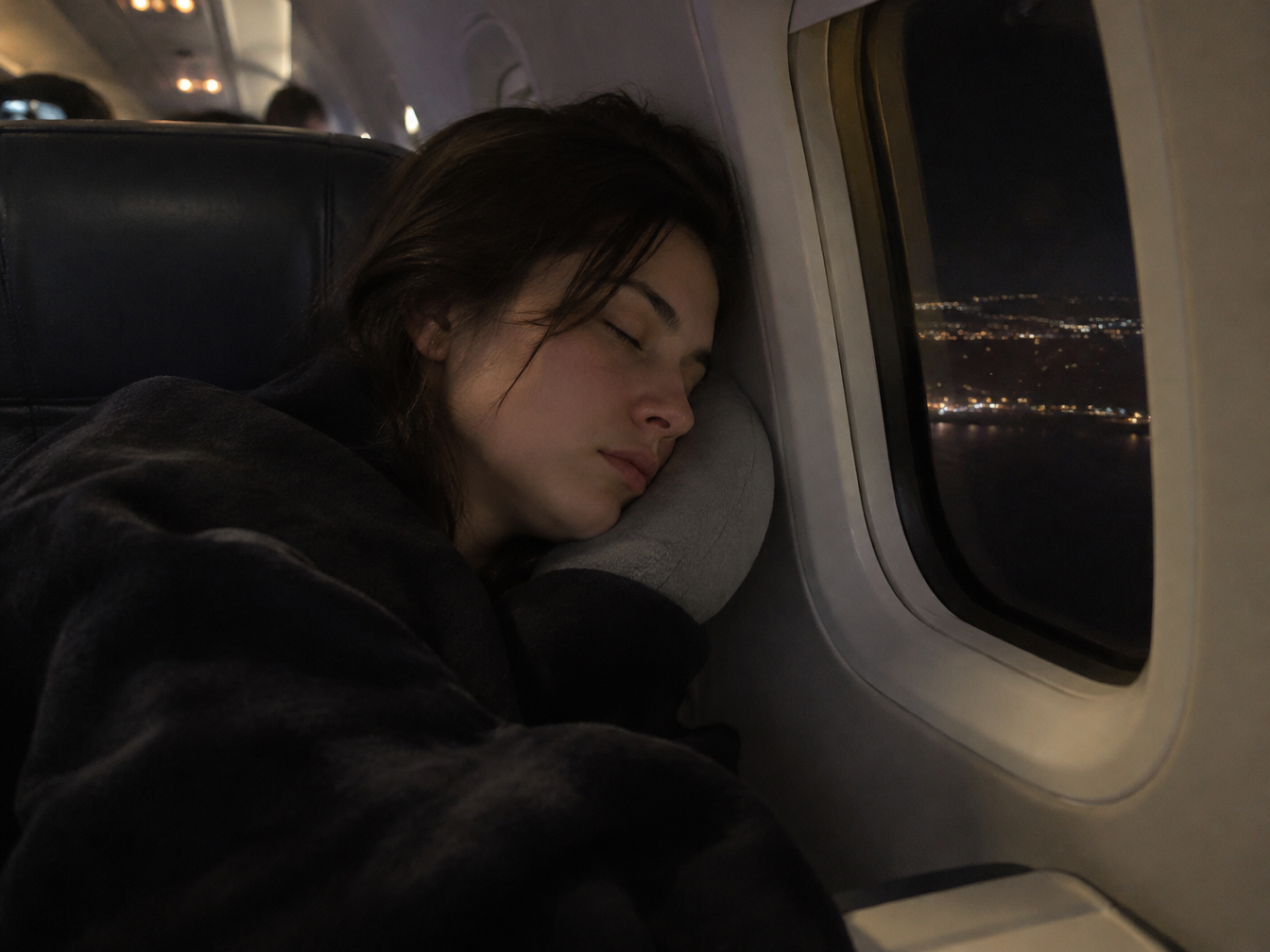
Before I get sentimental, let me be practical, because my hair was not imagining things. The air on a plane is genuinely brutal.
L’Oréal’s hair care editors, citing the World Health Organization, say cabin humidity usually falls to less than 20 percent at cruising altitude, compared with a normal 30 percent, and that the dryness pulls moisture out of hair and leaves strands dull, rough and brittle [1]. An aerospace explainer site puts it at roughly 10 to 20 percent during cruise, sometimes below 10 percent, versus about 50 to 70 percent on the ground before boarding. The same piece notes that comfortable indoor spaces sit around 30 to 60 percent, and that the average humidity of the Sahara Desert is about 25 percent, which makes your cabin drier than the desert [2].
I find that oddly comforting. I did not do anything wrong. I sat in a metal tube that was drier than the Sahara for fourteen hours, and my hair responded the way hair does.
The rest of the damage is less scientific and more human. Slept on a stiff airplane pillow. Pulled into a bun that I forgot about. Pushed against a headrest. Traded between a window and a shoulder. All of that adds up to a head of hair that has been rubbed, dried and compressed in a way no salon would sign off on.
The Panic Fix I Never Questioned
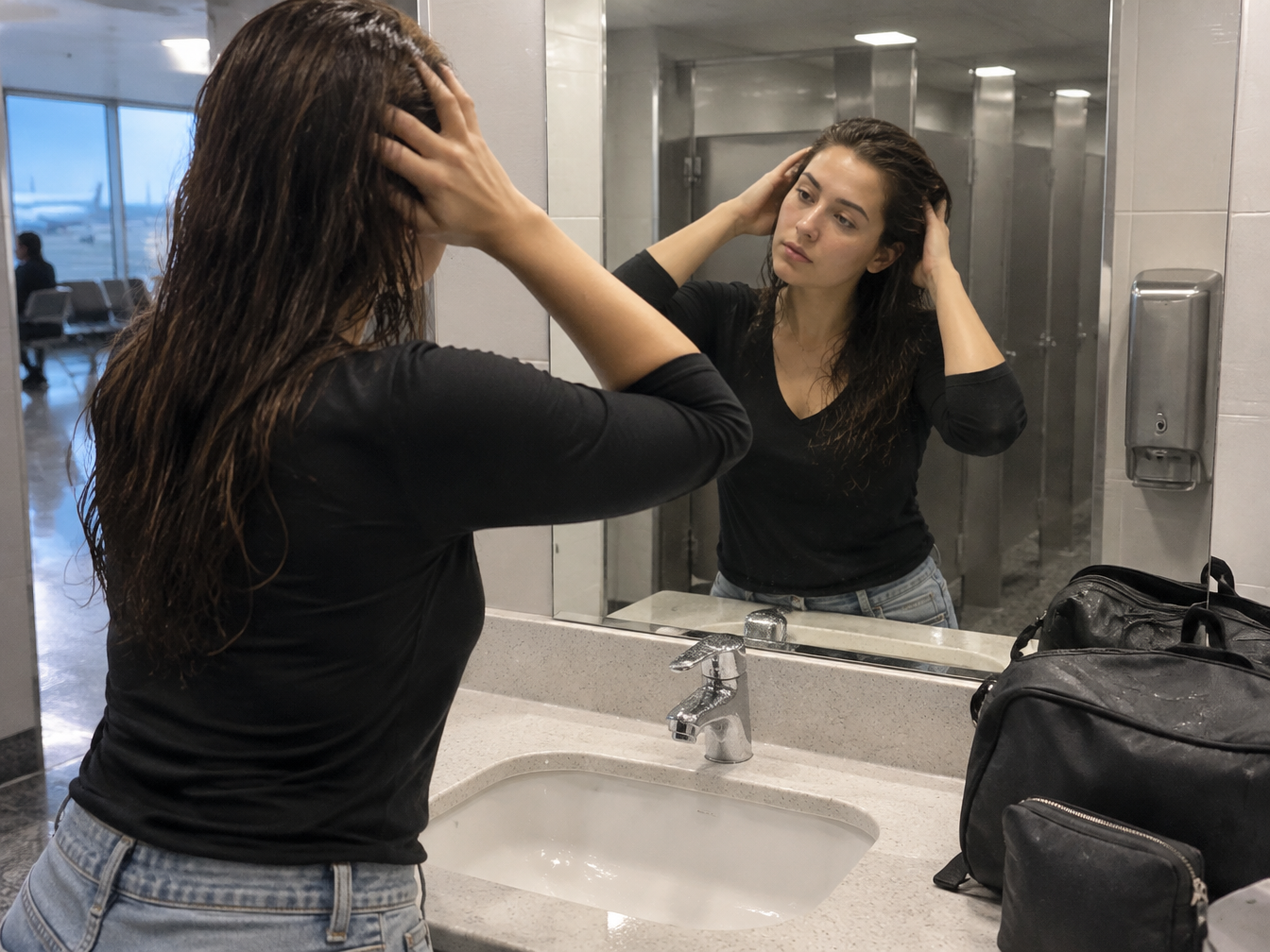
Here is what I used to do the moment I landed. I would find the nearest airport bathroom and perform a small emergency. Water on the hands, smooth it down, flip it over, shake it out, tie it up, take it down. I did this with the focus of someone defusing a bomb.
Then, in the car, I would check my reflection in the phone camera, tilting the screen like a detective studying a crime scene. Then again at the first red light. By the time I arrived at the front door, I had spent more energy on my hair than on figuring out what I wanted to say to the people I was about to see.
I have written before about why a bad hair day is never really about your hair, and this was the trip-home version of the same truth. The hair was not the problem. The hair was where I put the problem, because a flat part is easier to fix than the feeling underneath it.
I know this is not just me. Almost everyone I know has a ritual for the ten minutes before they walk into a family gathering, a hand through the hair, a swipe of lip balm, a quick pep talk in the rearview mirror. We call it getting ready. Mostly it is bracing.
So what was the feeling? Something like: I left. I built a life somewhere else. I am returning as a version of myself that has to prove it has been doing fine.
Static, Friction and the Scrunchie Problem
Let me give you the useful part before I get emotional again.
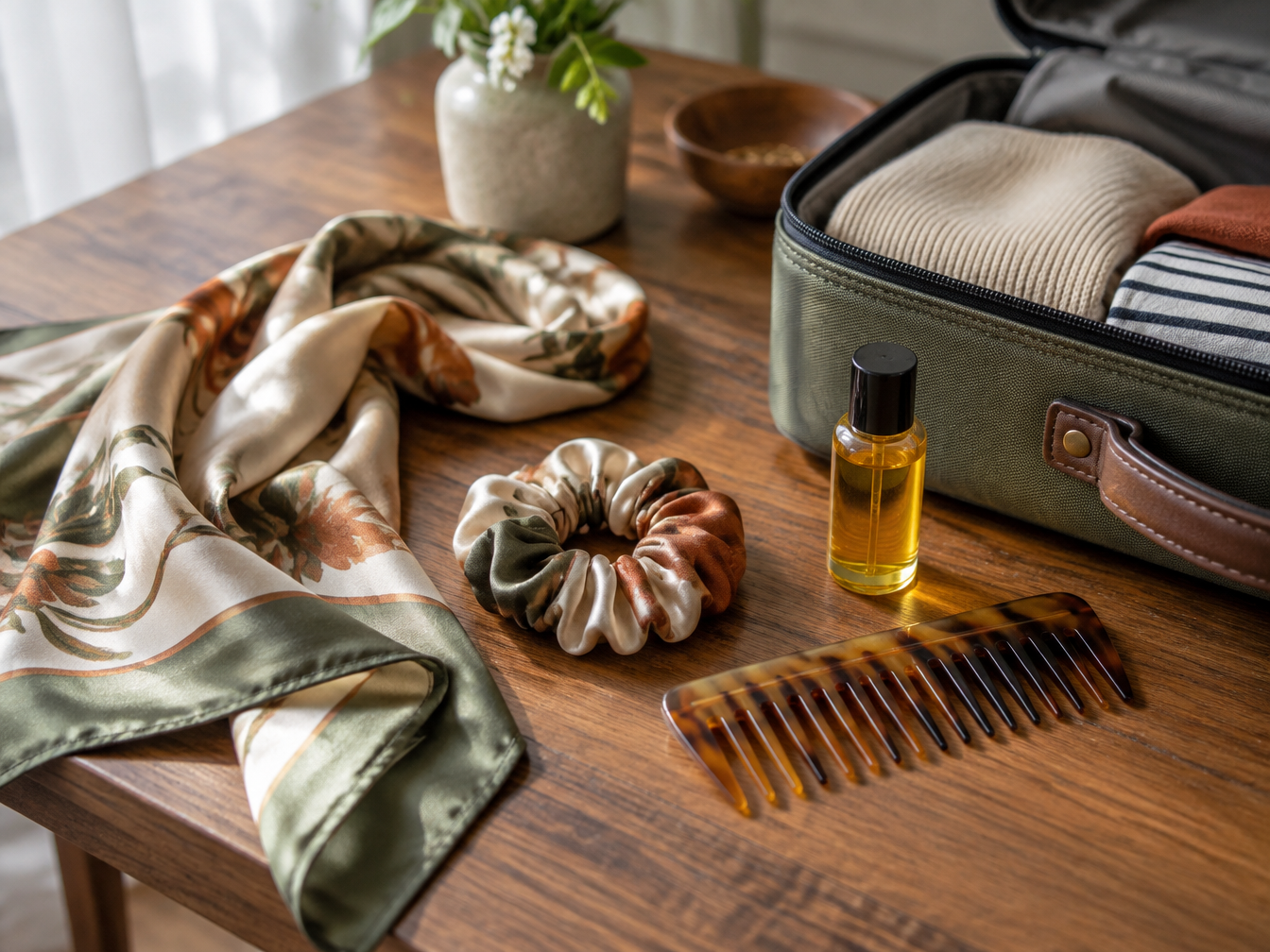
L’Oréal’s travel advice is surprisingly gentle. Wear hair loosely, not in tight styles, because elastic scrunchies can pull and cause friction. Choose a low ponytail or a braid with friction-free ties. If you have natural texture, wrap your hair in a silk or satin scarf. On an overnight flight, use a silk or satin travel pillow, since cotton can cause breakage, frizz and tangles [1].

I had always done the opposite. I pulled my hair into the tightest bun I could manage, because I thought “contained” meant “protected.” What I was actually doing was creating a tension line and then sleeping on it.
The static is the other thing. Dry air makes hair cling and fly, and I know exactly what that feels like because I once wrote about what static, frizz and hat hair taught me about letting things be messy. Winter hats, airplane headrests and indoor heating all do the same thing in different costumes. The lesson never changes. Hair is a fiber that responds to its environment, and I keep taking that response personally.
The Water at My Parents’ House Is Different
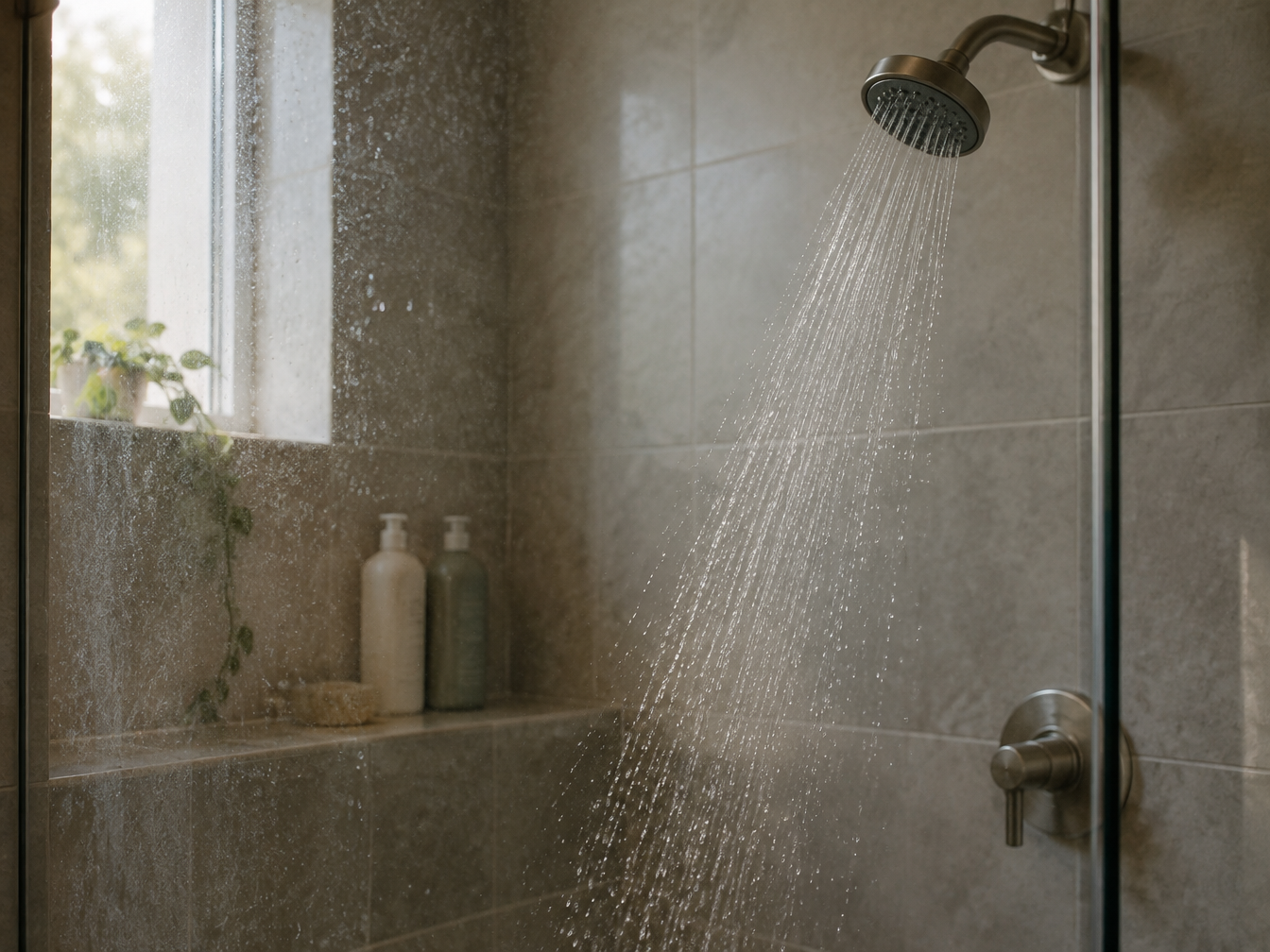
There is one more detail that surprised me. Every time I go home, my hair feels different in the shower, and I used to blame myself.
Hard water is a real thing, and a lot of homes have it. In a Refinery29 report, one hair expert explained that the calcium and magnesium in hard water leave a film on hair that blocks moisture from entering the strand. A hairstylist and colorist in the same piece said hard water typically makes hair look dull and feel dry and brittle [3].
I do not know the exact mineral content of the water in my parents’ house. But I do know that my hair behaves differently there, and that this is a very reasonable thing for hair to do.
The same article offers some calm advice. Stylists suggest a filtered showerhead, alternating a clarifying shampoo with a basic one, and rinsing with filtered water when you travel if you have access to it. One of them warns against washing more often, because that can make the problem worse [3]. That last part stuck with me. My reflex after a trip had always been to wash, wash again and hope.
Washing was never the cure. It was another version of the panic fix. And the more I think about it, the more I notice how many of my beauty habits are really just ways to feel in control after something that made me feel the opposite, like a long day, a long flight or a long absence.
What the Fixing Was Really For
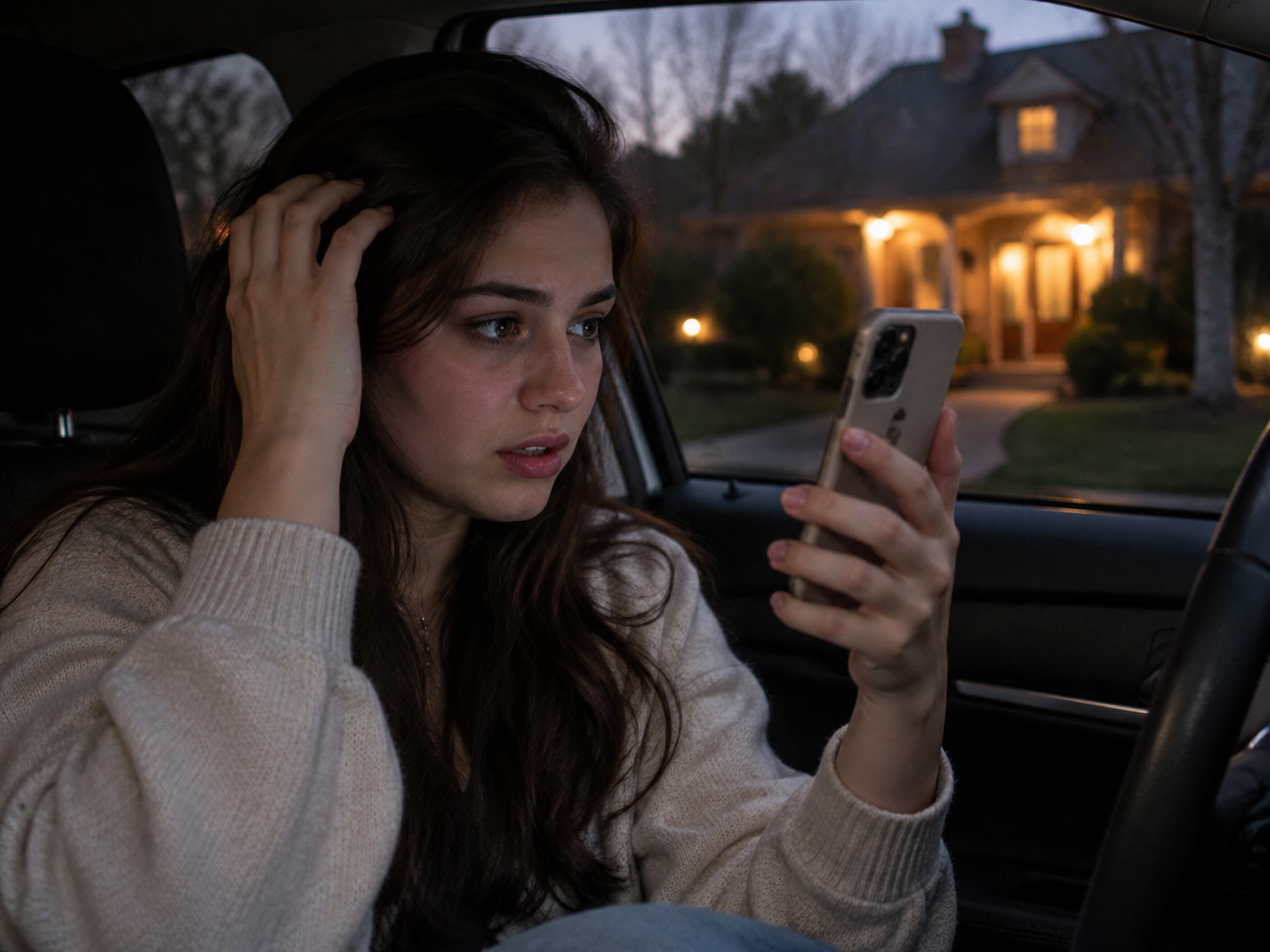
Let me say the quiet part out loud. I was not fixing my hair for my mother. She has seen me with a fever, with braces, with a haircut I gave myself with kitchen scissors. I was fixing it for the person I imagined she was expecting.
That person has a clean blowout and a calm face. She says “work is great” and means it. She walks through the door looking like proof that leaving was the right call.
I have tried to explain this feeling to friends, and the ones who also left home understand immediately. Arrival is a performance. The airport is backstage. The front door is opening night.
The funny part is that the performance exhausts me before I even get to the real visit. And then I spend the first two days with nothing left for the conversations that matter, because I used it all up on a part.
The month I stopped using hot tools taught me something related. I wrote about what my hair taught me when I stopped heat styling, and the biggest surprise was how much of my styling was fear dressed as routine. Home was the same. The fix was less about the hair and more about the fear of being seen mid-transition.
What I Do Now Instead

I am not telling you to stop caring about how you look. I am telling you to care in a way that costs less.
Before a long flight, I put in a deep conditioner and let it sit while I pack. During the flight, I use a tiny amount of nourishing oil or leave-in serum on the mid-lengths and ends, avoiding the roots so nothing gets weighed down, which is exactly what L’Oréal suggests [1]. I braid my hair loosely, I use a friction-free tie, and I bring a silk scarf for the plane.
After landing, I do almost nothing. A little dry shampoo if my scalp feels oily, because L’Oréal notes it helps absorb scalp oil and adds texture [1]. Then I wear it in a loose braid or a claw clip hairstyle that looks intentional, which is the closest thing I have found to a hairstyle that forgives travel.
I also drink an absurd amount of water on the plane and keep my hands off my hair while I sleep, which sounds silly but cuts down on the tugging and smoothing I used to do without noticing. Then I go inside, and I hug my mother back.
A Small Kit That Fits in a Carry-On
This is my own packing list, not a medical or expert one. A silk scrunchie or friction-free tie. A travel-size oil or leave-in. A tiny dry shampoo. A wide-tooth comb. A scarf. Everything has to be travel size, because L’Oréal reminds flyers that carry-on rules limit liquids to containers of 3.4 ounces or less [1]. That is a useful limit. It forces the routine to stay small, which is exactly how I want it.
Who Is Actually Looking

Here is what I learned on the last trip. I walked in with flat roots and a puffy braid, and my father said, “You look tired. Sit down, I made soup.”
That was it. No one mentioned my hair. No one cared about my part. The people who love me were looking at my face, because they wanted to know whether I was okay.
I have thought a lot about that sentence, “You look tired.” It used to sting. Now I hear it as what it is. Someone noticed me. Someone wanted to take care of me. Someone had soup.
I have started asking myself a question whenever I catch myself fixing something before a visit. Who am I doing this for? If the honest answer is a person who does not exist, I put the comb down.
The audience I imagine is almost always harsher than the audience that exists. The strangers at the airport do not remember me. The family at the door does not grade me. The only person doing a full inspection of my hair is me, in a mirror, in a hallway, trying to look like I have it handled.
Letting the Hair Tell the Truth

I think about that hallway mirror a lot now. It is a good mirror. It does not flatter me and it does not lie. Women do all kinds of things to their hair before a big moment, as I explored in what women do to their hair before a big life moment, and a homecoming is absolutely one of those moments.
What it showed me that day was a person who had traveled a very long way to be somewhere she belongs. Her hair looked like she had traveled. That is not a flaw. That is evidence.
So now, when I walk in the door after a flight, I try to let the hair do what it wants. If it stands up, it stands up. If it frizzes, it frizzes. It has been through twenty-two hours of dry air and borrowed pillows, and it still showed up.
I used to think that arriving well meant arriving untouched, as if the trip had never happened. I think now that arriving well means arriving as you are, with the evidence of the road still on you, and trusting that the people waiting would rather have you than the polished version.
Let them see you with the journey still on you. It is the most honest thing you can bring home.
Sources
- 5 Tips to Care for Dry Hair on a Long Flight, L’Oréal Paris
- Why Aircraft Cabins Are So Dry, The Flying Engineer
- Hard Water Hair Damage Tips, Refinery29
Leave a Reply