The Price Tag I Stared At for Eleven Minutes

I stood in front of a rack of coats holding the sleeve of one I could not afford, and I did the thing I always do. I checked the tag, flipped it over to make sure I had read it right, and put it back as if it had burned me.
Then I walked a lap around the store. I looked at scarves. I looked at socks. I pretended to be a person who had come in for socks.
And then I went back and stared at that coat for eleven minutes, which I know because I checked the clock on my phone twice, each time hoping it had been long enough that someone would tell me what to do.
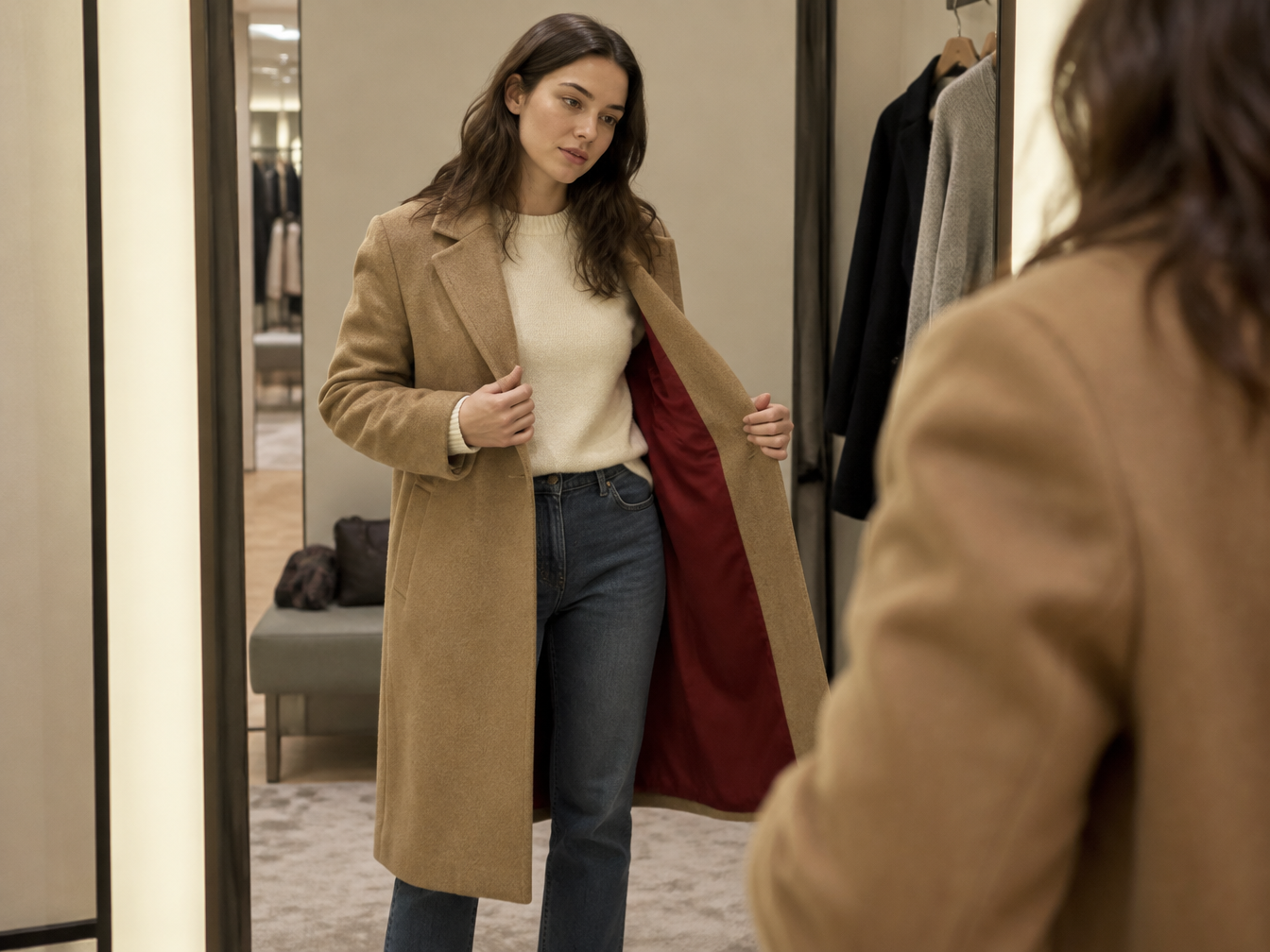
It was a long, camel wool coat with a collar that stood up on its own and a lining the color of red wine. It was more than I had ever spent on a single piece of clothing. It was also the first thing in years that made me feel like the woman I keep saying I am going to become.
The Argument I Had in the Fitting Room
Nobody tells you that buying something expensive is mostly an argument with yourself.
One voice said, you have a perfectly good puffer at home. The other said, that puffer has kept you warm and made you invisible for four winters. One voice said, grown women do not spend this much on a coat. The other said, grown women who are tired of feeling like an afterthought in their own wardrobe do exactly that.
I tried the coat on and turned toward the mirror, ready to hate it. I did not hate it. The shoulders sat right. The sleeves ended where my wrists begin. When I buttoned it, something in my posture changed before I noticed it changing.
I took it off immediately, because that felt dangerous. Then I put it on again, because that felt true.
What Cost Per Wear Actually Says

I did what any reasonable adult with a calculator would do. I tried to turn my feelings into math.
The idea is called cost per wear, and the formula is wonderfully simple: the price of an item divided by the number of times you wear it. The fashion marketplace Garmentory gives an example of a pair of $600 shoes worn at least 30 days a year. Over four years that is about 120 wears, or roughly $5 per wear [3].
The same piece points out something I have never forgotten. It cites a McKinsey estimate that fast-fashion pieces are worn an average of seven times before being discarded, which means a very cheap item can quietly cost more per wear than an expensive one you keep for years [3].
The article is honest about the limits too. Wearing something many times assumes it will last, and some occasions, like wedding gowns or black-tie formalwear, will always have a high cost per wear. It also suggests checking versatility before you buy: does the piece work with several outfits you already own, or will it force you to buy extra things to make it wearable [3]?
A winter coat is nearly the perfect candidate. You wear it nearly every cold day, over almost everything, for years. That does not make the price painless. It makes the price explainable.
This is the same logic I wrote about in why I stopped buying a new outfit for every event. Spending less often and spending better can turn out to be the same thing.
How to Tell a Coat Is Worth It
The math is useless if the coat falls apart in February, so I spent an embarrassing amount of time learning what to check.

Reviewed’s guide to buying winter coats treats the fabric as the most important decision. Wool is natural and breathable, and its natural oil helps it repel water, though it can still become saturated in heavy rain or snow. Down offers the best warmth for its weight but loses insulation when it gets wet. Synthetic fill resists water and can match down’s warmth without as much puffiness. Rayon is more decorative and will not keep you warm in a cold climate. Blends can soften scratchy wool and lower the price without necessarily lowering the quality [4].
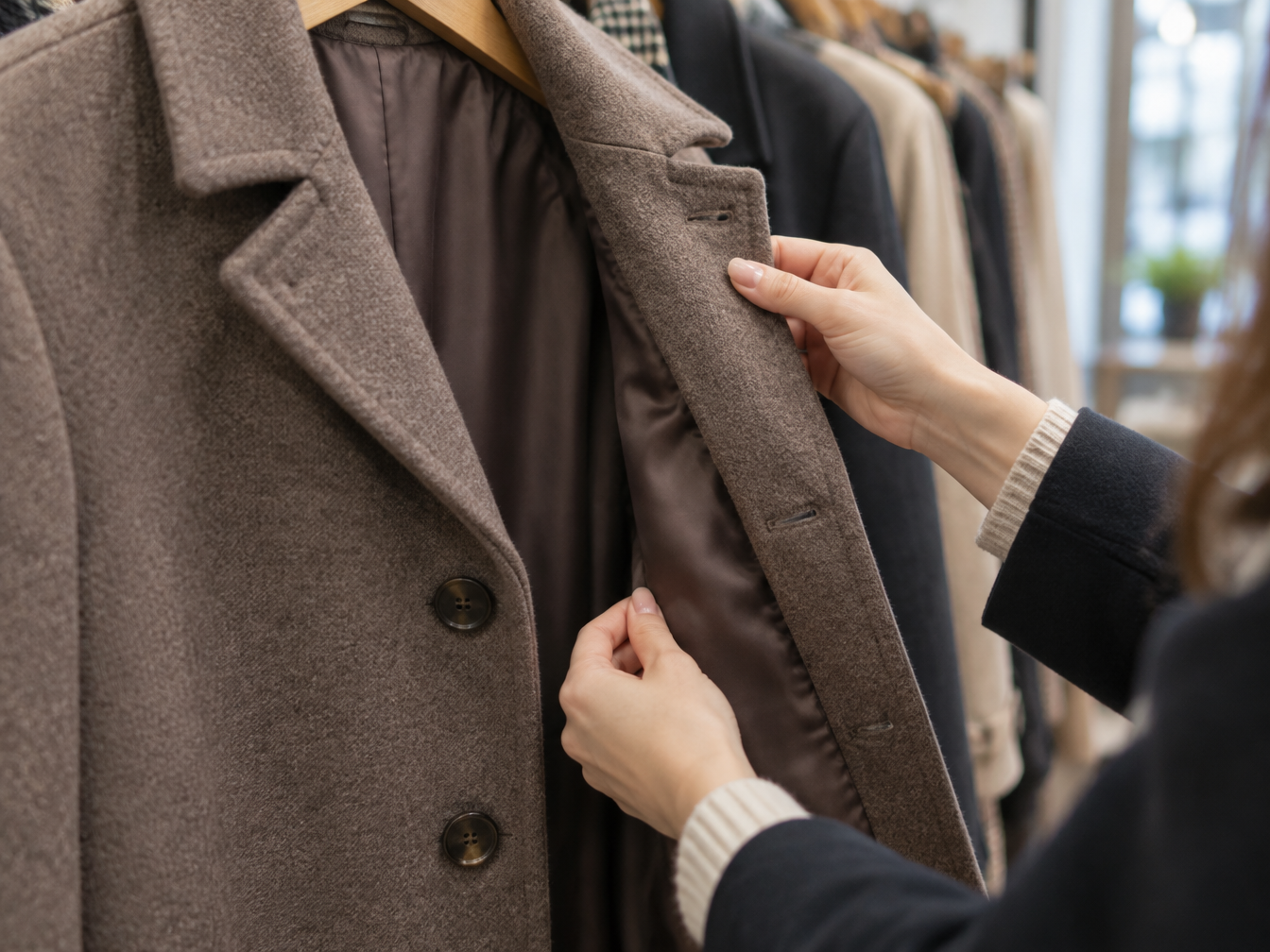
Then there are the small details. The guide says to look for a good lining, straight seams, an even hem and buttons that lay flat and do not feel cheap. Check for loose threads. Try the coat on, ideally before you remove the tags so you can return it, and if it feels itchy or lets a chill through, it will not last very long [4].
I did every one of those checks in that fitting room, running my thumb along the seams like a detective. The lining was smooth. The hem was even. The buttons sat flat and felt heavy in my fingers.
The article calls a coat an investment, which is the sort of phrase that sounds like marketing until you have worn a bad coat for three winters. Then it starts to sound like plain advice [4].
The Color Question
I almost talked myself into black. Black is safe. Black is what you buy when you do not want to be wrong. But I had already written about how winter outfit colors can make the cold months look good, and I could not make myself ignore my own advice. Camel it was. A color I would have called too risky a year ago.
The Morning I Noticed I Was Standing Differently

The first cold morning I wore it, I caught my reflection in a shop window on the walk to the train. I did not recognize the woman for a second. She was standing taller. Her shoulders were back. She walked like she had somewhere to be.
I had not decided to do any of that. The coat did something to my body that my brain had not approved.
There is real research behind a version of this feeling. Psychologists Hajo Adam and Adam Galinsky coined the term enclothed cognition in 2012 for the idea that clothing affects the person wearing it. In one study, 58 students did a test of selective attention, and the half who wore a scientist’s lab coat made half as many errors on the critical trials. In another, people who actually put on the lab coat did better than people who only saw one on the desk, and better than people who wore the same coat described as a painter’s [1].
The researchers concluded that the effect depends on both what the clothing symbolizes and the physical act of wearing it [1]. Which is a very official way of saying that a coat does not just hang on you. It tells your body a story, and your body believes it.
I have felt that before, in a smaller way, with the outfit I wear when I need to feel like myself again. Some clothes are a costume you put on. Some clothes are a posture you borrow until it is yours.
What the Research Does and Does Not Prove

I would be doing you a disservice if I stopped there, because science deserves honesty and so do you.
A 2025 paper by C. Blaine Horton, Hajo Adam and Adam Galinsky in Personality and Social Psychology Bulletin looked at 105 effects from 40 studies across 24 articles, with 3,789 participants in total. The authors found reason for concern about how well the early enclothed cognition studies would replicate. They also found that studies published after 2015 show evidential value, and that these later studies support the core idea that what people wear influences how they think, feel and act [2].
So the honest summary is this. The early excitement was probably bigger than the evidence. The later evidence is more encouraging. Nobody has proven that a good coat will fix your life, and I am not going to tell you it will.
What I can tell you is smaller and, to me, more believable. When I wear the coat, I stand differently, and standing differently changes how I move through a room. That is not a magic trick. It is just a person feeling taken care of and behaving accordingly.
The Quiet Ways a Coat Pays You Back

Confidence is the dramatic answer. The practical answers are more convincing.
I stopped dreading the walk to the bus stop. I stopped layering three cardigans to compensate for a thin jacket. I stopped spending ten minutes every morning deciding what to wear underneath, because a good coat quietly covers a lot of sins. A simple sweater and jeans under it look like a decision.
I also noticed a kind of calm. When I am cold, I am distracted, hunched, a bit mean. When I am warm and well dressed, I have room to be curious about the day. A warm body does a great deal for a mood.
It is the same quiet logic as the boots I wear every winter and the woman they turn me into. A few pieces, worn daily, become a kind of uniform for a certain version of you. It is hard to be dismissive of yourself in something that fits that well.
There is a part that I did not expect, too. The coat made me gentler about the rest of my wardrobe. I stopped chasing small hits of novelty because I already had one thing I loved without reservation. It turns out that having one thing you trust can quiet a lot of wanting.
The Guilt That Outlasted the Receipt

I will not pretend the guilt vanished the moment I paid. It lingered, and it was loud.
Every time someone complimented the coat, a small voice whispered how much it cost, as if I had to apologize for the very thing that had made me feel good. I would say thank you and then, ridiculously, add that it was on sale, which was not even true.
I think that is the real subject of this whole story. Many of us were taught that spending on ourselves is a kind of indulgence that must be earned, justified and downplayed. We will buy the gift, the dinner, the plane ticket for someone else without a flicker. For ourselves, we make a spreadsheet.
I had already learned a version of this. Cheap things I did not need cost me more, in the end, than the one thing I did. The pile of sales I chased taught me less than the single coat I had been afraid to buy.
None of this is permission to spend recklessly. It is permission to notice the difference between wanting more and wanting right. I learned that the hard way with the Black Friday haul I returned and what I actually wanted, a pile of bargains that taught me less than one honest purchase.
What I Wear Over Everything Else

Weeks into the season, the coat already has a small crease at the elbow where I lean on things. I like it better for that. A good thing that has been lived in looks like a good thing that has been loved.
I did the math again last week. If I wear it as often as I plan to, the price I stared at for eleven minutes will shrink every cold morning, one wear at a time. It is not even the main reason I love it.
I love it because of what it did on the first day. It made me stand up straighter, and then it asked me to keep standing that way.
Maybe the best thing you can put on this winter is the thing that reminds you to take up space.
Sources
- Introducing Enclothed Cognition, The British Psychological Society
- Evaluating the Evidence for Enclothed Cognition, Horton, Adam and Galinsky, Personality and Social Psychology Bulletin
- Cost Per Wear, Garmentory
- How to Buy a Quality Winter Coat, Reviewed
Leave a Reply