For years I believed that wearing the same sweater twice in one week was a small public confession. A confession that I had run out of ideas, run out of money, or run out of whatever it is that makes other women look like they float through winter in a different perfect outfit every morning.
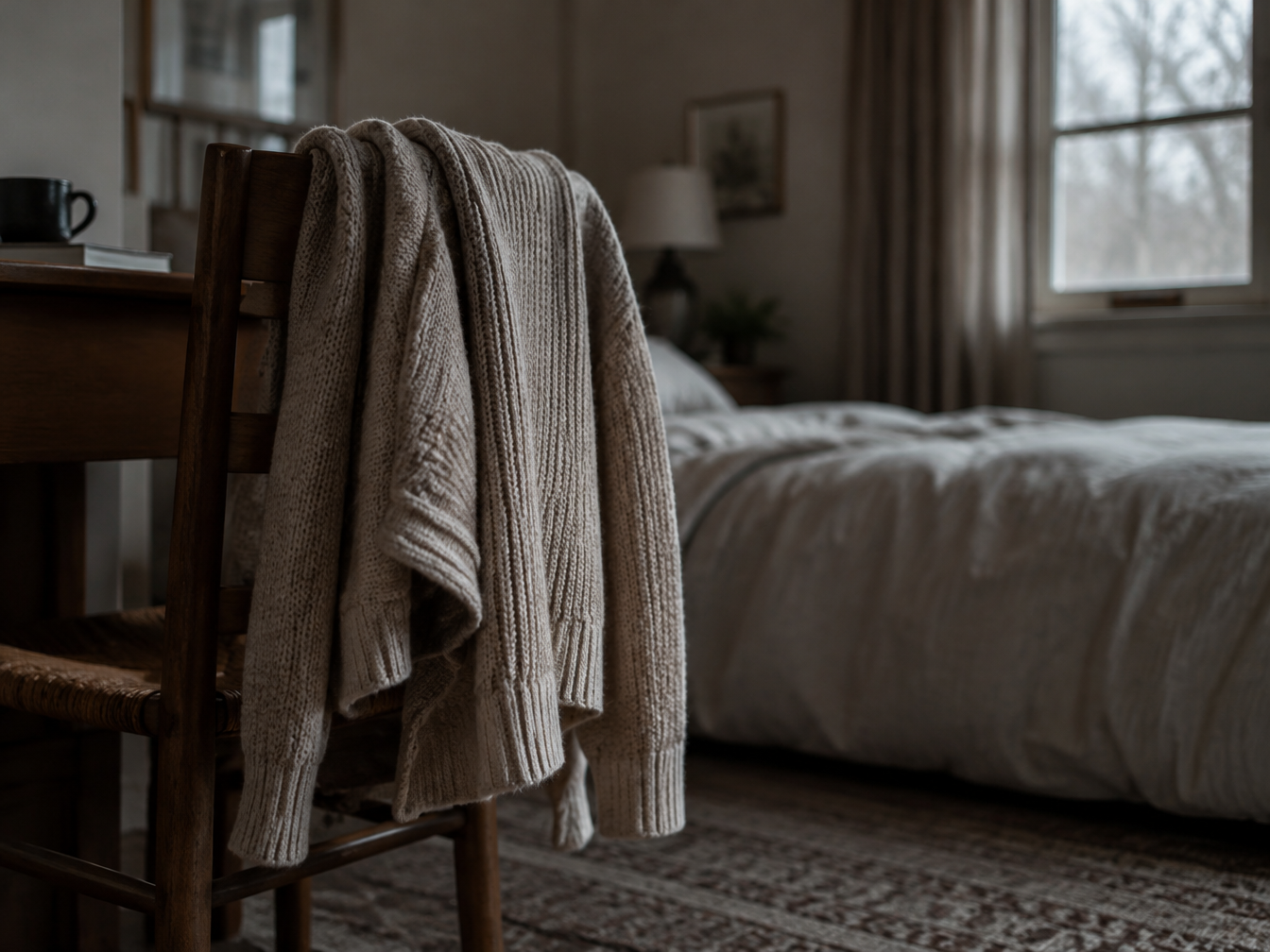
Then one gray Tuesday in November I reached into my closet and my hand landed on the same oatmeal sweater it had landed on the day before. I stood there in the half dark, feeling something loosen in my chest. Nobody was going to arrest me. And somewhere under the embarrassment, I realized I was happy to see that sweater again.
The Morning I Reached for the Same Sweater Again
I should explain what winter used to be for me. It was a season of low-grade performance. Every November I would promise myself a fresh start, which meant a new coat, a new pair of boots, a new scarf I had seen on someone who looked like she knew a secret. By January my closet was fuller and my mornings were worse.
The trouble was never a lack of clothes. It was that I had never decided what I actually liked wearing when it was cold. So every morning became a small negotiation with a pile of maybes, and I usually lost.
That Tuesday I did not negotiate. I put the oatmeal sweater on, added the gray trousers I wear far too often, and left the house ten minutes early. The day felt strangely quiet. There was no running commentary in my head about whether I looked interesting enough, because I had already answered that question months ago by choosing the sweater in the first place.
I started to wonder what would happen if I stopped treating repetition as a failure and started treating it as a decision.
What People Actually Notice About Your Outfit

Here is the fear underneath it all: someone will notice. A coworker, an old friend, the woman at the coffee shop who sees me twice a week. They will think, she wore that already.
Psychologists have a name for how much we overestimate this. In a famous set of studies presented in 2000 by Gilovich, Medvec and Savitsky, people who wore an embarrassing Barry Manilow shirt into a room of strangers expected far more people to notice it than actually did [1]. It is called the spotlight effect, and the short version is that we all feel like the star of a show most people are not watching.
I tested my own version of this a while ago, and wrote about it in what happened when I wore the same outfit for a week. Almost nobody said a word. The one person who did mention it, a coworker, only wanted to know where I had found the jacket.
That does not mean no one ever notices. It means the attention we imagine is much louder than the attention we get. Most people are busy wondering whether anyone is looking at them.
When I let that sink in, a heavy question became a light one. If almost nobody is keeping score, then who am I dressing for each morning?
The Difference Between Repeating and Giving Up
I want to be careful here, because there is a version of this idea that is just surrender. You can wear the same hoodie for six months because you have stopped caring, and I have been that person too. It is not the same thing.
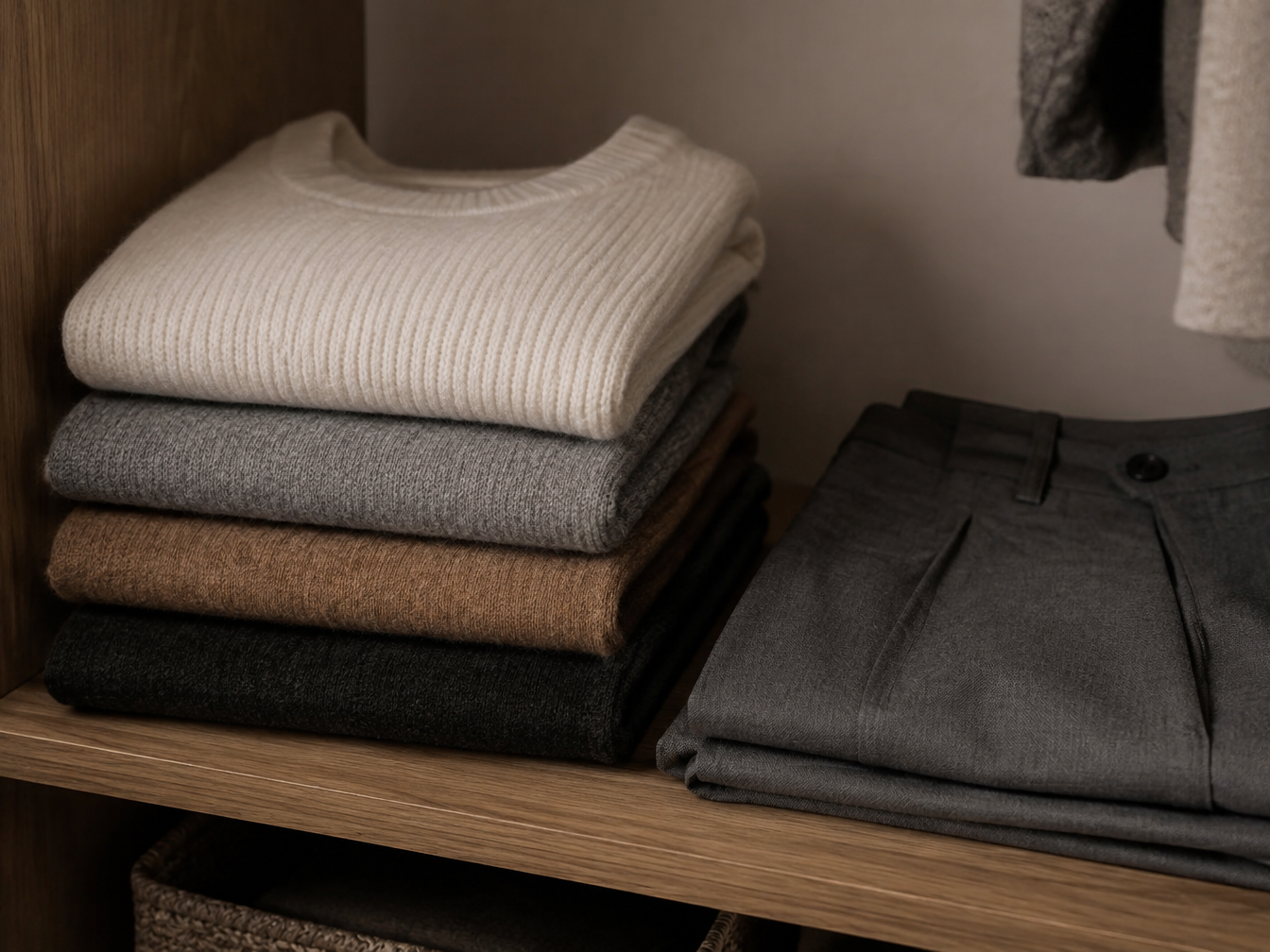
Wearing the same things on purpose feels different from the inside. When you give up, you reach for whatever is closest and feel a little flat afterward. When you repeat on purpose, you reach for a piece you chose, because it fits, because it feels like you, because you know exactly how it will behave on a cold bus at eight in the morning.
The difference is in the choosing. I did not stumble into my winter rotation. I built it slowly, the way you build a small group of friends, by noticing who made me feel good and keeping them around.
I went deeper into this when I tried a stripped down closet, which I wrote about in what building a capsule wardrobe taught me about how many versions of me I was dressing for. The surprise was not that I needed less. It was that most of my clothes had been built for imaginary women I never became.

A uniform is not a lack of imagination. It is a place to rest your imagination so you can spend it on things that matter more than which cardigan.
There is also a quiet kind of freedom in knowing your own taste well enough to predict it. I no longer stand in shops wondering whether I am the sort of person who wears mustard yellow. I already know I am not, and I know exactly which shade of green I am. That certainty saves me hours, and it saves me from a lot of purchases that would have lived in a bag by the door until spring.
My Winter Uniform, Piece by Piece
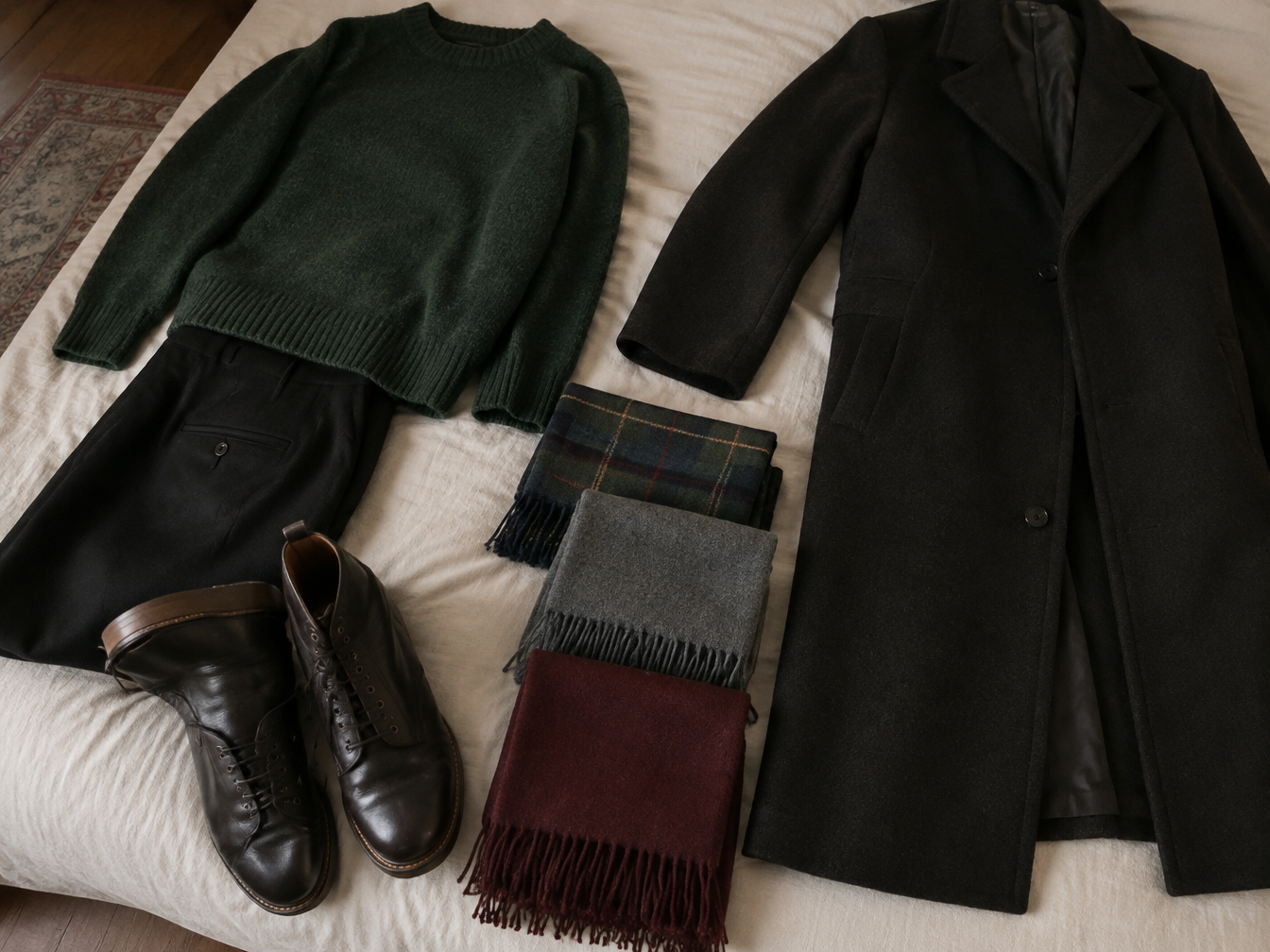
Let me tell you what is actually in my winter rotation, because specifics are kinder than philosophy. There are two sweaters, the oatmeal one and a deep green one that I bought secondhand and have worn so often the elbows have softened into something like a hug. There are two pairs of trousers, one gray and one black. One pair of boots, resoled twice. One long wool coat. Three scarves, because I cannot help myself.
Each of these pieces earned its place by passing a very simple test. Does it still feel good in February? Not in the store, not on the first wear, but in the sixth week of cold, when my mood is low and my patience is lower.
The coat is the best example. I wrote about the winter coat I splurged on and the confidence it quietly paid back because it changed how I think about spending. A piece you will wear a hundred times is not an indulgence. It is the cheapest thing you own, once you divide.
What surprised me most is how much variety is still possible inside a small set. The green sweater with the black trousers feels like a different day than the green sweater with the gray ones. A scarf tied differently, a collar flipped up, a belt over the coat, and suddenly it is another outfit entirely. Repetition leaves a lot of room to play.
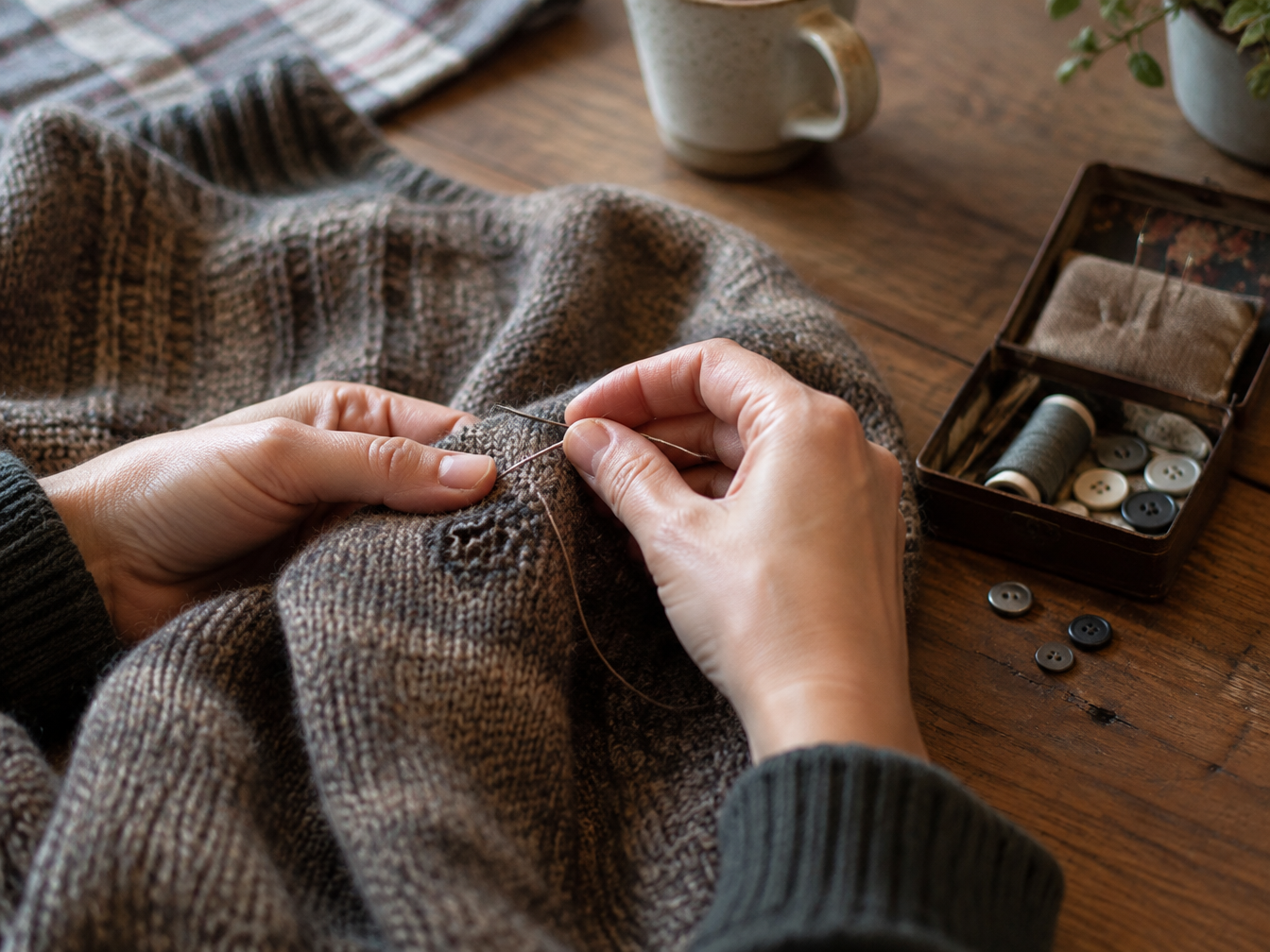
Care is part of it, too. Clothes you wear often deserve a little tenderness. I wash my sweaters less than I used to, air them by the window, and keep a small kit for loose buttons and pilled fabric. Ten minutes with a needle on a Sunday night has saved more pieces than any shopping trip ever did, and it makes the clothes feel like mine instead of like inventory.
Wearing the Same Things Is Quietly Good for the Planet
I did not start this for environmental reasons, but I will admit that it feels good to find out the choice has a bonus. According to the waste reduction organization WRAP, extending the life of clothing by nine months could reduce the carbon, water and waste footprints of that clothing by up to 20 percent [2].
The scale of the problem is easy to underestimate. The EPA reports that in 2018 the United States generated 17 million tons of textile waste, about 5.8 percent of all municipal solid waste, and landfilled 11.3 million tons of it [3]. Those numbers are not a reason to feel guilty about a sweater. They are a reason to feel quietly proud of one.
I think about my grandmother when I read figures like that. She owned few clothes and loved every one. I explored what her old coat still teaches me in my grandmother’s coat and the style lessons it keeps teaching me, and the lesson is the same one the research hints at. A well worn thing is not a boring thing. It is a thing that has been trusted.
You do not have to turn this into a crusade. You do not have to give up color, or shopping, or the pleasure of a new scarf. You only have to notice that every time you wear something again, you are quietly voting for a slower, kinder way of living with your stuff.
The Guilt I Had to Put Down

The hardest part was not the closet. It was the guilt I carried into it. For a long time I felt that if I was not constantly updating myself, I was falling behind at something I could not name. Shopping felt like keeping up. Not shopping felt like giving up.
I confronted this most honestly the winter I returned a big Black Friday haul. I wrote about it in the Black Friday haul I returned and what I actually wanted, and what I actually wanted turned out to be rest. I wanted to stop being managed by advertisements and my own fear.
Wearing the same things on purpose is one way I practice that rest. It is a small refusal. It says, I am allowed to be the same person on Wednesday that I was on Monday, and nothing terrible will happen.
I still buy things. Last month I bought a pair of earrings that make me stand taller. But now I ask a different question at the register. Not whether this is cute, but whether I can picture myself reaching for it in the dark on a cold morning. If the answer is yes, it comes home. If the answer is maybe, it stays on the shelf.
How to Wear the Same Things on Purpose

If you want to try this, start small. You do not need to purge your closet or follow a rule about thirty-three pieces. You need one cold week and a little curiosity.
Pull out the five things you actually reached for last winter. Not the ones you wish you reached for. The ones you did. Put them on one side and look at them honestly. They are telling you what you really like.
Then ask what is missing. Maybe it is a warm layer that does not itch. Maybe it is shoes that survive rain. Fill those gaps slowly and with care, and let the rest of the closet rest.
If it helps, keep a tiny note on your phone for that cold week. Write down what you wore and one word for how it felt. By Friday you will see a pattern, and the pattern is the real shopping list. You will notice that the soft green sweater always gets a good word and the stiff blazer never does.
Next, give yourself permission to repeat. Wear the sweater on Monday and again on Thursday. Change the scarf. Notice how it feels to be known by your own clothes.
And when the old fear shows up, the one that says everyone is watching, remember the Barry Manilow shirt. Remember that the room is mostly full of people thinking about themselves.
My oatmeal sweater has a tiny hole near the cuff now. I have decided to keep it, because it has been with me through the quietest, kindest winter I can remember. Some things are worth wearing until they wear you back.
Sources
- Spotlight effect and the Gilovich, Medvec and Savitsky study, Colby College Cognition Blog.
- Love Your Clothes case study, WRAP.
- Textiles: Material-Specific Data, U.S. Environmental Protection Agency.
Leave a Reply