There is a tube of lipstick in the left pocket of my winter coat, and it has never once been for a good day.
Good days don’t need it. On good days I leave the house already holding my shoulders the way I like. The tube is for the other days, the ones where a text at 8:40 in the morning rearranges my stomach, or a meeting goes sideways before I’ve finished my coffee, or I simply wake up feeling like a drawing somebody erased too hard. On those days my hand finds the pocket somewhere between the train platform and the office door, and the small cold weight of it is already doing something before the cap comes off.
I used to think that was silly. I used to believe a grown woman should be able to get through a Tuesday without a prop. Then I started paying attention to what the prop actually did, and I went looking for whether anyone had studied it. Here is what I found, plus what I worked out on my own, with one warning up front: a tube of color does not fix a terrible day. It only changes who is standing in it.
The Day the Pocket Rule Started

It began with a funeral that wasn’t mine.
A friend’s father had died, and I went to the service in a black coat I’d bought the winter before, back when I still believed a good coat could make me feel like a person who had her life in order. I stood in the back of a cold church and felt enormously useless. Everyone else seemed to know what to do with their hands. I held a tissue I didn’t need and watched my reflection in a dark window, a pale smudge of a woman, and I thought, I look like I’m already gone.
In the car afterward I dug through the pocket for my keys and found an old tube of lipstick I’d forgotten about, a plain rosy brown with a bent tip. I put it on without a mirror, using the dark rearview glass. I wasn’t trying to look better. I was trying to look present, like someone who had arrived at her own day on purpose.
It worked in a way I can’t fully explain. My jaw unclenched. I drove to the reception and managed to hug people properly. The coat was a good one, but that afternoon the thing that did the quiet work was a drugstore tube in the pocket. So I made a rule. A lipstick lives in the coat. It stays there for the days I don’t have a plan.
What Researchers Say About Makeup and Mood
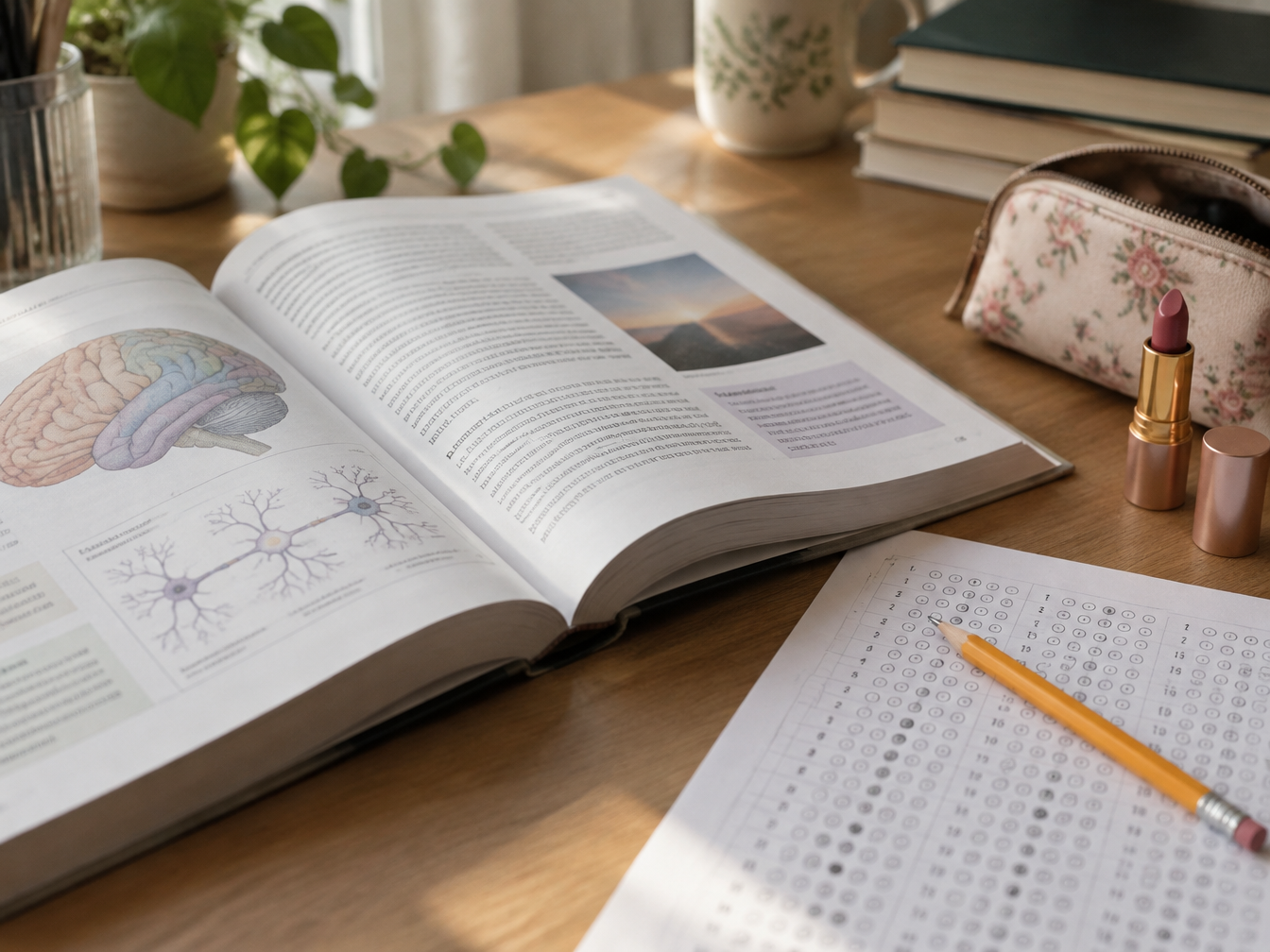
I’m a skeptic by nature, so my first question was whether I was kidding myself. I was relieved to learn that researchers have poked at this exact feeling, although the findings come with more caveats than a confident headline would admit.
The most cited example I found is a 2017 study in the journal Cogent Psychology, led by Rocco Palumbo of Harvard Medical School with colleagues at the University of Chieti in Italy. Female undergraduates were split into three groups. Before a multiple-choice test on a psychology textbook chapter, one group applied makeup, one listened to a piece of upbeat music, and one colored in a drawing of a human face. The makeup group scored best, significantly higher than the music and coloring groups [1].
Now the honest part. This was one test session with students, not a lifetime of real-world grades. The coverage I read didn’t report effect sizes, and the explanation for the result, that makeup lifts mood and self-esteem and that this helps thinking, is a reasonable guess rather than something the write-up shows directly. Upbeat music helped too, which tells me the secret ingredient might simply be doing one small, pleasant, deliberate thing for yourself right before a demanding moment.
I’m fine with that reading. It matches what happens in my pocket. The lipstick isn’t magic. It’s a switch I know how to flip, much like the way a bad hair day is never really about your hair and the real fix is usually the mood underneath.
Why Clothes and Little Rituals Change the Person Wearing Them

If you want a better-built piece of research, look at what psychologists call enclothed cognition. In 2012 Hajo Adam and Adam Galinsky of Northwestern University’s Kellogg School of Management published a set of experiments on what happens when people put on clothing that carries a symbolic meaning [2].
In the first study, 58 students took a Stroop test, the classic exercise where you name the ink color of a word while ignoring what the word says. Half of them wore a white lab coat, described to them as a lab coat. The other half wore their own clothes. The lab coat group made about half as many errors on the trickiest trials [2].
What convinced me was the follow-up. Wearing the coat mattered more than just looking at it. People who wore a lab coat did better on a sustained attention task than people who only had a lab coat sitting on the desk in front of them, and a coat described as a painter’s coat didn’t give the same lift [2]. In other words, the meaning of the garment and the act of putting it on both had to be there.
I’m not claiming a lipstick is a doctor’s coat. I’m saying the principle makes sense to me. Something you wear carries a story, and the story gets into your posture. For me the story of that rosy brown tube is I am a woman who is still showing up.

The Shade I Keep Where My Hand Can Find It
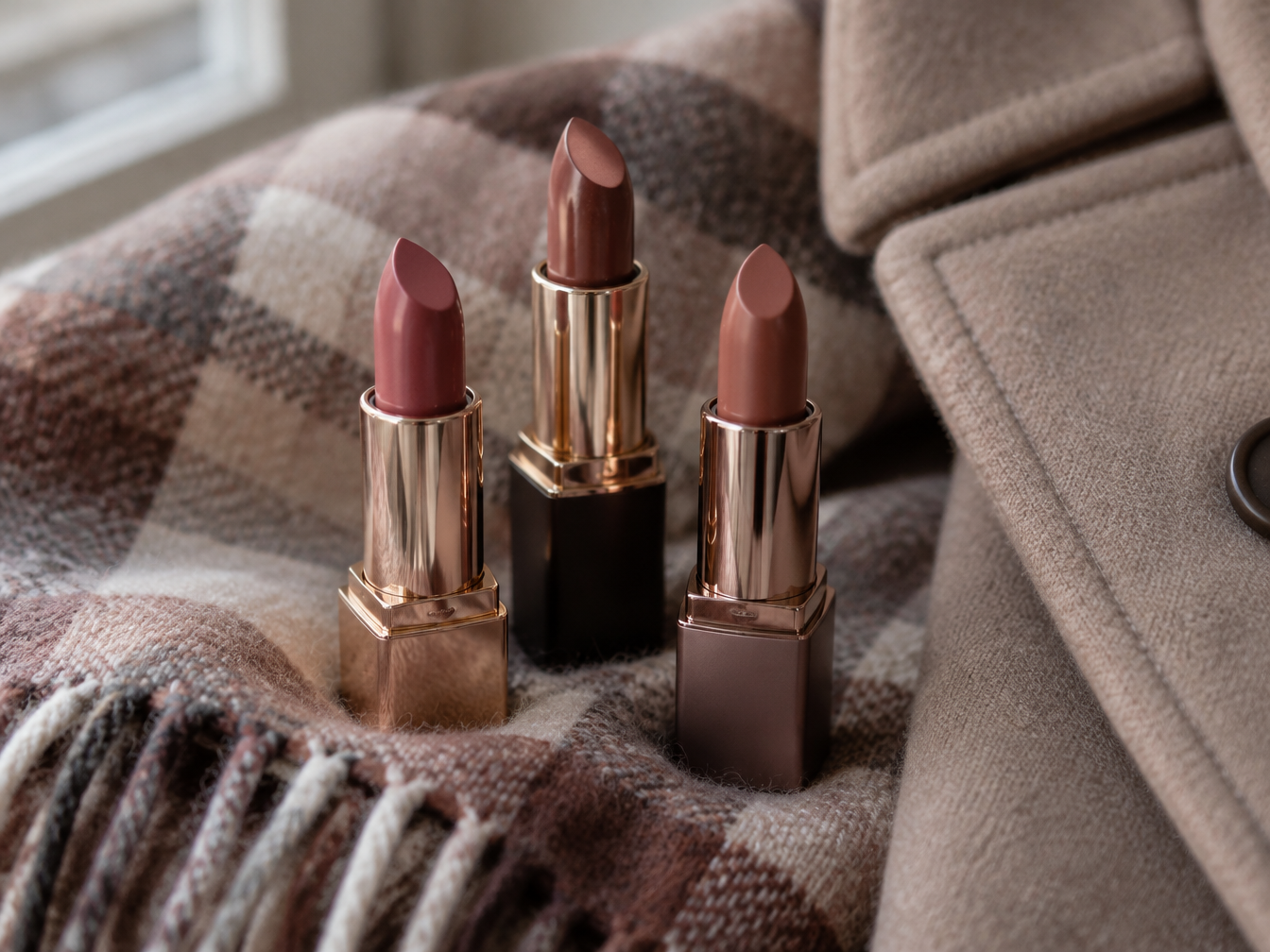
People ask whether the lipstick in the pocket should be a bold red. For me the answer is no, and I think this is the part most people get backward.
A terrible day is not a day for a statement. I learned that the hard way after years of being too scared to wear red lipstick, and then overcorrecting by wearing it in moments when I wanted to disappear. A shade that demands attention can feel like a costume on a day when you barely feel like yourself.
The pocket shade has a short list of rules.
It Should Look Like Your Lips on a Good Night
Mine is a muted rose with a little brown in it. It’s the color my mouth would be if I’d slept well and drunk enough water. That means I can put it on without a mirror, and if I miss the edge by a millimeter nobody will ever know.
It Should Survive Imperfect Application
Creamy, slightly sheer formulas forgive you. Matte liquids and sharp lines punish you. A bullet that glides on in one pass is the whole point when your hands are shaky and your phone is already buzzing again.
It Should Not Need a Second Product
If a lipstick needs a liner, a primer and a topcoat to behave, it lives in the bathroom. The pocket tube has to work alone.
How I Put It On in Thirty Seconds Without a Mirror

The ritual matters as much as the shade, so I keep it small and repeatable.
First I take a breath on the way to the pocket. This is not a wellness trick, just a way of telling my body that I’m about to do something on purpose. Then I find my reflection in whatever is nearby: the dark train window, the front camera of my phone turned off, the glass of the building door. Dark glass is more flattering than you’d think and it keeps me from analyzing my face.
I swipe the center of my top lip, then the center of the bottom, and press them together. Then I press my lips gently on a folded tissue to take off the excess. That’s it. If the color has wandered, I use my pinky to tidy the corners. The whole thing takes less time than waiting for a crosswalk.
I keep the tube in the coat, not the bag, for a practical reason. On the days I need it most, I am usually carrying too much and holding something I’m reluctant to put down. The coat pocket is the one place my hand goes automatically, like touching a key before I open a door. My version of this habit is also why I started loving a cold-weather makeup look that still reads as skin, because the lip is the only place I want to see a little deliberate color in winter.
Keeping Lips Ready for Color When the Air Is Dry
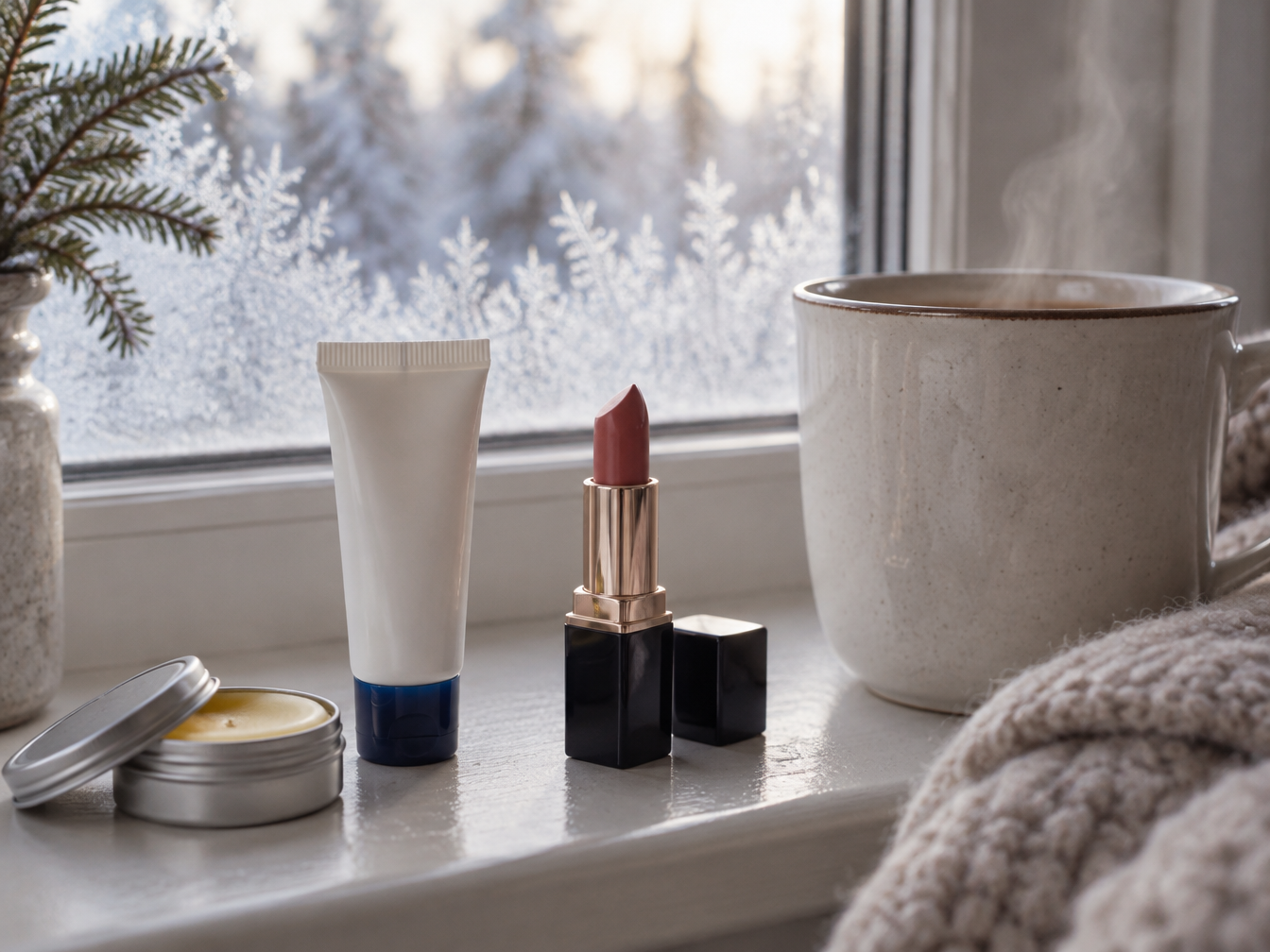
Here is the unglamorous truth about carrying lipstick in winter: cold air and heated rooms are brutal on lips, and lipstick on cracked skin makes a terrible day feel worse. I learned that after a week where every swipe made my mouth sting.
The American Academy of Dermatology has plain, useful advice. Use a non-irritating balm several times a day and before bed. For very dry lips a thick ointment such as white petroleum jelly seals in water longer than waxes or oils do. Wear a balm with SPF 30 or higher outdoors, even in winter, and reapply it about every two hours. And stop licking your lips, because saliva evaporates and leaves them drier [3].
The same guide lists ingredients to avoid while lips are chapped, including fragrance, menthol, camphor, lanolin, salicylic acid and flavorings such as cinnamon and peppermint, and it suggests fragrance-free, hypoallergenic products. If a lip product burns, stings or tingles, stop using it. If chapped lips haven’t improved after two to three weeks of self-care, it recommends seeing a board-certified dermatologist, since other causes are possible [3].
So my pocket now holds two things, not one: the lipstick and a small balm that goes on first. I once wrote about how chapped lips taught me to stop ignoring small things, and this is the habit that grew from it. The color is the finishing touch. The care is what makes the color feel good.
When the Lipstick Is Not the Point

I want to be careful here, because I’ve read enough self-care writing to be suspicious of tidy promises.
A lipstick will not make a grief smaller. It will not argue with your boss or fix the message you’re afraid to answer. If you are in the kind of hard season where getting dressed feels impossible for days at a time, that is worth bringing to a doctor or a therapist, not to a cosmetics counter. I keep the tube in my pocket for ordinary terrible days, the ones that are survivable and just need a little steadying.
What the ritual gives me is a handle. When everything in the day is happening to me, one small thing is happening by me. A decision, a color, thirty seconds, a mouth that looks like it belongs to someone who is still in charge of at least one square inch of her life.
That is what the researchers keep circling, I think, whether they use the word mood or meaning. People do better when they have something to hold that says who they intend to be. On the nights I want to feel like that all the way through, I go for a look with more sparkle, and I’ve written about what going out makeup looks like when nobody is going out. But the pocket tube is the everyday version, small enough to carry anywhere.
So here is my only advice. Find your plain, forgiving shade. Put it where your hand already goes. And the next time the morning rearranges your stomach, take a breath, find your reflection in a dark window, and make one small decision that belongs to you.
The day can stay terrible. You get to walk into it wearing your own color.
Sources
- Does makeup make you feel smarter? — Phys.org, July 2017, reporting on Palumbo et al., “Does make-up make you feel smarter? The ‘lipstick effect’ extended to academic achievement,” Cogent Psychology, 2017.
- Introducing enclothed cognition: how what we wear affects how we think — Christian Jarrett, British Psychological Society Research Digest, March 2012, on Adam and Galinsky, “Enclothed cognition,” Journal of Experimental Social Psychology, 2012.
- How to heal dry, chapped lips — American Academy of Dermatology.
Leave a Reply