The first time I noticed I had no quiet left, I was standing in a grocery store aisle holding a jar of pasta sauce, and I could not remember if I’d come for pasta sauce.
It had been one of those weeks. Not a tragedy, just a pileup. Calls that ran long, messages that arrived in clusters, a friend who needed me to be the calm one, a landlord email I kept opening and closing like a refrigerator door. By Thursday my brain had the texture of an overfilled sponge. Every spare second was already spoken for, and somewhere in the middle of the cereal aisle I realized I couldn’t remember the last time nothing had been happening to me.
That night I did something small and slightly silly. I took a sheet mask out of a drawer, tore the packet open and lay down on the bathroom floor with the lights off. I set a timer for ten minutes. And for ten minutes, nobody needed anything from me except to stay still and let a piece of wet cotton do its job.
I’m not telling you a face mask will fix your life. I’m telling you it gave me the only thing I couldn’t buy, which was a socially acceptable reason to do nothing. That small ritual has since grown into the one hour of quiet in my week, and I’ve spent some time figuring out why it works and how to do it properly.
The Week I Realized I Had No Quiet Left

Here is the strange thing about modern tiredness. It rarely arrives as a single heavy blow. It comes as a thousand tiny interruptions, each too small to complain about, until you can’t hear your own thoughts.
I had spent that autumn treating self-care as another project to manage. I had a serum for the morning, an acid for Tuesdays, a retinol for the nights I remembered, a spreadsheet of products that mostly produced guilt. I wrote about that spiral in the skincare routine that made me realize I was treating myself like a project, and the honest summary is that I had turned rest into a to-do list.
The mask was different because it asked for nothing. There was no step two. No scrolling for the next product, no decisions, no performance. The instructions on the back said ten minutes and I obeyed them with the relief of someone being told to sit down at last.
Why Ten Minutes Is a Real Unit of Rest
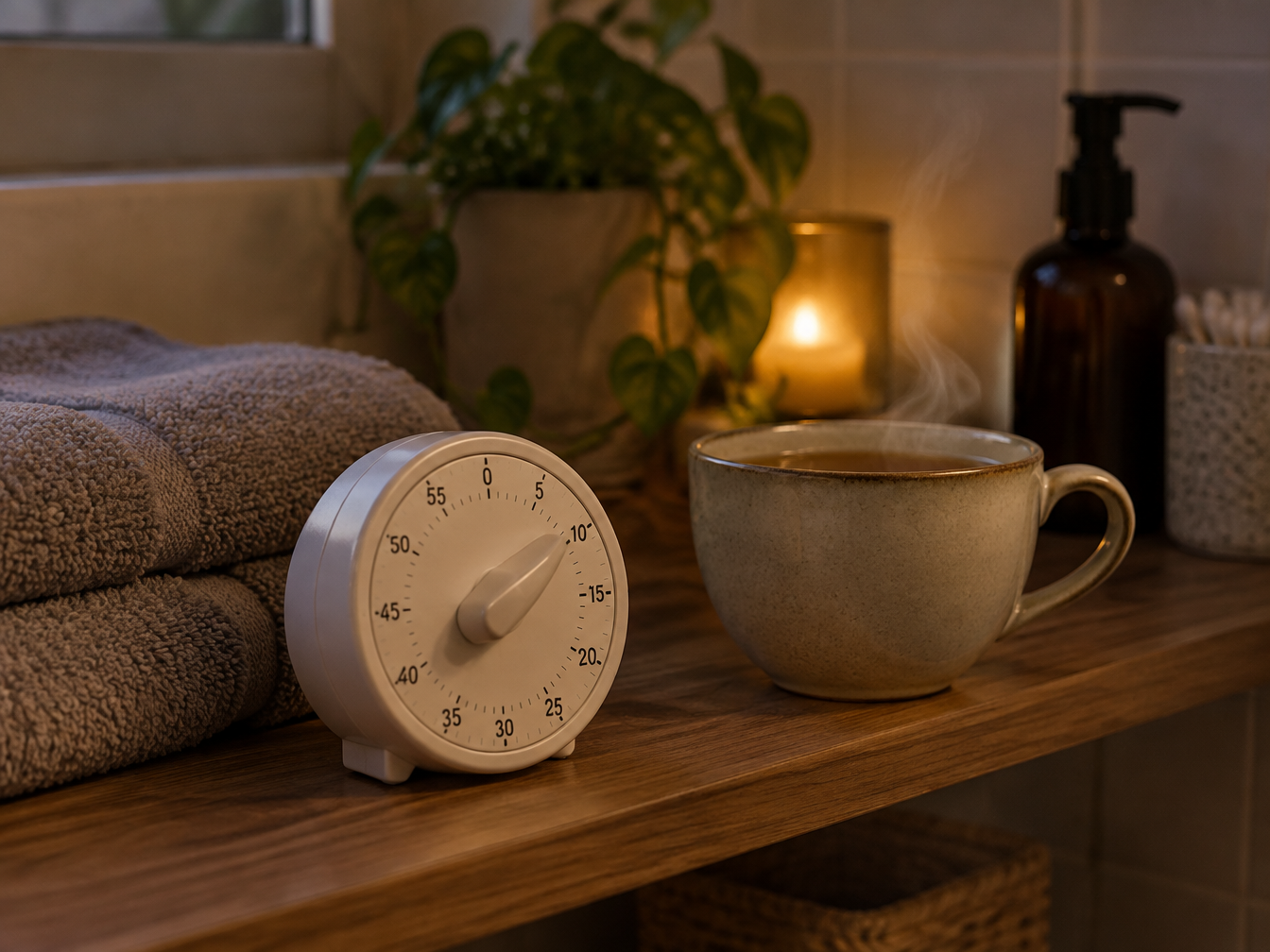
I’m a skeptic, so I went looking for whether tiny breaks do anything at all. The answer is more modest than the wellness industry would like, and I trust it more for that.
A meta-analysis by Patricia Albulescu and colleagues at West University of Timisoara in Romania, published in PLoS One, pooled 22 samples from 19 publications with 2,335 participants in total. The researchers defined microbreaks as breaks of ten minutes or less. They found that microbreaks had a small but statistically significant effect on vigor and fatigue, meaning people felt a bit more energetic and a bit less drained afterward [1].
The same review did not find a clear boost in overall performance, and the authors say the small number of studies limits how far the conclusions can be stretched. They also did not look at what people did during their breaks, and they don’t present microbreaks as a replacement for longer breaks or days off [1].
I find that oddly reassuring. Ten minutes will not rescue you from burnout. What it can do is take the edge off the feeling of running on empty, and it can do it on a weeknight when a vacation is not on offer. A mask turns that ten minutes into something with a clear beginning and end, which is why it’s easier to protect than a vague promise to “take a moment.”
Think of it less as a treatment and more as a boundary. For ten minutes, the day’s demands are held at the door. The study can’t tell us what happened inside anyone’s breaks, but my own experience says the boundary is at least half the benefit.
What Dermatologists Say Before You Put Anything on Your Face
I should be responsible here, because skin is not a metaphor. A quiet ritual that leaves your face red and angry is not quiet at all.
The American Academy of Dermatology offers practical guidance on facial masks. Test a new mask on a small area of skin first. Follow the label for how long to leave it on, because using masks too often can irritate your skin. If you feel itching, burning or stinging, rinse it off right away. And keep up your daily routine, since a mask isn’t a replacement for cleansing, moisturizing and sun protection [2].
The guidance also flags who should be careful. People with sensitive skin should avoid strong alpha or beta hydroxy acids. People already using retinol or exfoliating acids can overdo it when actives overlap. And ingredients to be wary of include fragrance, essential oils, rubbing alcohol and physical exfoliants like crushed walnut shells, which can cause tiny tears in the skin [2].

If your skin feels worse after using a mask, the advice is to see a board-certified dermatologist [2]. I mention it because the mood of the ritual only holds if the face underneath it is comfortable. This was especially true for me in winter, when my skin barrier is already frayed. I wrote about that struggle in why winter skin makes me cry in the bathroom, and the lesson is that gentler almost always beats stronger.
How I Choose a Mask for the Mood I Am In
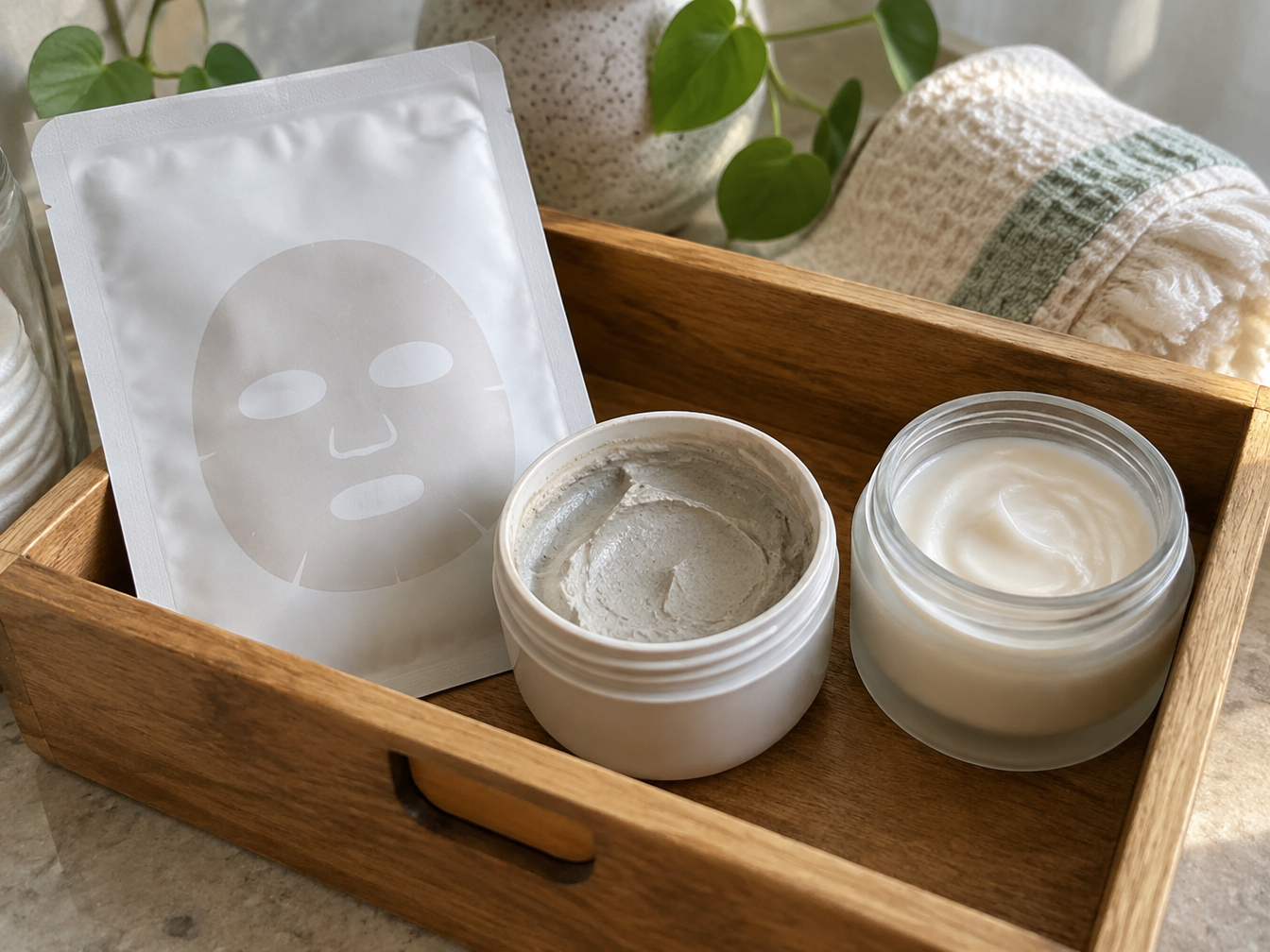
I used to buy masks by the packaging. Now I choose by what my skin and my head both need that night, using the AAD’s grouping as a rough map [2].
Dry or Sensitive Nights
When my face feels tight and my nerves feel the same, I reach for something with hyaluronic acid, ceramides or glycerin. The AAD also lists colloidal oatmeal and green tea extract for dry or sensitive skin. It is the least exciting mask on the shelf and the one I use most [2].
Oily or Congested Nights
On the rare nights my skin is shiny and restless, a clay mask with kaolin or bentonite does the job. The AAD lists clays, lightweight hydrators like aloe and niacinamide, and acids such as salicylic acid for oily or acne-prone skin, and it cautions against stacking them with other strong products [2].
Nights I Want to Feel Taken Care Of
Sometimes the skin is fine and the person underneath it is not. On those nights I choose a plain hydrating sheet mask and skip anything with active ingredients, because the point is the ten minutes and not the result.
I try to keep three or four options in a drawer, no more. A pile of sixteen masks recreates the pressure the ritual is supposed to remove.
I also keep one rule for new products: one at a time. If I try a new mask on Thursday, nothing else on my face changes that week, so if something flares I know exactly where to look. Samples are ideal for this, because a sachet makes the small-patch test the AAD recommends cheap and easy. Once the mask is off, I sometimes press my fingers along my jaw, a habit I picked up after massaging my face every night for two weeks and finding out where I hold my stress.
The Ten Minute Ritual From Start to Finish
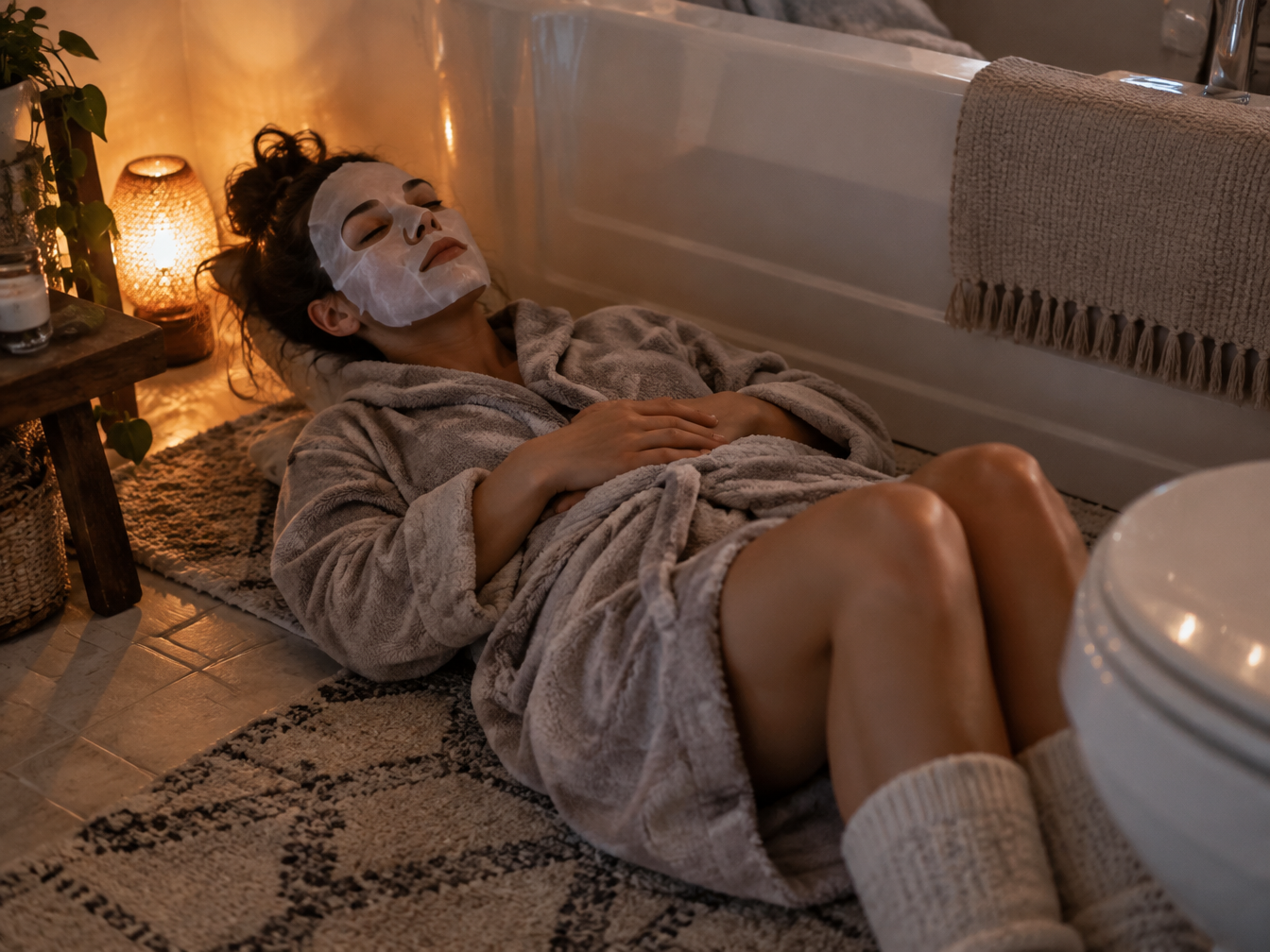
The details matter, because a ritual is made of them.
I start by cleansing, quickly and without ceremony. Then I dim the lights, put my phone across the room and set a timer for the number of minutes printed on the packet, not one minute longer. If it’s a sheet mask, I smooth it from the center outward and press the edges to my skin. If it’s a clay mask, I apply a thin even layer and avoid the eyes and lips.
Then I lie down. Not sit, lie down. On the floor, on the bed, on a folded towel on the bathroom tiles when my apartment feels loud. I breathe slowly for a few counts and let my body notice where it’s been braced all day, usually my jaw and the muscles between my shoulders.
On clay mask nights I lay a warm, damp washcloth over my eyes, so they get a rest from the light as well. It costs nothing and feels like a very small luxury, which is exactly the right size for a Thursday.
When the timer rings I rinse, or peel the sheet off and pat in whatever’s left. Then comes the part I never skip: moisturizer, and the rest of my night routine, which I’ve kept deliberately short since I tried a gentle night skincare routine for three weeks. The mask is the centerpiece of the evening, not the whole evening.
What I Do With My Phone and My Feet
The hardest rule is the phone. It stays in another room, face down, because the entire point is that nothing is allowed to ask me for anything.
I tried scrolling during the first few masks and it was a disaster. Ten minutes later I’d absorbed four stories I didn’t care about and my shoulders were as tight as before. The mask was working on my skin and the screen was working against everything else.
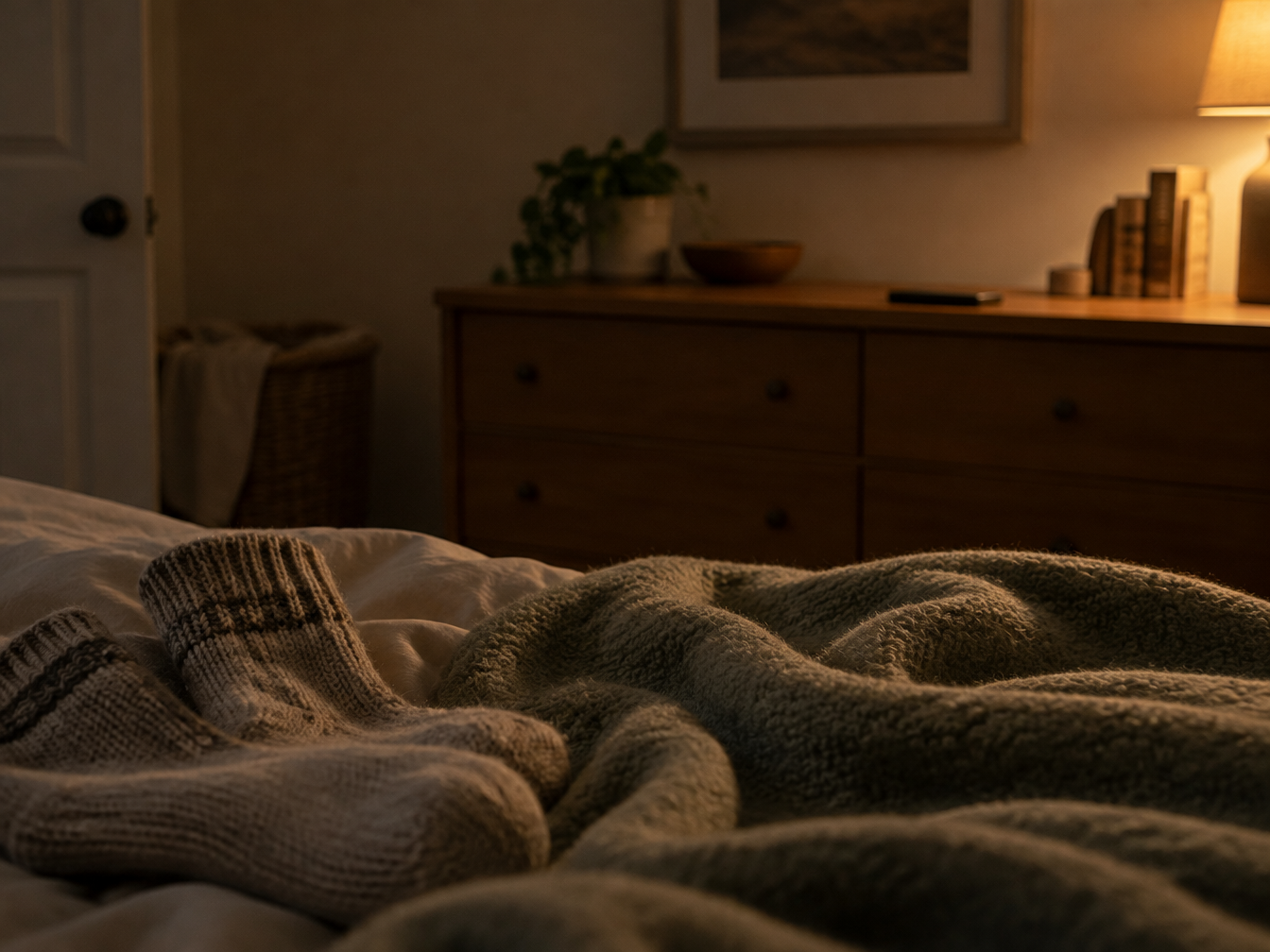
What I do instead is small and physical. I put on warm socks before I lie down, which turned out to matter more than I expected, and I’ve come to believe cozy socks are some of the most underrated self-care there is. I let my shoulders drop an inch. I listen to the radiator, or the neighbors, or nothing.
If my mind races, I let it. I don’t try to meditate, because that turns quiet into a task. I just stay where I am and let the thoughts pass like cars on a far-off road.
A friend asked whether lying there felt wasteful. It did, for about four masks. Then it started to feel like the most productive ten minutes of my week, because it was the only stretch where I wasn’t producing anything.
How Ten Minutes Quietly Became an Hour

Here is the part I did not expect. After a few weeks, the ten minutes started to spread.
Because I knew I had the mask waiting on Thursday, I stopped answering messages at 9:45. Because I’d practiced lying still, I got better at sitting in a parked car for one extra minute before walking into the building. The ritual became a doorway to a whole quiet evening: tea, a book, a slow bath, a plan to leave the dishes. The mask is the ten minutes. The hour is everything I’m willing to protect because of it.
That is also why I keep a self-care Sunday even on weeks when it feels like another chore. The shape matters more than the products. Pick a time, tell people you’re unavailable, and treat it with the seriousness you’d give a dentist appointment.
I want to say one more thing, gently. If quiet never comes, even after you carve out the time, or if exhaustion has settled into your days and won’t lift, that deserves a conversation with a doctor or a therapist, not another mask. A face mask is a small tool for ordinary tiredness, nothing more.
But for the Thursdays that feel like a jar of pasta sauce in a grocery aisle, it’s enough to get me back to myself. Ten minutes, a timer, the lights low.
Somewhere in the stillness, my own thoughts finally became audible again, and what they said was simple. You can stop for a minute. Everything will still be there when you get back.
Sources
- Gimme a microbreak — British Psychological Society Research Digest, on Albulescu et al., a meta-analysis of microbreaks published in PLoS One, 2022.
- Facial masks and skin care — American Academy of Dermatology.
Leave a Reply