The Sweater That Was Doing Too Much
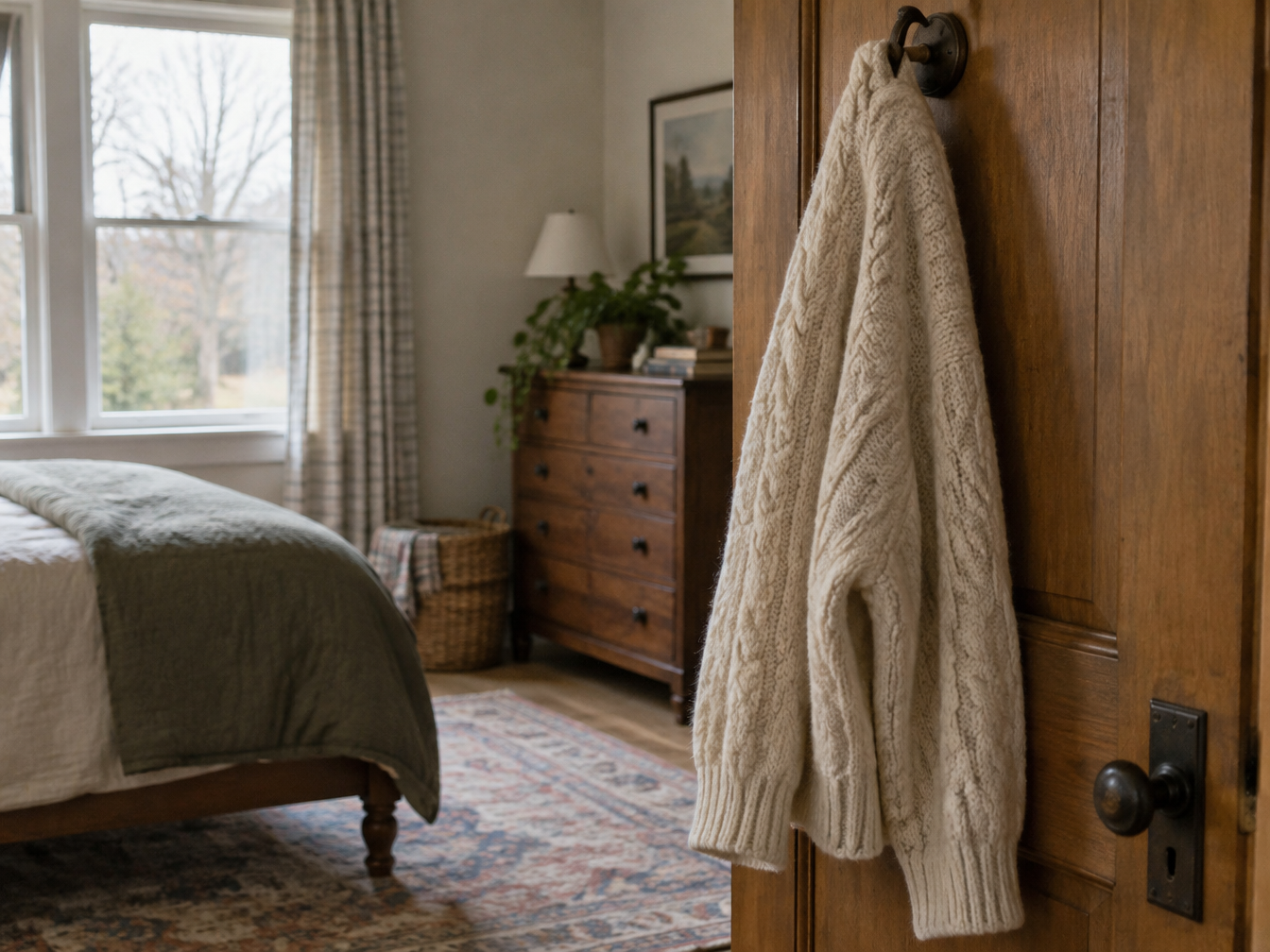
The sweater was cream, cable-knit, and a size too stiff, because it was brand new and I had not yet earned the right to slouch in it. I put it on in the bathroom of my parents’ house at 11:40 on Thanksgiving morning, turned sideways, sucked in my stomach for no reason at all, and told my reflection, “Okay. You’ve got this.”
I did not have this. I had a job I was quietly thinking about leaving, a relationship that had gone vague in the way relationships do when nobody wants to be the one to say it, and a savings account that looked like a sad little hallway. But I had a sweater. And somewhere in my brain, the sweater had been given a very big job. It was supposed to say: look at her, she’s fine, she’s thriving, please don’t ask follow-up questions.
Here is what nobody tells you about the holiday outfit. It is almost never about the holiday. It’s a press release. You’re writing the version of your year that you want your aunts to read, and you’re publishing it with a collar and a pair of earrings.
I’m not going to pretend I’ve stopped doing this. I still stand in that bathroom some years, tugging at a hem that is fine. I’m just going to tell you what I’ve learned from doing it badly for a very long time, and what I wear now instead.
Because there is a better way to walk into that house, and it doesn’t involve a new sweater or a perfect answer to “so what are you up to these days?”
What We Mean When We Say We Want to Look Put Together
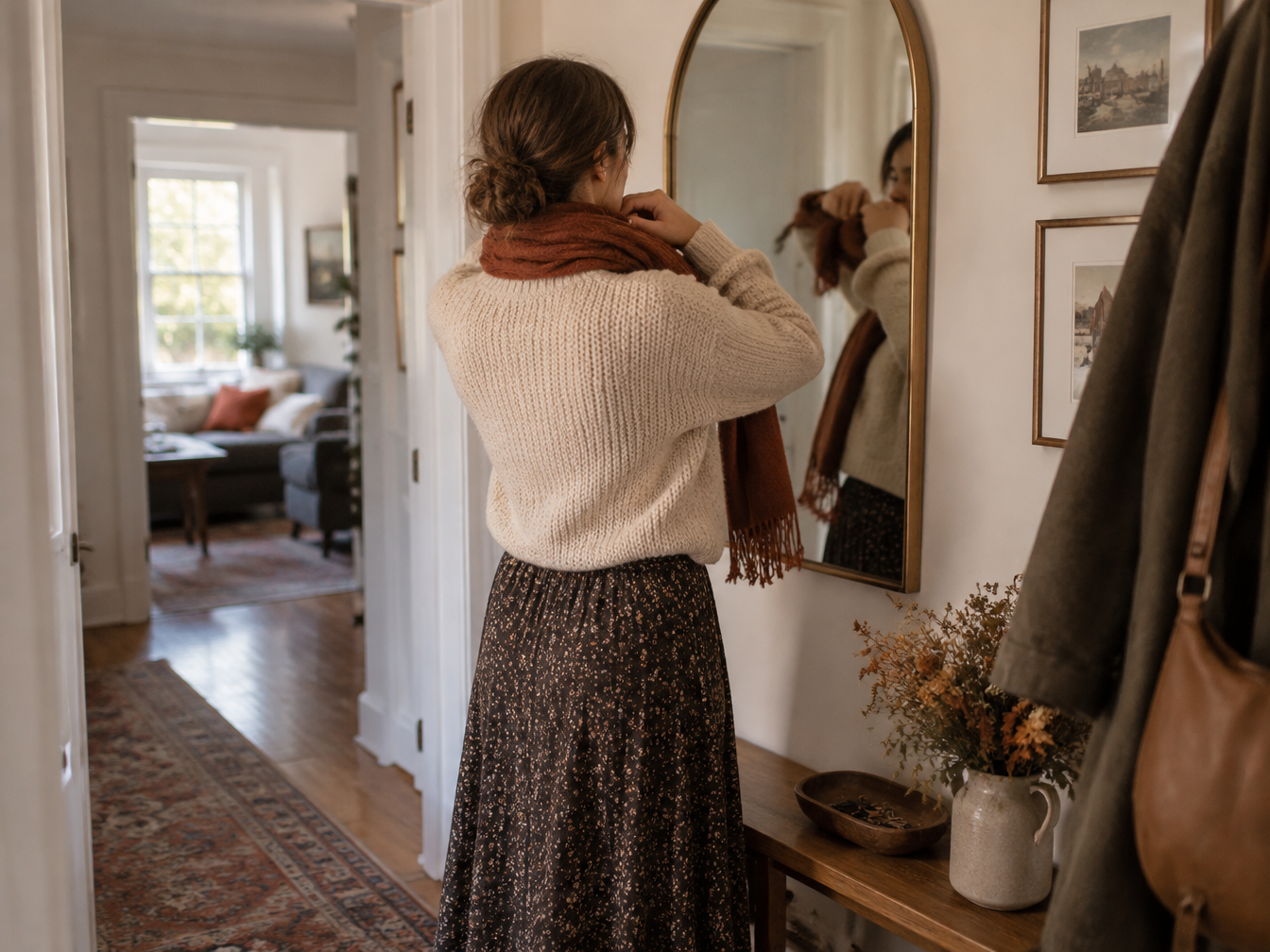
Think about the phrase “put together.” It sounds like furniture. Like if you follow the diagram carefully enough, you’ll end up with a woman who stands up straight and doesn’t wobble.
When I say I want to look put together on Thanksgiving, what I actually mean is that I’m afraid of being read. Not seen, because being seen is fine. Read. There’s a difference. Being seen is a stranger noticing your coat. Being read is your cousin noticing you’ve lost weight, or gained it, or stopped wearing the ring, or started wearing a new one, and then looking at your mom, and then looking at you with a face that says everything.
So the outfit becomes armor. Not the cool kind, with a cape. The nervous kind, with too many layers and a scarf you keep adjusting so you have something to do with your hands.
I’ve noticed that the harder I try to look like I have it all together, the more I check myself. I check my hair in the dark window of the microwave. I check my posture in the hallway mirror. I check my face every time someone says my name. All that checking is the opposite of being put together. It’s being taken apart, slowly, one anxious glance at a time.
If you want a gentler look at how an outfit can quietly hold your whole mood, I wrote about the outfit I wear when I need to feel like myself again, and the short version is that it has almost nothing to do with looking impressive.
Why Clothes Really Can Change How You Feel
Here’s the part where I stop being dramatic and tell you something real, because it matters.
Researchers have a name for the way clothes shape the person wearing them. It’s called enclothed cognition, and the idea is that what you put on affects not just how other people see you, but how you think and behave yourself. David McRaney describes it as certain clothes preparing you to be more attentive or more careful, in the same way a lab coat or a pair of glasses can change how you act [1].
That’s not nothing. It means your instinct to dress up on a hard day isn’t silly. It means the sweater was not entirely wrong to carry weight.
But I want to be careful here, because I’ve seen people stretch this idea into something it isn’t. The research is about the meaning a garment carries for you. A lab coat works because you believe it’s a lab coat, and that belief changes your focus. It is not a promise that any expensive thing will turn you into a calmer person. That part is just my own opinion, based on a lot of mirror time.
What the idea does tell me is that the question to ask isn’t “what will impress them?” It’s “what does this piece mean to me?” A jacket that reminds you of the day you finally spoke up in a meeting. A pair of boots you wore through a hard winter and survived. Those garments carry something. My stiff new cable-knit carried nothing but tags and hope. (It’s the same trap I fell into when I was dressing for a life I hadn’t started yet, buying clothes for a woman who didn’t exist.)

The Questions Nobody Asks Across the Table

Let me tell you what actually happened at that table.
Nobody read me. Nobody asked about the job. My aunt asked if I could pass the cranberry sauce, and my grandfather told the same story about the parade he does every year, and my cousin spent forty minutes explaining her fantasy football league to a man who did not care and nodded anyway.
The questions I’d been bracing for since the night before simply did not come. And the few that did, like “so what’s new with you?”, were the kind you can answer in one sentence and a smile.
I think about this a lot now. A real, grown-up lesson hides in it, and it took me far too many holidays to learn it. How much of my outfit planning was a defense against a conversation that mostly existed in my head. I was building armor for a battle nobody had scheduled.
And yet, not everything was imaginary. There was one moment, right after dessert, when a relative looked at my sweater and said, “Oh, you look so nice today. Very polished.” And I felt my whole chest unclench, which was embarrassing, because it showed me exactly how much I’d been waiting for that sentence.
That’s the trap. The compliment worked. It worked so well that I started needing it. If you’ve ever lived off one kind remark for months, you’ll understand why I wrote about the compliment I never forgot about my style, and what happened when I realized I’d been believing the wrong one.
The Stress Spend Before the Big Day

So how did the sweater get into my closet in the first place?
I bought it eight days before Thanksgiving, after a bad Tuesday. Nothing dramatic. Just one of those days where a small email made me feel behind in my own life. I opened a store’s app on the train home, and forty minutes later I owned a cream sweater and a very small amount of relief.
It turns out that’s common. A Credit Karma survey reported by NBC News found that 52 percent of U.S. adults say they’ve made impulse purchases to cope with feelings of stress, anxiety and depression [2]. Psychologist Teodora Pavkovic compares it to coffee when you’re already stressed: you think it will calm you down, but it mostly leaves you more jittery [2]. That matched my experience exactly. The relief lasted about as long as the train ride.
The same article points out that retailers know this, and that their messaging often leans on urgency and the promise that a purchase will improve your life, which lands hardest on someone who is stressed and looking for a fix [2].
I’m not telling you never to buy a holiday outfit. I’m telling you to notice which kind of buying it is. There’s the kind where you’ve pictured the occasion, checked what you already own (I did a whole experiment on that when I built a capsule wardrobe), and found a real gap. And there’s the kind where you’re trying to purchase a feeling you can’t find anywhere else. The first one gives you a sweater. The second one gives you a sweater and a small bruise on your bank account.
Another honest check is to ask who the outfit is for. If the answer is a specific person whose opinion you’re trying to manage, put it back. If the answer is you, in a photo you’ll look at in ten years, keep going.
One trick that helps: put the thing in your cart and wait a full day. If it’s still the thing you need tomorrow, you can feel better about it. If you’ve forgotten it by lunch, the sweater was never the point.
What I Wear Now Instead
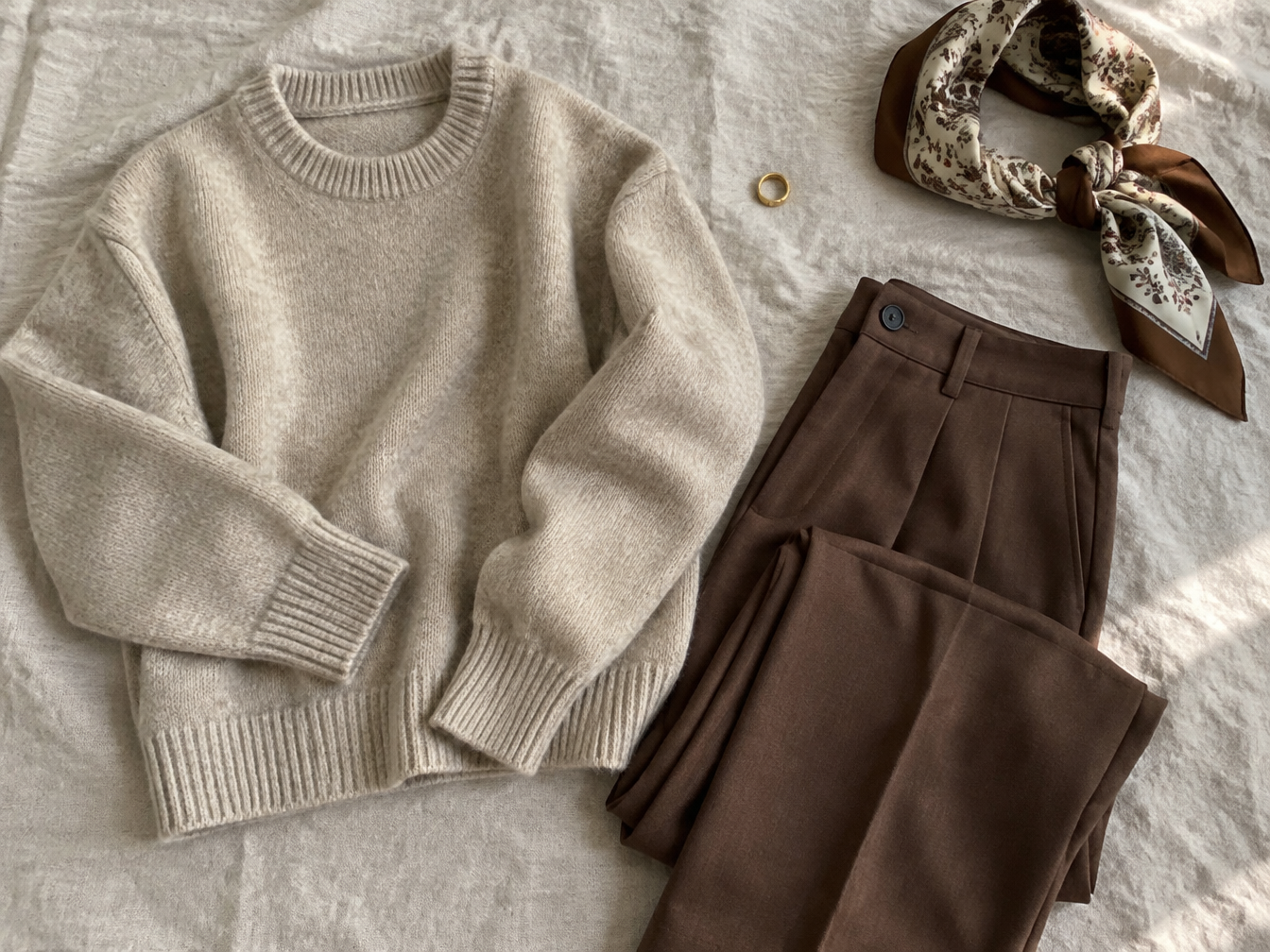
Here is the uniform I’ve settled on, and it is not glamorous. It is a soft knit I already own, high-waisted trousers or a long skirt with a real waistband that forgives a second helping, and something at my neck or ears that I actually like.
The rules are simple.
I sit down in everything before I commit to it. If I can’t sit, lean, and reach for the rolls without thinking about the outfit, it doesn’t go.
I wear at least one thing with a story. A ring from my grandmother, a scarf from a trip, a bracelet a friend gave me. Something that does the work of reminding me who I am without me having to perform it.
I keep my shoes kind. Four hours on a hard kitchen floor will do more damage to your mood than any unflattering angle, and no one has ever remembered an outfit but forgotten the sore feet.
And I leave the corners loose. A little untucked, a sleeve pushed up. I’ve started believing that an outfit that looks a bit lived-in reads as more confident than one that looks like it’s holding its breath.
If you want a full menu of options, I put together a guide to Thanksgiving outfits that are cute, comfy and totally you, and it’s built on one idea: you should be able to eat in it.
Dressing for the Version of You Who Shows Up

The older I get, the less I believe in looking like I have it all together,, and the more I believe in showing up as someone who is okay not having it all together.
That’s not giving up. It’s a different kind of strength, the kind where you walk into your parents’ house with a new job question unresolved and a relationship in limbo and you still hug everybody for a beat too long and ask your grandfather about the parade.
My favorite Thanksgiving memory from the last few years isn’t from the year of the cream sweater. It’s from the year I wore an old oatmeal cardigan with a tiny hole at the cuff, and I spilled gravy on it, and nobody blinked. I laughed, wiped it with a napkin, and realized I’d been performing for an audience that had left the theater years ago.
If you’re standing in front of a mirror right now, sucking in your stomach and telling yourself you’ve got this, here’s what I’d say to you. You do. Not because of the outfit. In spite of how much weight you’ve put on it.
Wear the sweater. Just don’t make it carry the whole year.
Sources
- Big Think, “Clothes Make the Mind: How What We Wear Changes How We Think” (2013). https://bigthink.com/articles/dress-to-impress-yourself/
- Nicole Spector, NBC News BETTER, “Why we stress-spend during the holidays — and how to stop” (2017). https://www.nbcnews.com/better/business/why-we-stress-spend-during-holidays-how-stop-ncna824156
Leave a Reply